

What China Just Announced
China recently released a national policy framework called the Implementation Opinions on the Standardized Application and Innovative Development of Intelligent Agents. The document focuses on “AI Agents,” not ordinary chatbots, and that distinction matters.
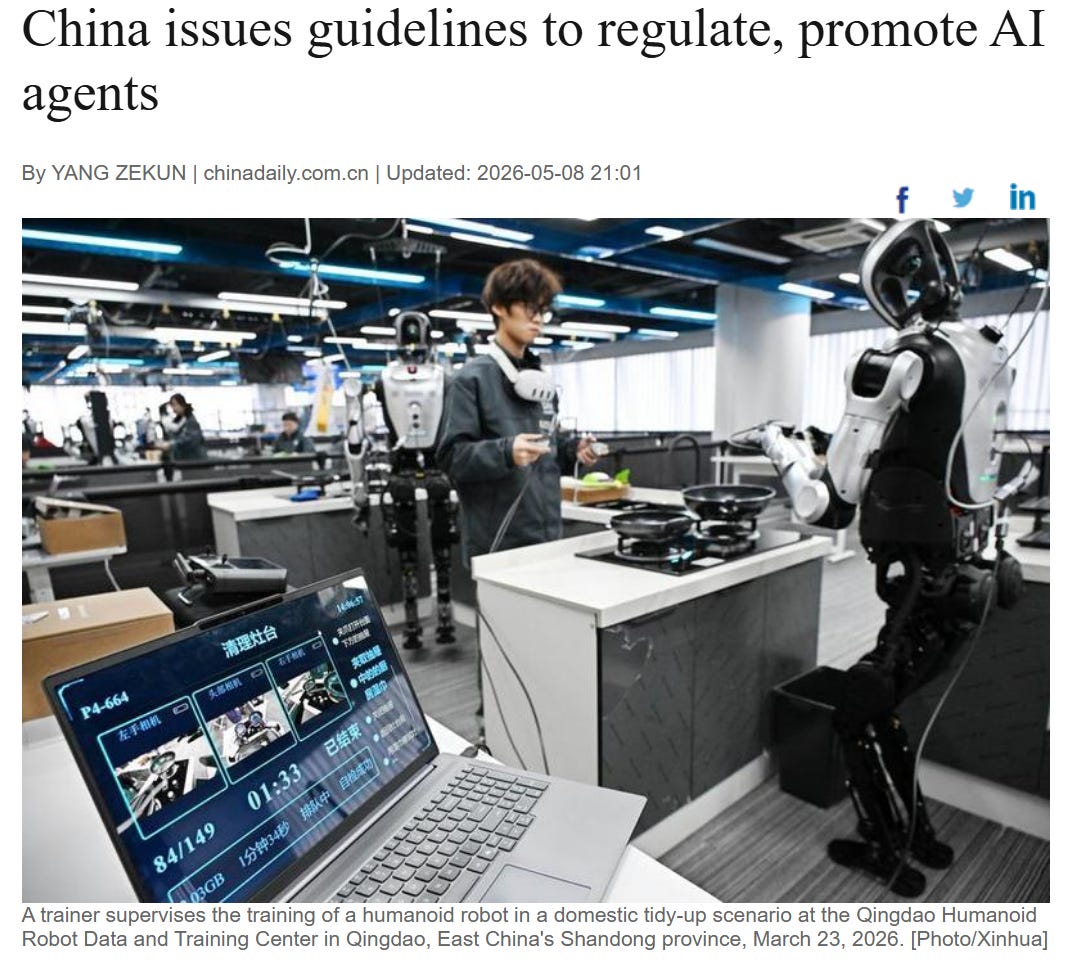
The official definition describes AI Agents as systems capable of perception, memory, decision-making, interaction, and execution. The key word is “execution.” Most AI tools today still function as information tools. They generate text, images, code, or answers while humans remain the final operators. AI Agents are different because they are designed to understand tasks, call tools, access systems, make decisions within certain permissions, and carry out operations.
Once AI begins executing tasks instead of simply answering questions, it stops being just software. It becomes part of the labor system itself. That is the real meaning behind this policy. China is preparing for AI to enter factories, logistics systems, offices, hospitals, financial infrastructure, public administration, and industrial operations.
Why China Is Pushing AI Agents Now
China’s AI strategy is increasingly tied to productivity. The country is dealing with an aging population, slower labor-force growth, tougher industrial competition, and rising technology pressure. Under those conditions, AI is not just a consumer tool. It becomes a way to make the whole economic system more efficient.
This is the plain meaning behind China’s phrase “new quality productive forces.” It sounds bureaucratic, but the logic is simple: use advanced technology to improve industrial efficiency, reduce coordination costs, automate repetitive work, and make large systems operate better.
That is why the policy focuses on manufacturing, logistics, transportation, energy, healthcare, agriculture, scientific research, public services, and governance. China is not just trying to make AI better at conversation. It is trying to make AI useful inside the real economy.
Earlier this year, China’s Ministry of Industry and Information Technology proposed deploying 1,000 industrial AI Agents and promoting 500 major application scenarios by 2027. That target shows the direction clearly: China’s AI strategy is moving toward industrial integration, not just consumer-facing AI products.
But productivity is not the same as fairness. Higher efficiency does not automatically mean workers benefit. The real question is whether the gains from AI will be shared through better wages, better services, and less repetitive labor, or whether they will be concentrated in the hands of large companies and platforms. That is where the politics begins.
Policy Breakdown: Building Rules Before Large-Scale Deployment
China’s policy focuses on four major areas: technical standards, security controls, real-world deployment, and industrial ecosystem construction. The common thread is simple: Beijing wants AI Agents to spread into real economic systems, but not as a chaotic mess of incompatible tools, unclear permissions, and uncontrolled risks.
The policy emphasizes technical foundations, standard protocols, and interoperability. In plain English, China does not want thousands of isolated AI systems operating with incompatible interfaces and different permission structures. If every company builds its own closed AI system with different rules and access methods, large-scale deployment becomes difficult, regulation becomes weak, and security risks grow.
So China is trying to establish rules early. Questions such as who can access data, who can call systems, how permissions are managed, who is responsible when systems fail, and how interfaces are standardized are all becoming part of long-term infrastructure planning.
The policy also emphasizes ecosystem construction. China is not simply trying to support a few AI startups. It is trying to build an industrial chain involving model developers, software firms, manufacturers, infrastructure providers, research institutions, and local governments. AI at scale requires more than good models. It requires data systems, computing infrastructure, industrial integration, deployment capacity, regulation, and real operating environments.
Why China Keeps Emphasizing Security and Control
One of the most important parts of the policy is its focus on security. Officials specifically mention privacy leaks, unauthorized operations, and behavioral loss of control. The policy also emphasizes permission management, traceability, and operational oversight.
Most public conversations about AI risk still focus on misinformation or inaccurate answers. But the real danger of AI Agents is not bad answers. It is bad actions.
Future AI Agents may have access to databases, payment systems, hospitals, industrial controls, supply chains, financial infrastructure, and government platforms. Once AI gains operational authority, mistakes become much more serious. If an AI Agent is manipulated, attacked, or poorly designed, the consequences could include financial losses, operational failures, infrastructure vulnerabilities, or disruptions to critical systems.
That is why China keeps emphasizing “safe and controllable” AI. Once AI becomes integrated into infrastructure, it is no longer just software. It becomes part of the operating system of society itself.
What This Means for Companies
In the future, companies will not simply buy AI chat tools. They will deploy AI-driven workflows. Customer service, inventory management, procurement, scheduling, finance, human resources, logistics, and after-sales operations may all be reorganized around AI Agents.
Companies that complete workflow automation earlier will likely gain efficiency advantages. But this also means large corporations may become even stronger, because they possess the data, capital, infrastructure, and operational environments needed to integrate AI deeply into production systems.
Smaller businesses may still use AI tools, but many could become dependent on large platforms and infrastructure providers. In the long run, this could create a new form of digital dependency. AI is therefore not only about efficiency. It is also about concentration of power.
What This Means for Workers
Many people still ask whether AI will replace jobs, but the real question is where the disruption begins. The first major wave may not hit manual labor first. It may hit repetitive white-collar work.
Administrative support, customer service, routine accounting, operations support, data organization, entry-level programming, and office coordination all contain structured workflows. These are exactly the kinds of tasks AI Agents are designed to absorb.
The most dangerous effect may not be sudden mass unemployment. It may be fewer hiring opportunities, disappearing entry-level roles, merged positions, and situations where one employee supervises multiple AI systems while performing work that previously required several workers.
This creates a serious problem for younger workers. Many industries train newcomers through repetitive foundational tasks. If those tasks disappear, it becomes harder for new workers to gain experience and enter industries in the first place.
AI may also become a new management structure. Systems could increasingly handle scheduling, performance analysis, customer scoring, warehouse coordination, production monitoring, and labor analytics. Technology improves efficiency, but it also expands managerial control.
Some people will argue that reducing repetitive labor is simply technological progress. That is not entirely wrong. The problem is that if workers do not share in the gains created by higher productivity, then “efficiency” can easily become fewer jobs, heavier workloads, and more centralized control.
Technology is never truly neutral. Its social impact depends on who controls it.
Conclusion: China Is Building Rules for an AI Labor System Before It Fully Arrives
China’s new AI Agent policy reveals that AI is beginning to evolve from a tool into labor, from software into infrastructure, and from a chat interface into a production system.
That is why China is establishing standards, security boundaries, industrial frameworks, and governance structures before large-scale deployment fully arrives. Once AI becomes deeply integrated into society, it will reshape employment, labor relations, industrial organization, public services, cybersecurity, and the structure of economic life itself.
The biggest debate in the future will not simply be whether AI becomes smarter. The real debate will be who controls these systems, who benefits from the productivity they create, and who absorbs the cost when human labor becomes easier to replace.
Increasing productivity is only the first step. The real political question is how the benefits of that productivity are distributed afterward.


