

Let’s start with the irony, because it matters.
From the same political figure who openly threatened Greenland with military pressure and approved the extraterritorial seizure of Venezuela’s president, we are now told to welcome a brand new “Board of Peace.” That alone should slow people down. Peace is a word. Power is behavior. And those two things are not always aligned.
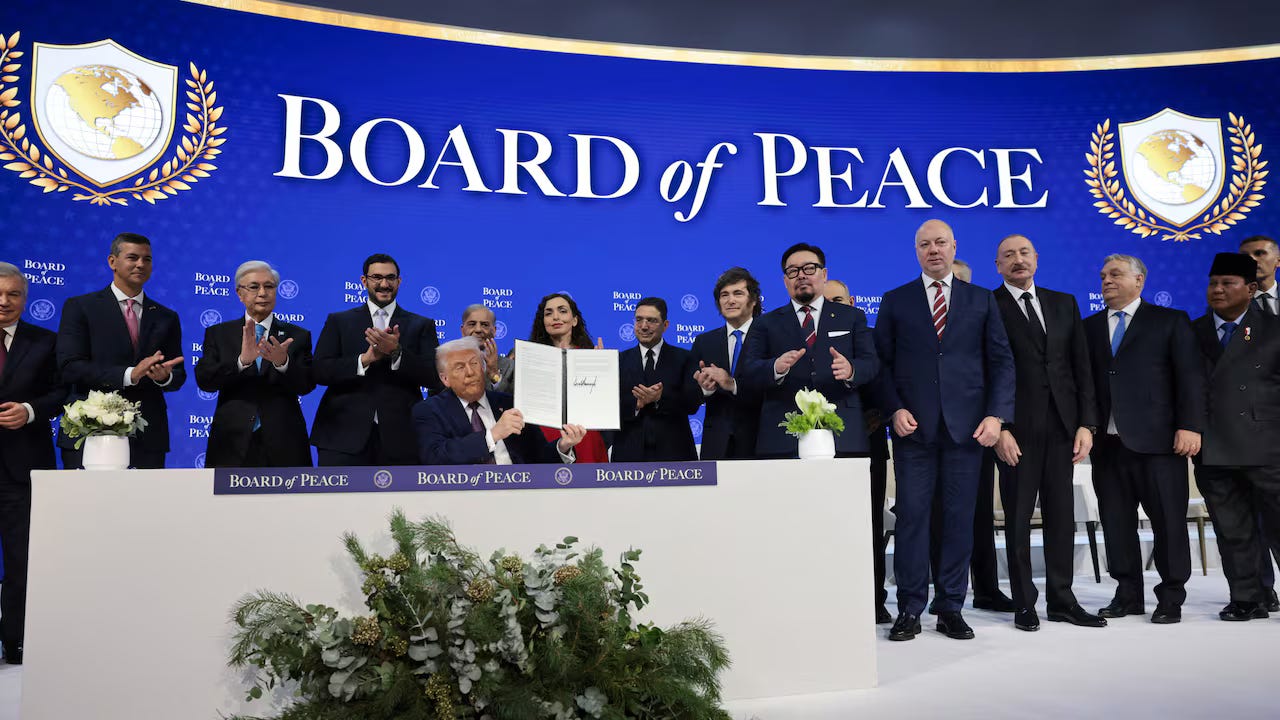
Today at the World Economic Forum in Davos, Donald Trump signed the charter for what he is calling the Board of Peace. It is being marketed as a new international mechanism to manage and resolve global conflicts, starting with Gaza. According to the White House, the Board will help lock in a Gaza ceasefire, support post war governance, and coordinate reconstruction.
On paper, that sounds reasonable. In reality, the structure and the politics tell a more complicated story.
What the Board of Peace actually is
The Board of Peace is not a United Nations body. Trump and his administration have emphasized that it will “work with” the UN, but it operates outside the UN system. It has its own charter, its own legal status, and its own leadership structure.
Trump is named the inaugural chairman. The chair has broad authority over agenda setting, invitations, and organizational direction. Member states formally have equal votes, but the design is clearly centralized. This is not a neutral secretariat model. It is a top down forum built around political leadership, not institutional distance.
That distinction matters because global peace mechanisms live or die on legitimacy. And legitimacy is not created by a signing ceremony in Davos.
Who joined and who did not
At the signing ceremony, only Bahrain and Morocco stood alongside the United States to formally sign the charter. That is the hard fact from today.
Beyond that, a seecond tier exists. Several Middle Eastern and Global South countries have either accepted invitations or signaled intent to participate. Reporting has named countries such as Saudi Arabia, Egypt, Jordan, Qatar, the UAE, Turkey, Pakistan, Indonesia, Israel, and a handful of Central Asian and Eastern European states.
But the absences are just as important as the names.
Key Western powers like France, the United Kingdom, Norway, and Sweden have either declined, delayed, or stayed silent. Others have avoided public commitments altogether. That uneven participation immediately raises questions about whether this body will ever command broad international authority.
The part many people say quietly, but think loudly
Here is where the skepticism becomes unavoidable.
A large number of people around the world associate the words United States, Israel, and the CIA not with peacebuilding, but with proxy wars, covert operations, regime change strategies, arms pipelines, and long term regional destabilization. That perception did not appear out of nowhere. It is rooted in decades of interventions, intelligence operations, sanctions regimes, and security partnerships that often turned local conflicts into permanent battlegrounds.
You can argue about motives. You can argue about justification. But you cannot pretend that this history does not exist.
So when the same power structure announces a new “Board of Peace,” many people do not see a neutral mediator. They see a rebranding exercise. Public diplomacy on the front stage. Intelligence and security influence in the background. The same actors who shaped the conflicts now claiming the authority to manage their resolution.
That is not a conspiracy theory. It is a credibility problem.
Peace is not a logo. Peace is behavior. Peace is restraint. Peace is fewer interventions, fewer proxy wars, fewer weapons shipments, and fewer intelligence driven power games that generate blowback for decades. Without that change in behavior, any peace forum risks looking more like conflict management under a different name.
China was invited. China said no.
China’s response is one of the most revealing parts of this story.
Beijing confirmed publicly that it received an official invitation from the United States to join the Board of Peace. That part is not disputed. What followed is the signal.
China did not join. It did not sign. It did not commit. And it has shown no indication that it plans to.
Instead, Chinese officials pointed back to a familiar position. They emphasized support for multilateralism with the United Nations at its core and reiterated the authority of the UN Charter as the proper foundation for peace processes.
That is diplomatic language, but the meaning is clear. China does not want to legitimize a US led diplomatic club that operates outside existing multilateral frameworks, especially one centered around a single political figure.
From China’s perspective, the UN system may be slow and flawed, but it is rule based, institutionalized, and predictable. A new forum chaired by the US president with flexible rules and selective membership introduces uncertainty. It shifts peace governance away from law and toward personality.
China benefits from institutions. It is cautious of experiments.
Will China ever join
Under the current design, it is unlikely.
China typically joins new international bodies when governance rules are formal, authority is shared, and major powers participate symmetrically. None of those conditions are present here. For China to reconsider, the Board of Peace would likely need to be clearly embedded within the UN system or fundamentally redesigned.
Until then, China’s refusal is not passive. It is a message.
What this really represents
The Board of Peace is not just about Gaza. It is about who gets to define order in a fractured world.
Some states are willing to experiment with new power centers outside the UN. Others are not. The divide here is not East versus West. It is institutional stability versus personalized power.


