

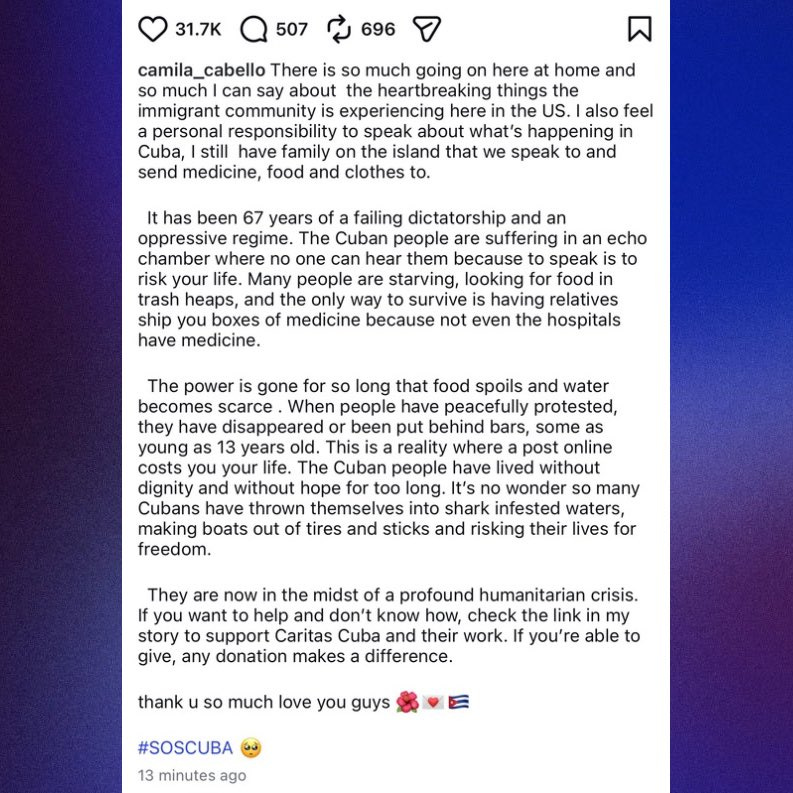
Camila Cabello posted about Cuba’s suffering. Starvation. Trash heaps. Hospitals without medicine. Fear of speaking out.
The suffering is real.
What’s missing is the structure that helped create it.
And that omission is not accidental. It reflects a liberal way of thinking about politics that stops at moral outrage and refuses to examine power.

Quick Background: The Variable That Gets Erased
Camila framed Cuba as “67 years of a failed dictatorship.”
What she did not mention is that Cuba has been under U.S. sanctions since the early 1960s. Not symbolic sanctions. Economic restrictions on trade, finance, credit access, and international transactions. Measures reinforced by multiple administrations and codified by Congress.
Cuba is a small island economy heavily dependent on imports. Fuel, industrial inputs, medical supplies, spare parts. When access to global markets and dollar transactions is restricted, that affects growth, inflation, and supply chains.
You can criticize Cuba’s internal system. You can criticize repression and inefficiency. But if you remove sanctions from the equation, you are not analyzing the situation. You are simplifying it.
This Is Not About Trump
Some people want to turn this into a partisan argument. They say Camila is anti-Trump. That this is a Democrat versus Republican issue.
It isn’t.
Sanctions on Cuba are bipartisan. They have survived Republican and Democratic administrations. Presidents changed. The policy endured. If lifting the embargo were a priority, it would have happened at some point in the last several decades. It didn’t.
That tells you this is not a personality problem. It’s systemic.
Trump is not the engine. He’s a loud symptom of a broader state consensus.
The Question Nobody Wants to Answer
If Cuba’s government is truly incompetent and destined to fail on its own, why keep the sanctions?
Why not lift them and let the system collapse under its own weight?
If the regime is as fragile as critics claim, it does not need economic strangulation to expose itself.
The fact that sanctions remain suggests the goal is not observation. The goal is control.
Sanctions restrict credit, limit trade, complicate imports, and increase transaction costs. In a constrained economy, that pressure compounds. Scarcity deepens. Inflation rises. Infrastructure deteriorates.
Then the resulting hardship is cited as proof that the system itself is unworkable.
That is not neutral policy. That is managed pressure.
Call It What It Is: Imperial Policy
This is American imperialism in practical form. Not in a theatrical sense. In a structural one.
Imperial behavior means using control over global finance, trade networks, and market access to discipline states that refuse to align politically.
Cuba is 90 miles from the United States. It chose a political model outside Washington’s framework. The response has been sustained economic containment across administrations and parties.
All this is about geopolitical leverage.
Liberal Politics vs Structural Politics
A liberal asks: “Is this government oppressive?”
A leftist asks: “Who controls the economic environment this country is forced to operate in?”
Liberals focus on moral judgment. Leftists analyze power.
Liberal discourse describes suffering and condemns the visible authority. Structural analysis looks at leverage, sanctions, and the global financial architecture that shapes outcomes.
Camila’s post fits squarely in the liberal model. Emotional. Direct. Focused on Havana. Silent on Washington.
That silence is the blind spot.
My Position
This is not a defense of the Cuban government. It is a defense of analytical honesty.
If Cuba’s system is fundamentally broken, remove the sanctions and let it prove that under normal conditions.
If sanctions must remain indefinitely, then stop pretending the crisis is purely internal.
You cannot run a decades-long economic containment policy and then act surprised when the contained economy struggles.
That is not serious politics.
What This Debate Should Actually Be About
The real issue is not whether Cuba has problems. It does.
The issue is whether the United States has the right to restrict a neighboring country’s economic breathing room for sixty years because it rejects American alignment.
That question cuts deeper than celebrity outrage or partisan commentary.
As long as the conversation stops at “failed dictatorship” and never examines imperial leverage, it remains incomplete.
And incomplete analysis protects power.


