

For years, Washington treated China like a problem that could be solved with pressure. Raise tariffs, restrict chips, move factories, punish companies, and tell the public that “decoupling” would rebuild American industry and bring jobs back home.
That was the promise. Reality turned out differently.
Trump’s visit to China is being presented as a major diplom
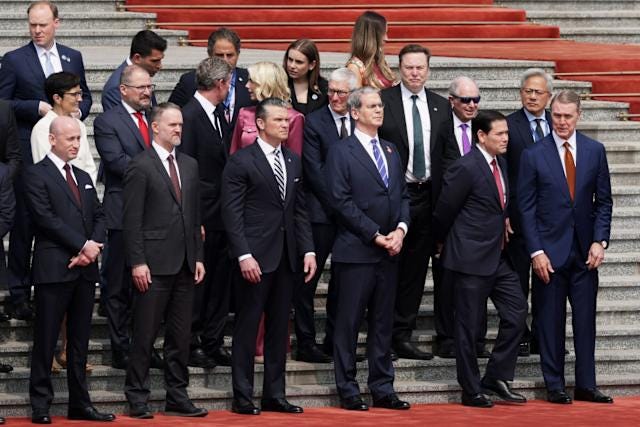
atic event, but the real story is more practical, and frankly, more embarrassing. After years of tariffs, sanctions, and tough talk, the United States is realizing it cannot simply order the global economy to reorganize itself on command.
The Decoupling Fantasy
The American political class spent nearly a decade talking about reducing dependence on China. But during that same period, American consumers still bought Chinese-made products, American companies still relied on Chinese factories, and American investors still wanted access to the Chinese market.
The supply chain changed shape, but the dependency did not disappear.
Some factories moved to Vietnam, Mexico, or India. But many of those factories still rely on Chinese components, Chinese machinery, Chinese materials, or Chinese industrial networks. In many cases, “decoupling” became rerouting.
A product leaves China, gets assembled somewhere else, enters the United States with a different label, and politicians call it strategic success. Corporations protect their margins. Ordinary people still pay higher prices.
That is the part most political coverage ignores.
The insulting part is not just that the strategy failed. The insulting part is that ordinary people were asked to pay for it while politicians called it strength.
The real issue was never just trade deficits or cheap goods. The deeper issue is that China spent decades building industrial capacity at a scale the United States no longer has. Rare earth processing, battery supply chains, industrial chemicals, shipping infrastructure, electronics manufacturing, engineering talent, machine tooling, and logistics coordination cannot be recreated overnight because a politician gives a speech in front of a factory backdrop.
Washington believed tariffs were a one-sided weapon. The assumption was simple: China exports more to America than America exports to China, so China would suffer more. But over time, the United States ran into its own vulnerabilities. Inflation stayed stubborn, manufacturing costs stayed high, and supply chains became unstable.
American corporations quietly pushed back because they understood something politicians did not want to admit publicly: the American economy is still deeply tied to Chinese industrial capacity.
Why the CEOs Still Came
That is why Trump arrived in China with a large group of business leaders. Apple still depends heavily on Chinese manufacturing. Tesla’s largest factory remains in Shanghai. American agricultural exporters still need Chinese buyers. Nvidia CEO Jensen Huang joining the trip at the last minute was not symbolic theater. It was a reminder that even America’s most powerful technology companies still see China as too important to ignore.
This is also why the trip looked less like a traditional diplomatic mission and more like a trade delegation. Behind the public rhetoric about national security and strategic competition, American corporations are still looking for deals, market access, stable production, and supply chain security.
Washington talks about decoupling. Corporate America understands the limits of that idea far better than politicians do.
A full economic divorce from China would not only hurt profits. It would raise costs across the American economy almost immediately: electronics, vehicles, construction, energy, and basic household expenses. For families already dealing with rent, healthcare bills, insurance, and debt, foreign policy becomes daily life through prices, wages, and economic pressure.
This is what always happens. Elites gamble with trade wars, sanctions, and wars overseas. Then regular people get the bill through higher prices, weaker jobs, and more stress at home.
Deals for Washington, Boundaries for Beijing
This is where the official readouts matter. The American side emphasized economic cooperation, market access, agricultural purchases, fentanyl, and the Strait of Hormuz. That tells you what Washington needed from the trip: deals, stability, business confidence, and help managing global pressure.
The Chinese side put more weight on Taiwan, opposition to militarization, mutual respect, and political systems. That also tells you something important. Beijing was not just negotiating purchases or business access. It was drawing boundaries.
So the two sides were not reading the meeting in exactly the same way. Washington came looking for economic breathing room. Beijing came to make clear where the red lines are.
That difference matters because it shows the real balance of the meeting. America wanted relief. China wanted recognition.
America Is Managing Too Many Crises at Once
There is another reason Washington’s tone has changed. The United States is no longer dealing only with economic competition against China. It is also managing inflation, rising debt, domestic political division, supply chain instability, and an Iran conflict that continues to consume military resources and political attention.
That matters because global power is not just military strength. It is also economic endurance, industrial capacity, energy stability, and political focus.
Every crisis in the Middle East makes it harder for Washington to concentrate pressure in Asia. Every missile, ship, sanction package, and crisis meeting spent in the Middle East is attention and capacity not being used elsewhere. Very efficient empire management, apparently.
This is why Trump needed the China trip to look stable and productive. He needed economic signals, business confidence, and the image of diplomatic control at a moment when the United States is under pressure abroad and at home.
A few years ago, Washington talked about maximum pressure. Then it shifted toward export controls and technology restrictions. Now the conversation is becoming more practical. The goal is no longer complete separation. The goal is controlled competition without total breakdown.
In plain English, the United States is learning that it cannot wage economic war against the world’s largest industrial system without damaging itself in the process.
The Real Lesson
For the first time in years, Washington appears to be accepting that China is not simply another country in the supply chain. China is one of the central operating systems of the global industrial economy.
That does not mean the rivalry disappears. Competition over technology, trade, finance, and geopolitical influence will continue. But the fantasy that America could rapidly isolate China while protecting its own economy is fading.
Tariffs can create headlines, and sanctions can create political theater. But neither one can instantly rebuild factories, replace industrial ecosystems, or recreate forty years of manufacturing infrastructure.
And that is the real reason Trump had to go to China.


