

1. Start with a simple question
After the Minneapolis ICE shooting incident, a lot of people ask the same thing: what does a different system look like? Specifically, how does China handle police guns?
This piece is not meant to excuse any country or attack any country. It is simply a look at design choices. In other words, how rules, tools, and procedures shape behavior.
2. Guns are not the default for most officers
In China, most police officers do not walk around with a gun as the default. Many officers carry non-lethal tools instead, such as pepper spray, batons, or restraints.
The reason is not complicated. Most day-to-day policing is not a war zone. It is traffic issues, disputes, crowd control, theft, routine calls, and community incidents. Also, civilian gun ownership is very low in China, so the average officer is not trained to expect a gun in every encounter.
This creates a different baseline. When guns are not everywhere, police encounters do not automatically start at the highest level of threat.
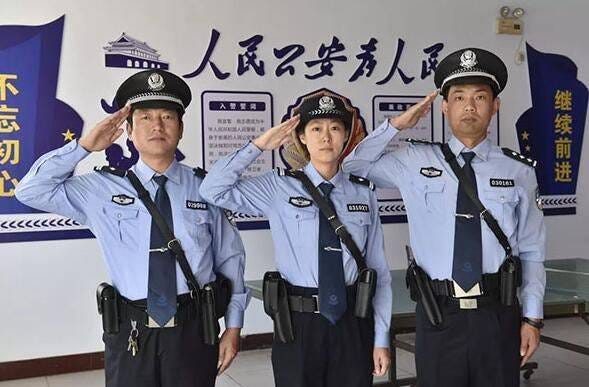
3. Firearms are treated as high-risk equipment, not daily gear
China treats firearms as high-risk equipment. The system is built to slow escalation.
The practical meaning is simple: if you can solve the problem without a bullet, you do that first. Firearms are not treated as a normal tool for getting compliance. They are treated as an exception for extreme situations.
This approach does not eliminate violence, and it does not guarantee perfect outcomes. However, it does change the default behavior. It pushes officers to rely on control, containment, and non-lethal methods in most situations.
4. When can Chinese police use firearms
Chinese rules treat firearm use as a last resort, mainly tied to extreme scenarios, such as:
Serious violence
Immediate threat to life
Hostage situations
Attempts to seize weapons
Situations where other methods fail or are too slow to prevent death or serious harm
There is also an important concept built into the rules: if the threat stops, firearm use must stop. The idea is not “I am nervous, so I shoot.” The idea is “there is imminent lethal danger, and there is no other option.”
That is a very different standard than a system where fear or stress can easily become the main justification.
5. What happens after a gun is fired
This is one of the biggest differences in design.
In China, firing a gun is not treated as the end of the incident. It triggers mandatory steps, especially if there is injury or death. The basic chain includes:
Medical aid
Protecting the scene
Immediate reporting
Investigation and written justification
Oversight procedures, including involvement of legal supervisory bodies
In plain language, using a firearm creates a heavy administrative and legal burden. Many officers do not want to shoot partly because it brings serious review and consequences if it is judged unnecessary or improper.
That pressure is not a small detail. It is part of how the system tries to reduce gun use in practice.
6. What this design choice produces
When guns are not the default, escalation slows down. When firearms are high-risk exceptions, officers have strong incentives to avoid them. When firing triggers mandatory review, officers think twice.
This does not mean the system is perfect. It does not mean mistakes never happen. It does mean that the rules are built around one idea: firearms should be rare, tightly controlled, and followed by strict procedures.
Conclusion
If you want to understand why Chinese police do not commonly walk around with guns, the answer is not one single rule. It is the entire design: low civilian gun prevalence, non-lethal tools for routine policing, strict limits on when firearms can be used, and serious procedural consequences after firing.
That combination makes guns less central to everyday enforcement. It also changes how police and civilians experience ordinary encounters.
In here, some Americans are going to argue that they have guns because they have 2nd amemdment, I think it is a joke. No one is going to exercise this 2nd amemdment, your little firearms have no match with the army with full military gear, this is not the 1950s.
After reviewing posts and comments across social networks, my conclusion is that the United States, especially right now, is operating as an extremely violent and deeply uncivil society.
More stories you might missed…


There are rays of light here, but in a gathering darkness.
Its so obvious…same same tools for « control » but behind it China has « good government « and a lot of happy citizens.Don’t beleive me…go see for yourself…!