

1. Stop laughing at “state media”
Americans love to point at China or Russia and say:
“Look, they have state media. We have a free press.”
That comfort story does not match reality anymore.
What we have now is a third model:
The security state and Pentagon give huge contracts to a few tech and cloud companies.
Those companies grow into the backbone of search, maps, social media, cloud and AI.
The same billionaires then buy TV networks, newsrooms and streaming platforms.
On paper, it is all private.
In practice, it looks like outsourced propaganda.
The government does not need to call every editor. It just writes the laws, signs the checks, and lets friendly billionaires set the tone.
2. The Ellison model: from CIA database to your feed
Take one example: the Ellison family.
In 2025, Skydance finished its merger with Paramount. David Ellison, son of Oracle founder Larry Ellison, took control of CBS, MTV, Nickelodeon, Paramount+ and more. Layoffs followed. CBS News shut down its Race & Culture unit.
Then Paramount Skydance bought Bari Weiss’s outlet The Free Press and made her editor in chief of CBS News, reporting directly to David Ellison.
So a strongly pro Israel, anti “woke” pundit now sets the line at a major news brand, under a CEO whose father is one of Trump’s favorite billionaires.
That is the visible part.
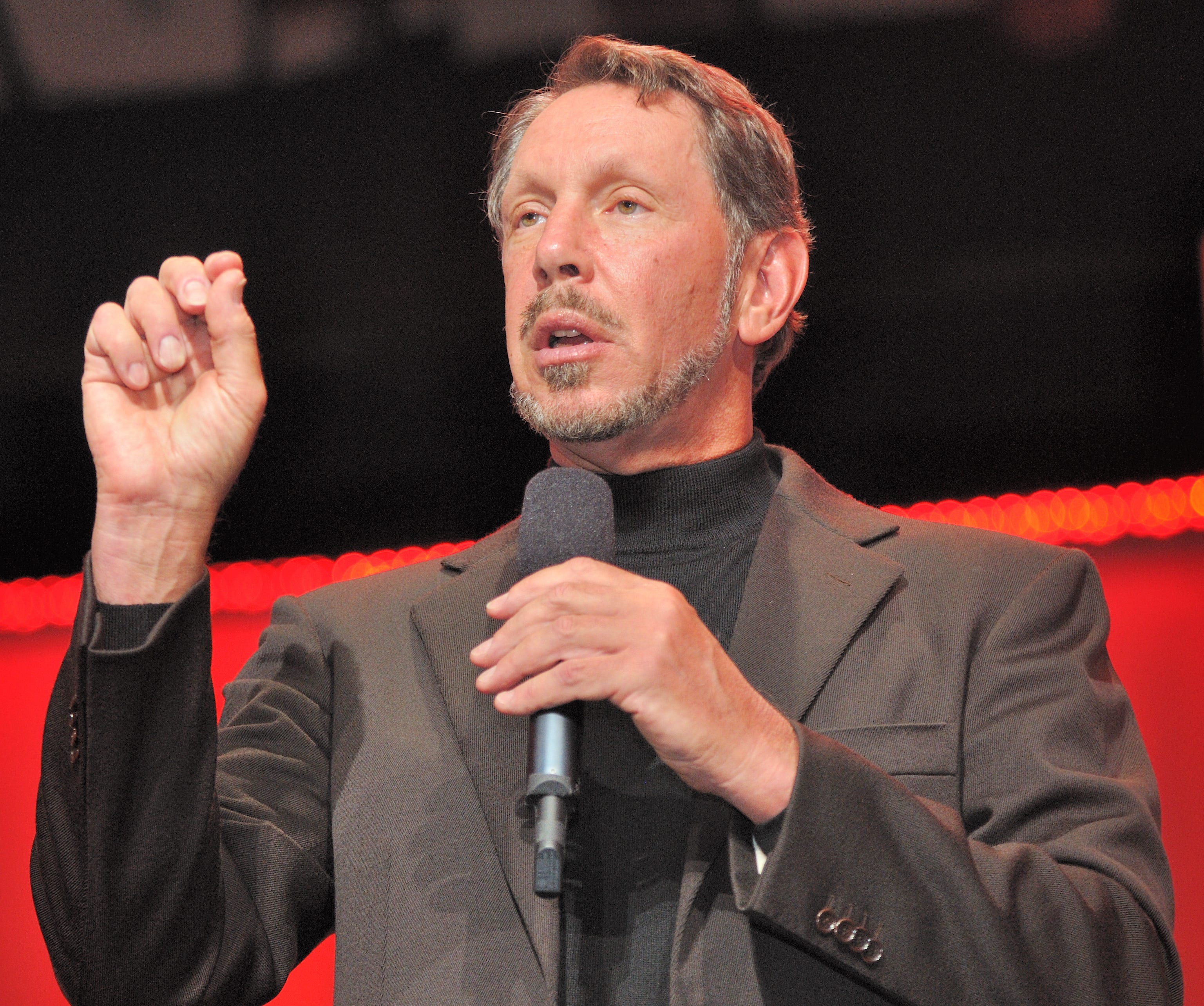
The deeper story starts in the 1970s. Larry Ellison worked on a CIA funded database project at Ampex. The code name was “Oracle”. Later he founded his own company and kept the name. The CIA became one of Oracle’s first big customers.
Jump to today:
Oracle sells cloud and database systems to the US intelligence community and other agencies.
Larry Ellison is a top Trump donor and insider.
His son runs Paramount Skydance and controls CBS.
Oracle is lined up to handle TikTok’s US data and tech under a forced divestment deal.
Your TV news, your streaming shows and the app you doomscroll at night are drifting into the same small circle of people who live on government contracts and have strong foreign policy loyalties.
On your phone it looks like variety.
On their balance sheet it is one system.
3. Security state money behind Big Tech
The Ellisons are not alone.
Look at Google. In-Q-Tel, the CIA’s venture arm, invested in a 3D mapping startup called Keyhole in the early 2000s. Google bought Keyhole. Its tech became Google Earth, which then got used by the US military and intelligence community.
Look at Amazon. Its cloud division won a major CIA contract, then fought for and shared in a huge Pentagon cloud deal.
Look at SpaceX. It survived its early crisis with help from NASA and Pentagon launch contracts, and now launches spy satellites and works on military networks.
These are not just “cool startups”. They grew up on national security money and then rolled that power into:
search and YouTube
Twitch, Audible, MGM
Starlink and other critical infrastructure
So your news feed, your video recommendations, your maps and even your basic connectivity are heavily shaped by companies that owe a lot to the defense and intelligence world.
You do not need hidden documents to see this. The contracts are public.
4. Israel as a priority baked into the system
Add one more layer: Israel.
Larry Ellison is not a neutral businessman. In 2017 he gave 16.6 million dollars to Friends of the IDF, the biggest single gift in the group’s history.
Oracle’s leadership talks openly about its commitment to Israel. After October 7, the company publicly aligned itself with the Israeli government and doubled pay for staff in Israel for a period of time.
Put it together:
Oracle is a long term supplier to US intelligence and the Pentagon.
Ellison and Oracle are deeply tied to the Israeli state and military.
The Ellison family now controls CBS and wants more media assets.
Oracle is central in the TikTok deal for US operations.
You do not need any racist conspiracy theory here. You only need to see that on Israel and Palestine, the line between security state, tech platform and media ownership is extremely tight.
You can see it in practice:
Palestinian content and simple pro Palestine statements are taken down or buried on major platforms at high rates, as documented by human rights groups.
Workers inside big tech and media who speak about Gaza report pressure and retaliation.
Coverage on TV and big outlets often stays inside a safe frame: individual “tragedy”, “terrorism” and “self defense”, but not a serious look at occupation, blockade and war profit.
This is not an accident. It is what happens when the same network of interests controls both the weapons and the stories.
5. For working people, this is not just “bias”. It is control.
If you treat this as “left media vs right media”, you miss the class angle.
From a working class point of view, three things matter.
1), anti war and anti-capitalist views are treated as background noise.
Platforms and outlets live off ads, finance and defense money.
Critique that really threatens those flows does not need to be banned. It just needs to be invisible. No reach, no trend, no discovery.
You feel like nobody else cares. In reality, you have been quietly sidelined.
2), real anger is pushed toward safe targets.
People are furious about wages, rent, health care, debt, job insecurity. That anger could go up the chain.
Instead, the easiest content is always:
blame immigrants
blame “the other party”
blame another race
blame “woke” or “boomers” or whatever group of the week
Your anger becomes someone else’s engagement metric.
It does not become pressure on the people who actually control policy.
3), workers cannot build a shared picture of reality.
Feeds are personalized.
You see conspiracies.
Another person sees self improvement clips.
Someone else sees nonstop culture war.
Another one sees nothing but sports.
If you never see the same basic picture, you cannot form common demands on wages, housing, war, or anything else. Division is not a side effect. It is a feature.
From the top, this is perfect.
If people are busy hating sideways, they do not look up.
So when seven men sit on more wealth than billions of people and own key information pipelines at the same time, the main danger is not “unfair coverage”.
The main danger is a population that cannot even agree on what is happening to them.
6. The “firewall” story, flipped
There is a popular line in the West:
“Chinese people live behind a firewall. They only see propaganda. Americans see the full picture.”
Reality is messy.
Many Chinese know there is a wall. They use VPNs, watch YouTube, see Western news. They travel, study, work abroad. They learn to compare narratives from different systems. They know every country spins its own story.
Now look at the average American:
Only English language media.
Same handful of US based outlets and platforms.
Little or no time abroad outside tourist bubbles.
A feed that gets narrower over time, not wider.
So yes, China has a visible wall.
America has an invisible wall built from ownership, contracts, language and habits.
In some ways, the invisible wall is more dangerous, because people inside it think they have none.
If this continues, the result is simple:
The national worldview shrinks.
Structural problems are turned into stories about foreign enemies or internal “traitors”.
Sooner or later, people start reaching for strongmen who promise to sort it all out.
Trump did not come from nowhere.
This information structure helped prepare the ground.
7. How to start breaking the cage
No one is going to build a perfect, global, worker owned media system tomorrow. But people can take small, concrete steps.
1. Compare one story across countries.
Big event happens. Do this:
Read US coverage.
Read an English piece from a Chinese outlet.
Read something from the Middle East, Russia or Europe.
You do not have to fully trust any of them. You will see what your own media simply leaves out.
2. Use machine translation.
Paste foreign articles into a translator. The text will be clumsy. The basic idea will be clear. The goal is to break the “English only” bubble.
3. Stop calling one ownership group “diverse”.
CNN, MSNBC, Fox and a couple of streamer shows are not diversity if they answer to the same kind of boards and advertisers.
Look for other water:
union and worker media
small foreign outlets in English
independent reporters and investigative nonprofits
4. Talk to people from other countries.
Ask immigrants, foreign students, international coworkers how they saw US wars, elections, crises from the outside, and how they see US media now that they are here.
One real conversation can do more than a hundred segments.
5. Learn to ask three questions.
Every time a topic explodes everywhere at once with the same talking points, ask:
Who makes money from this narrative?
Who uses it to get votes or pass laws?
Who never gets a microphone when this is discussed?
This habit does not make you paranoid. It makes you harder to manage.
8. Conclusion: admit you also live behind a wall
China has a wall. People know it, argue with it, climb over it.
America has a wall built out of capital, contracts and code. Most people inside it still think they are standing in the open air.
The real issue is not “does a state censor”. Every state does, in some form.
The real issue is whether ordinary people can still see the basic structure of power.
From a class point of view, breaking the information cage is not about becoming better informed Democrats or Republicans.
It is about keeping one basic tool:
The ability to see who is exploiting you, who is lying to you, and who is using the news as anesthesia.
If that tool is gone, it almost does not matter who sits in the Oval Office.
The system will keep producing the same kind of leaders.
Sources and further reading
You do not have to take my word for any of this. Here are some public starting points:
Larry Ellison, Oracle and the CIA
Ellison’s biography and Oracle’s own corporate history, which describe the early CIA “Oracle” database project and the agency as one of Oracle’s first big clients.
Ellison and Israel
Coverage of the 2017 Friends of the IDF gala, where Ellison donated 16.6 million dollars, the largest single gift in the group’s history.
Paramount Skydance, CBS and Bari Weiss
AP, CBS and other reporting on the Skydance–Paramount merger, layoffs, closure of CBS News’ Race & Culture unit, and the purchase of The Free Press with Bari Weiss installed as editor in chief of CBS News.
TikTok and Oracle’s role
US coverage of the TikTok divestment law and proposed deal in which Oracle would host and control TikTok’s US data and infrastructure.
Google, In-Q-Tel and Keyhole
Tech and policy histories of In-Q-Tel’s investment in Keyhole and how it led to Google Earth, later used by the US military and intelligence community.