

Jeff Bezos just gave one of the most dangerous elite-defense interviews in years. Dangerous not because he sounded greedy or detached, but because he sounded reasonable. He admitted ordinary people are getting crushed by rent, groceries, and taxes. He even said a nurse making $75,000 should pay zero taxes. That line will resonate because it touches something real. And on that narrow point, he’s not wrong.
But here’s what makes this interview worth dissecting: Bezos takes a legitimate crisis and carefully reframes it. Instead of talking about concentrated corporate power, monopoly formation, or lobbying influence, he repackages America’s economic collapse as a “government competence problem.” That redirect is the entire game.
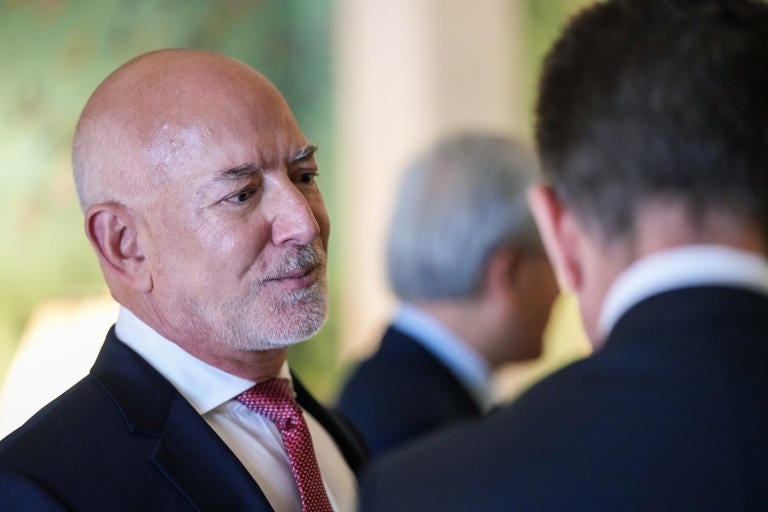
Full interview is here,
Squawk Pod: Jeff Bezos & Andrew Ross Sorkin at Blue Origin - 05/20/26 | Audio Only
The Redirect
Bezos says the nurse is overtaxed because the government wastes money. New York City schools spend $44,000 per student with mediocre outcomes. Housing permits take years. Bureaucracy is bloated. He’s describing real dysfunction that people experience every day, which is exactly why the framing works.

But here’s the part he skips: why did the system become structured this way? American government didn’t become disconnected from ordinary people in a vacuum. Corporate lobbying, campaign financing, revolving-door politics, and regulatory capture shaped it. Amazon alone has spent over $250 million on lobbying since 2010. During that same period, the company paid negative federal taxes in 2017 and 2018 while Bezos became the richest man on Earth. When he criticizes government waste, he’s criticizing the system his class designed.
The Tax Shell Game
Bezos supports cutting taxes for workers. Great. But he won’t discuss why labor income and capital income are treated so differently under American tax law.
The nurse making $75,000 pays a 22% marginal rate on every dollar, withheld automatically, with no escape. Bezos built his fortune on Amazon stock appreciation. As long as he doesn’t sell, he pays nothing. When he does sell, he pays capital gains tax at 20% - lower than the nurse’s rate. Better yet, he can borrow against his stock and pay interest instead of taxes, often deducting that interest. The loan never triggers a taxable event.
This isn’t illegal. It’s just the structure. Labor gets taxed immediately and heavily. Capital gets taxed later, lower, and optionally. Bezos wants lower taxes for workers, but he won’t advocate for equalizing how labor and capital are taxed. Because that would cost him.
Safe Reform vs. Structural Reform
Notice what Bezos is willing to criticize: bureaucratic inefficiency, wasteful spending, zoning restrictions, permitting delays, corporate welfare in the abstract. These are all real problems. They’re also politically safe.
Now notice what he will never discuss: antitrust enforcement against Amazon, union organizing rights, wealth taxes, mandatory profit-sharing, labor law reform, or platform regulation. Why? Because those policies would actually redistribute power. Cutting administrative bloat doesn’t threaten capital. Breaking up monopolies does. Bezos can talk about government efficiency all day. He cannot talk about why Amazon fights unions, why AWS locks in customers, or why his wealth grew $70 billion in a year while he gave away $200 million.
The reforms he supports don’t touch ownership. They don’t touch bargaining power. They don’t touch who writes the rules. That’s the tells you everything.
The “Non-Zero-Sum” Myth
Bezos repeatedly argues that wealth isn’t zero-sum. Investment creates value. The economy grows. More wealth doesn’t mean someone else has less. In theory, he’s right.
In practice, it’s a misdirection. Between 1979 and 2020, American productivity grew 64.6%. Worker wages grew 17.5%. CEO compensation grew 1,322%. The pie got bigger. Workers got a smaller slice. That gap didn’t evaporate. It went to shareholders, executives, stock buybacks, and financial engineering.
Amazon is the perfect case study. AWS genuinely transformed cloud computing. Amazon logistics genuinely made delivery faster. Value was created. But Amazon’s warehouse workers make $23 an hour - about $52,000 a year - in cities where rent consumes half that. Meanwhile, Bezos is worth $280 billion. Both things are true: Amazon created value, and Amazon’s workers can’t afford rent. Bezos talks about the first part. He doesn’t talk about the second. The question isn’t whether wealth is zero-sum. The question is who controls the distribution system.
AI Will Save You (Says the Man Who Owns the Bulldozer)
Bezos is deeply optimistic about AI. He thinks it will increase productivity so much that America will face labor shortages, not job losses. Workers will use AI like a bulldozer instead of a shovel. They’ll get more done, earn more, and live better.
Here’s why workers don’t believe him: they’ve heard this story for 40 years. Automation was supposed to make life easier. Globalization was supposed to make everyone richer. Productivity gains were supposed to flow downward. Instead, workers watched their bargaining power collapse, their wages stagnate, and their jobs get more precarious while corporate profits hit record highs.
When Bezos says AI will help workers, workers hear: “The people who own the AI will decide what happens to the savings.” And historically, those savings don’t go to labor. They go to shareholders. Amazon already uses algorithms to monitor warehouse workers, track their movements, and optimize their productivity. That’s AI helping workers - by making their jobs faster, harder, and more surveilled. When the man worth $280 billion tells you not to worry about AI, ask yourself: does he profit more if you believe him or if you organize?
The Question He Won’t Answer
Bezos says the system is broken. Government is inefficient. Ordinary people are struggling. Corporate welfare is out of control. Tax loopholes are everywhere. He’s diagnosed the problem.
So here’s the question: if the system is broken, and you have $280 billion and more political influence than almost anyone alive, why haven’t you fixed it?
He says he’ll give away most of his wealth in his lifetime. He’s 62. At his current pace, he’d need to give away $10 billion a year for 25 years. Last year, he gave away less than $200 million while his wealth grew $70 billion. Philanthropy doesn’t change power structures. It smooths them. It treats symptoms while protecting the system that creates them.
Maybe the system isn’t broken for Bezos. Maybe it’s working exactly as designed. He got richer during the pandemic while his workers got infected. He paid no federal taxes for years while nurses paid thousands. His company received billions in subsidies while fighting union drives. He built monopolistic infrastructure while calling for government efficiency. None of this happened by accident. It happened because the rules were written to allow it.
The Real Problem
Bezos is right that ordinary Americans are struggling. He’s right that a nurse making $75,000 shouldn’t be crushed by taxes. He’s right that government is often inefficient.
But his explanation carefully avoids the part where people like him spent decades lobbying, donating, and shaping policy to make sure labor gets taxed and capital doesn’t. To make sure wages stay flat and stock prices soar. To make sure workers have no leverage and platforms have all of it.
The real question isn’t government efficiency versus revenue. The real question is: who owns the economy, who writes the rules, and who always walks away richer? Bezos won’t answer that. Because the answer is him.


That’s a lot of information but in a very digestible format. Thank you for such good articles. 😇
Really well written! All your articles are great and informative. Thank you!