

There’s a story making the rounds: “We let China into the WTO. We gave them market access. We thought they’d become democratic. Instead, they stole our technology, manipulated currency, and became a superpower. We were too naive.”
It’s bipartisan. It’s clean. It’s also almost entirely bullshit.
Not because China didn’t benefit from WTO accession, or because there aren’t legitimate concerns about technology transfer and military expansion. Those are real.
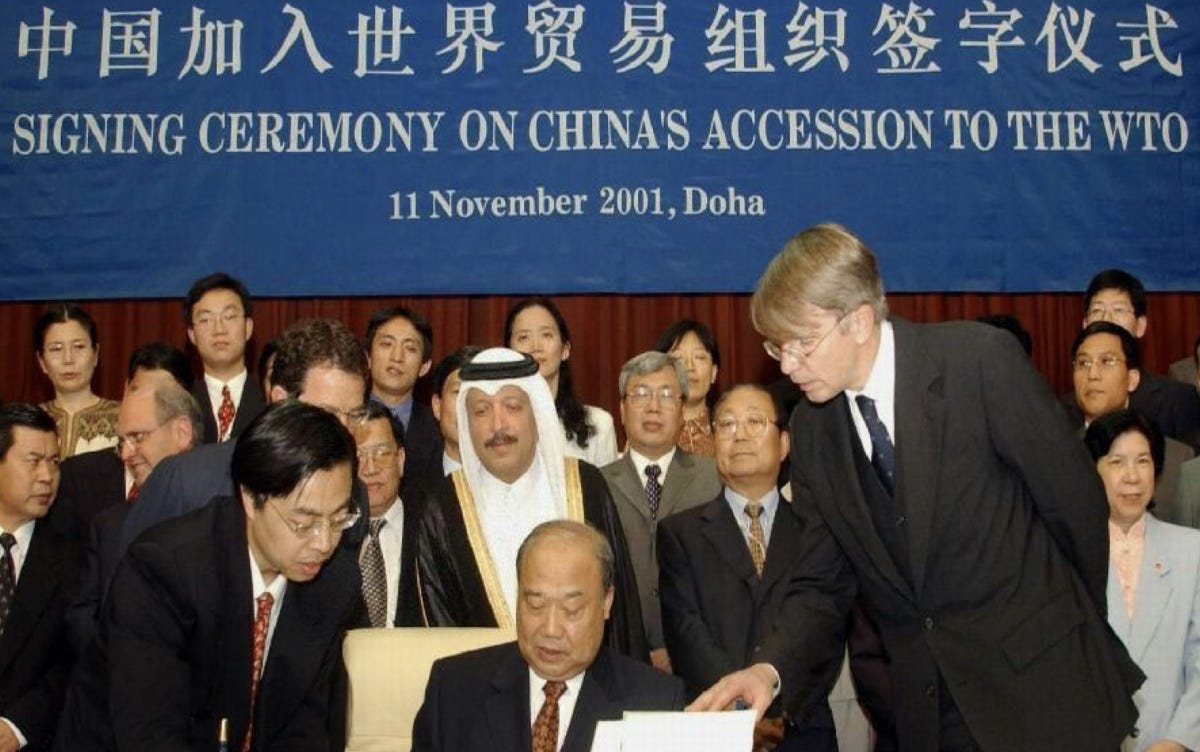
But this framing, “we allowed them,” obscures who made these decisions, why they made them, and who profited. It transforms calculated bets by American elites into a story of national innocence betrayed.
Let’s break it down.
“We Allowed China Into the WTO”
This language should make you suspicious. The WTO isn’t America’s private club. China negotiated entry into a multilateral organization over 15 years.
More importantly, American corporations were desperate for this deal.
Boeing wanted to sell aircraft. GM wanted to manufacture cars for Chinese consumers. Wall Street wanted investment opportunities. Walmart wanted cheap manufacturing.
These CEOs didn’t just support China’s WTO entry, they lobbied for it. They testified before Congress. They funded favorable studies.
So when you hear “we allowed China in,” ask: who is “we”? American workers whose jobs would be offshored weren’t consulted. The decision was made by elites who stood to gain enormously, and did.
“They Protected Their Economy While We Opened Ours”
Yes, those were the terms American negotiators agreed to.
Why? Because the deal wasn’t one-sided:
Access to the world’s largest consumer market
Dramatically lower manufacturing costs
Chinese purchases of U.S. Treasuries (keeping interest rates low)
New markets for American agriculture and services
The bet was: “We have better technology and capital. We’ll dominate even with asymmetric tariffs.”
It was a calculated gamble that didn’t pay off as expected. But you don’t get to lose a bet and claim you were tricked, especially when you’re still making money. Apple’s margins are enormous. Wall Street has thrived. The problem isn’t that elites lost, it’s that workers did, and elites are rewriting history to deflect blame.
“We Thought China Would Become Democratic”
This treats sophisticated policymakers like naive children.
The people making these decisions weren’t idealistic students, they were seasoned politicians and Fortune 500 executives. They knew authoritarian China wouldn’t transform overnight.
What they believed: “We can engage with China, make enormous profits, maintain dominance, and maybe they’ll liberalize.”
The profits were guaranteed. Liberalization was a hope. When it didn’t materialize, profits kept rolling in.
The “we were naive” line is retrospective face-saving. It lets elites claim good intentions while obscuring that they made these deals knowing exactly what they were doing.
“They Stole Our Technology”
Commercial espionage does exist. Some technology acquisition happened through espionage. That’s real.
The bigger scandal is that American executives traded long-term industrial capacity for short-term profit.
The vast majority of IP transfer happened through terms, contracts, joint ventures, licensing deals, supply chains, and business arrangements that American executives agreed to because they wanted access to China’s market and cheaper production.
GM chose joint ventures requiring technology sharing. Apple chose to manufacture in China, training thousands of Chinese engineers. Cisco chose to build R&D centers there. Universities chose to accept Chinese researchers and benefited from their contributions.
These were business decisions by executives chasing quarterly earnings.
Framing this only as “they stole from us” erases accountability. American executives sold the technology and got rich doing it. Now they’re playing victim.
“They Pegged Their Currency and Devalued Alongside Us”
This complaint is particularly rich, because the peg massively benefited the United States.
When China bought trillions in U.S. Treasuries to maintain the peg, they:
Kept U.S. interest rates artificially low
Allowed enormous deficits without immediate consequences
Financed American consumption, wars, and tax cuts
The U.S. fought two wars, bailed out banks, and cut taxes for the wealthy, all while keeping borrowing costs low. That wouldn’t have been possible without China buying U.S. debt.
Yes, the peg made Chinese exports cheaper. But it subsidized American living standards. Complaining now is like taking a loan, spending it, then blaming your creditor for the interest.
“Deficit Spending Created Inflation, Hurting Workers”
True. But who did that spending?
American politicians, both parties:
Tax cuts for corporations and the wealthy
Wars in Iraq and Afghanistan
Bank bailouts
Poorly targeted stimulus
China didn’t force any of that.
Why have American workers suffered? Domestic causes:
Union destruction
Wage suppression
Stock buybacks over raises
Financialization
Monopolization
Underinvestment in infrastructure and education
Chinese competition played a role. But American policy choices, made by American elites, for American elites, determined how those pressures affected workers.
Blaming China avoids confronting that.
“China Became a Superpower Off Those Trade Deals”
And what did the U.S. do with those 20 years?
China built:
25,000 miles of high-speed rail
Massive infrastructure
World-class universities
Coordinated industrial policy
The United States:
Spent $8 trillion on Middle East wars
Let infrastructure crumble (D+ grade)
Allowed private equity to gut industries
Watched inequality explode
Bailed out Wall Street while homeowners lost everything
China didn’t beat America. America beat itself.
You had every advantage: reserve currency, largest military, best universities, technological dominance.
And you squandered it on short-term extraction, tax cuts for billionaires, and pointless wars.
China stayed focused, played long-term, and invested in their country.
What Actually Happened
American elites bet they could integrate China, profit enormously, and maintain permanent dominance. They were right about profits, wrong about dominance.
They assumed American superiority was inevitable. China took the deal, played smart, and built their economy with discipline.
American elites got rich. American workers got screwed. Now, rather than admit bad choices and fix domestic problems, elites are selling a victim story.
It’s historical revisionism designed to protect the people who made these decisions.
Moving Forward
The U.S.-China relationship was never a charity project. It was a deal. American elites wanted cheap labor, lower production costs, access to China’s market, and higher corporate profits. China wanted development, technology upgrading, industrial capacity, and access to global trade.
Both sides made strategic choices. China used the opening to build. American elites used it to extract.
If America wants to compete, it has to stop hiding behind the China blame game and start fixing the rot at home. Invest in infrastructure. Rebuild manufacturing. Strengthen education and research. Enforce labor standards and antitrust law. Create actual industrial policy.
Blaming China is easier because it protects the people who made the decisions. It lets CEOs, politicians, and Wall Street pretend they were victims instead of participants.


