

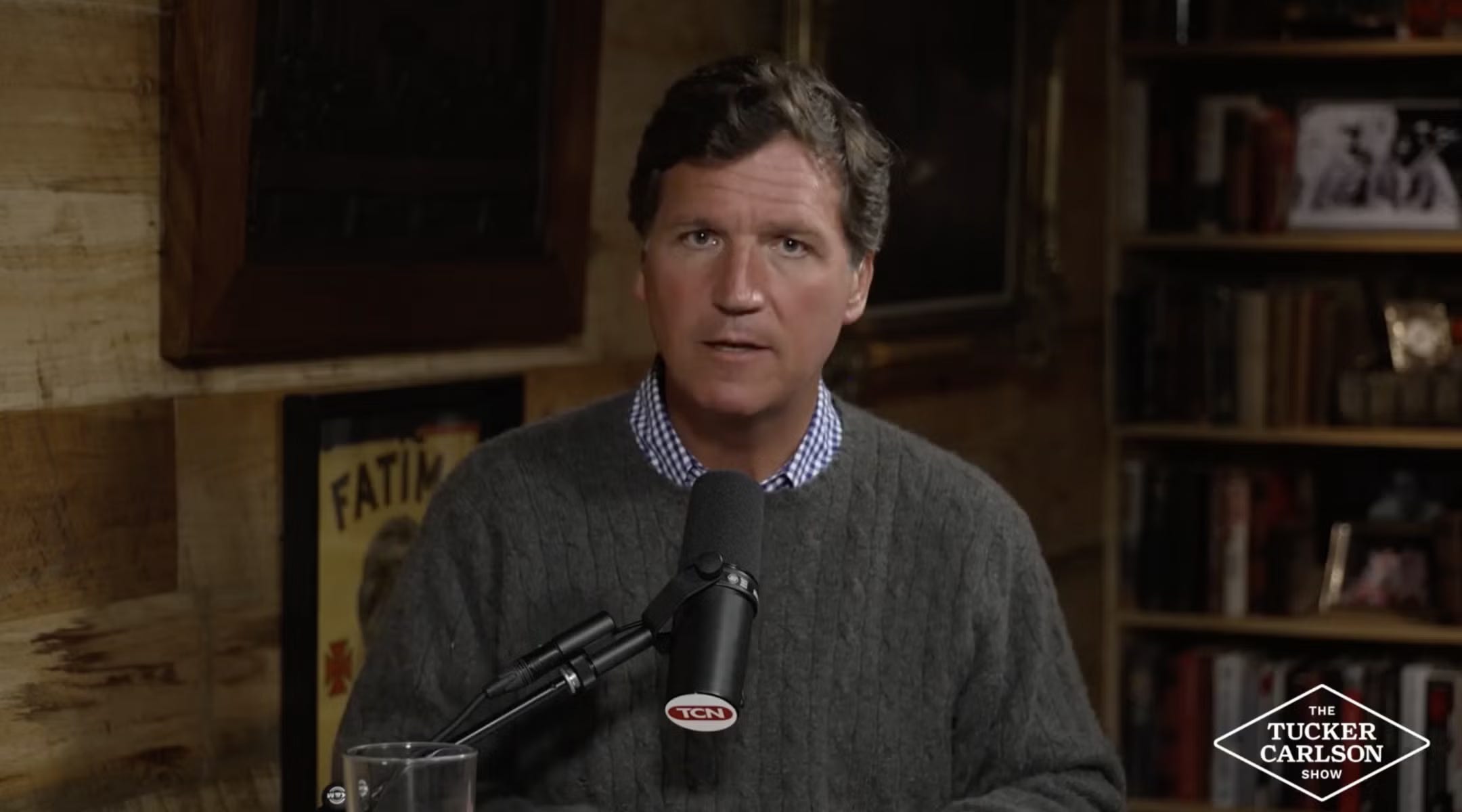
When Tucker Carlson says he regrets supporting Donald Trump, it comes across as genuine reflection, as if he is finally confronting what he helped create. But regret is not the real story here. The real story is that people like Tucker Carlson, Theo Von, Candace Owens, Nick Fuentes, and a whole layer of right-wing influencers still have not confronted the deeper problem. They keep treating political failure as a matter of choosing the wrong person, when the real issue is the capitalist structure they refuse to challenge.
That is why this cycle keeps repeating. Different candidate, same illusion. Different slogan, same outcome.
This Is Bigger Than Tucker Carlson
Tucker Carlson matters because people know his name. So do Theo Von, Candace Owens, Nick Fuentes, and the rest of that media ecosystem. Their names are useful because they are familiar to the audience. They are the entry point. But they are not the core issue.
The real issue is what these people have been doing for years. They take legitimate anger from ordinary people and redirect it into a politics that never actually threatens capital. They tell working people that the problem is the wrong elite, the wrong immigrants, the wrong cultural values, the wrong party, the wrong media class. What they do not do is lead people toward a serious confrontation with class power, capitalist ownership, and the material structure that keeps ordinary people trapped.
That omission is not small. That omission is the whole game.
They Never Judged Politics Through the Working Class
The basic failure here is not that they supported Trump. The deeper failure is that they never judged politics through working-class politics in the first place.
Working-class politics is not just a slogan. It is not aesthetic. It is not performance. It is a very simple standard. Does this politics improve the material reality of ordinary people? Does it raise wages, reduce exploitation, lower housing pressure, make healthcare more accessible, weaken the grip of capital, and shift power toward the people who actually keep society running? If the answer is no, then the branding does not matter. The speech does not matter. The personality does not matter.
And that is exactly why so many of these influencers fail. They do not start from class. They start from image, emotion, resentment, spectacle, and personality. That is why they are always vulnerable to the next strongman who knows how to talk like an outsider while serving the same old structure.
Why They Avoid Class Politics
Some of them do not understand class politics. Others understand it well enough to know why they do not want to touch it.
The moment you seriously talk about working-class politics, you move away from safe, profitable outrage and toward dangerous questions. You have to talk about employers, landlords, private capital, health insurance companies, military contractors, and the entire architecture of capitalist power. You have to ask who owns, who profits, who pays, and why the working class is always told to sacrifice while the rich keep collecting.
That is not good for the business model of political influencing. It is much easier to monetize culture war rage than class consciousness. It is much easier to talk about identity panic than capitalist exploitation. The moment they seriously touch class struggle, they risk losing audience, losing sponsors, losing platform comfort, and getting hit with the usual anti-communist smear. So they stay inside the safe zone. They posture as anti-establishment while carefully avoiding the one analysis that would actually explain the system.
That is not courage. That is controlled opposition with good lighting and a microphone.
Capitalism Is the Structure They Refuse to Name
The United States is not failing because the wrong individuals occasionally take office. It is failing because its political system is built inside a capitalist order that places profit above human need and elite power above democratic control.
Within that structure, politicians do not primarily answer to the working class. They answer to donors, capital networks, lobbyists, corporations, and the institutions that protect concentrated wealth. This is true whether the rhetoric is nationalist, liberal, conservative, populist, or technocratic. The packaging changes. The class character does not.
That is why Trump was never going to fundamentally serve ordinary people. He is not an accident outside the system. He is one more expression of it. A capitalist strongman is still a capitalist. A man from the elite class does not become a champion of workers because he wraps himself in anti-establishment language.
Too many people wanted to believe otherwise because they had no class standard to measure him against.
Why Reform Is Not Enough
Reform can produce temporary relief. That part should not be denied. Wages can be nudged. Benefits can be expanded. Specific abuses can be restrained for a time. But within capitalism, reforms are always unstable because the structure that generates exploitation remains intact.
That is the part liberals and soft reformists never want to face. If capital still controls investment, employment, housing, healthcare, media influence, and political access, then reform is operating on borrowed time. Gains can be diluted, rolled back, absorbed, priced out, or reversed the moment conditions change. History has shown this again and again. What gets won under pressure gets clawed back when pressure falls.
So no, reform does not solve the problem in the long run if the capitalist structure remains untouched. It can delay damage. It can buy breathing room. It can improve immediate conditions in limited ways. But it does not remove the ruling logic of the system. And as long as that logic remains, politics will keep bending back toward profit, hierarchy, and elite control.
That is why people keep ending up in the same cycle. They mistake temporary adjustment for structural change.
Why the Cycle Keeps Repeating
Once politics is cut off from class struggle, people are left judging power by style. They look for authenticity, boldness, outsider energy, anti-establishment branding, and emotional force. That is exactly how they get trapped over and over again.
A candidate arrives speaking the language of anger. Influencers rally around him. The audience projects hope onto him. The system remains what it was. Disappointment follows. Then the same people go looking for the next savior, the next “real one,” the next figure who supposedly understands the people.
This is not political maturity. It is political illiteracy produced by a culture that refuses to teach class politics and punishes anyone who names capitalism as the root problem.
So yes, Tucker regrets it. Fine. But regret is cheap. The real question is whether he and the people around him are willing to name the actual structure that produced both Trump and the disappointment that followed. So far, the answer is mostly no.
My Take
The lesson here is not “be more careful next time.” The lesson is that without working-class politics, people will keep getting fooled by elite-managed populism. Without class struggle, politics becomes a carousel of slogans. Without naming capitalism, every critique stays trapped inside the very system it claims to oppose.
That is why these people keep failing. Not because they are uniquely stupid, but because they are operating inside a framework designed to keep the working class angry, fragmented, and politically disarmed.
If politics is not organized around the needs and power of ordinary working people, then it is organized around someone else’s interests. There is no neutral ground here.
Closing
A government should serve the people who make society function. That means the working class, not the donor class, not the investor class, not the professional political class, and not the media personalities who sell rebellion while staying inside the boundaries of acceptable capitalism.
As long as capitalism remains the structure, every so-called outsider will be pressured, absorbed, or revealed. Some reforms may soften the blow for a while, but they do not break the system. They do not put power where it belongs.
So the real divide is not Tucker versus Trump, or right versus left in the shallow media sense. The real divide is between a politics rooted in working-class interests and a capitalist order that will never voluntarily serve them.
That is the lesson people keep refusing to learn.


