

February 10. An account in Trump’s name buys up to five million dollars of Dell stock, at $126 a share.
9 days later, he tells a rally crowd to go out and buy a Dell computer.
May 8. He stands in the White House and thanks the Dell family by name for putting $6.25 billion into his signature program.
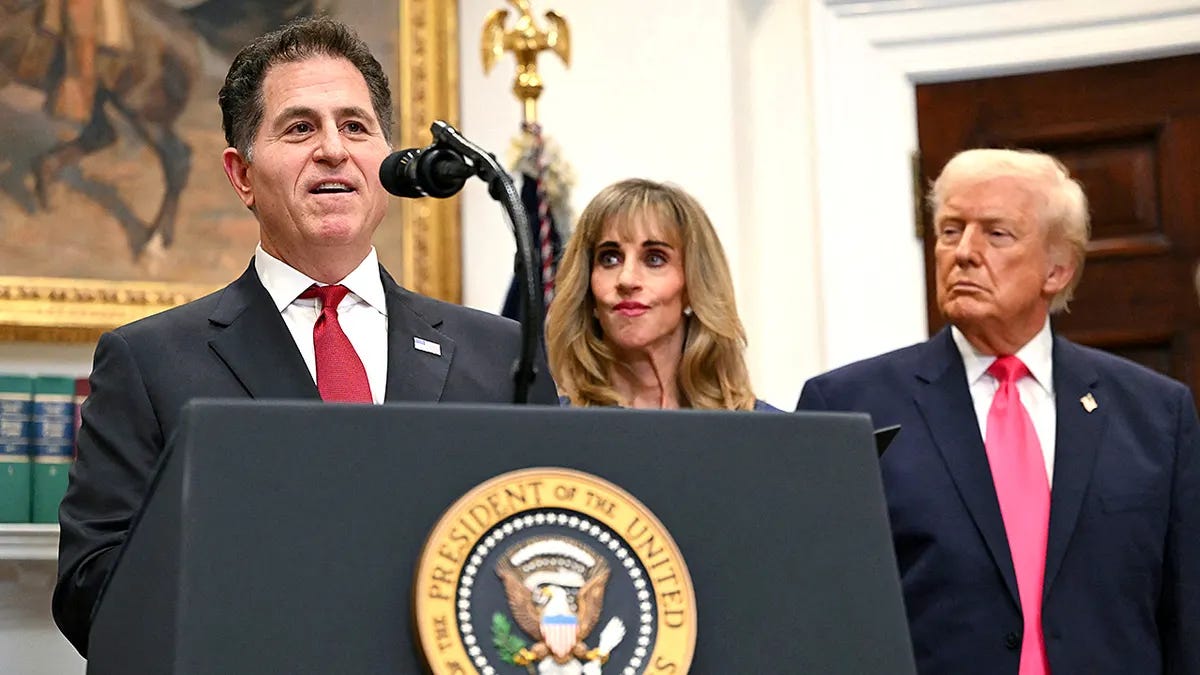
May 27. His Pentagon hands Dell a $9.7 billion contract, the largest it has ever signed. The stock jumps almost 40 percent overnight.
Most of the coverage is filing this under ethics. Watchdogs raise alarms, experts talk about the optics, everyone agrees it looks bad.
That framing is the trap. It turns a simple sequence into a lawyers’ argument you are supposed to find too boring to follow. Strip it down and there is nothing complicated here. He bought the stock, he promoted it from the White House, and then the government he runs paid the company. None of this is alleged. It is in his own filings, in the rally footage, and in the Pentagon’s own announcement.
Here is what makes it possible. Conflict of interest law does not apply to the president. Trump never divested and never set up a blind trust, breaking with every president from Lyndon Johnson on. Obama held Treasury bills. Biden held no individual stocks at all. Trump signed a 113-page disclosure listing 3,642 separate trades in 90 days.
A man does not sign a record of holdings he claims to know nothing about.
And Dell is not a one-off favor. Michael Dell put $6.25 billion into the children’s savings accounts Trump named after himself, and he sits on a White House council that advises the president on economic and technology policy. So the same man funds Trump’s signature program, advises him, then collects the Pentagon’s biggest contract, while the president holds his stock and praises him on camera.
The same filing shows Trump trading Disney, Netflix, Intel, and Micron, often right around his own public praise, his attacks, or his administration’s decisions about those companies. The man who spent years calling Nancy Pelosi a criminal for insider trading made more trades in one quarter than she did in three years.
Now look at who is actually allowed to do this. Every other person who works for the federal government is barred from touching a decision they have money riding on. A regular employee who owned Dell stock and went near that contract could be prosecuted. The president is the one person the rule leaves out. He did in the open what would put an ordinary worker in a courtroom, and he kept the money.
And the $9.7 billion he sent to his friend’s company is not his money. It comes out of federal revenue, which comes out of your paycheck, the same paycheck that no longer covers rent, groceries, and a car payment in the same month.
You did not get a vote on the contract. You got the bill.
That is the real line running through American life. Not left against right. The people who write the contracts, and the people who pay for them.
I lived in Canada for years, so here is a quick comparison. Canada has a conflict of interest law, and it actually applies to the prime minister. Justin Trudeau was officially found to have broken it. However, Canada barely punished him, but the rule still reached the man at the top. In America it does not even apply to the president. There is no finding to make, because there is no rule for him to break.
This keeps happening for a reason that has nothing to do with one man. The rules around money and power in this country were written mostly by the people they protect. The only thing standing between a president and his own portfolio was the expectation that he would hold back. Trump’s own answer, on paper, was to call for a ban on congressional stock trading in his February speech. The bill went nowhere, because the people who would have to pass it are the same people who profit from leaving it alone.
So the real question is not whether Trump broke a law. He did not, and that is the whole problem. The same move that would drag you in front of investigators left him richer, and the system filed it as a footnote.
If the rules only bind the people who cannot afford to break them, they were never really rules. They just describe who has power and who does not.
Most of what I publish here is free. I appreciate every one of you who reads it and shares it. If you want to support the work and help me keep doing this, consider upgrading to a paid subscription.


