

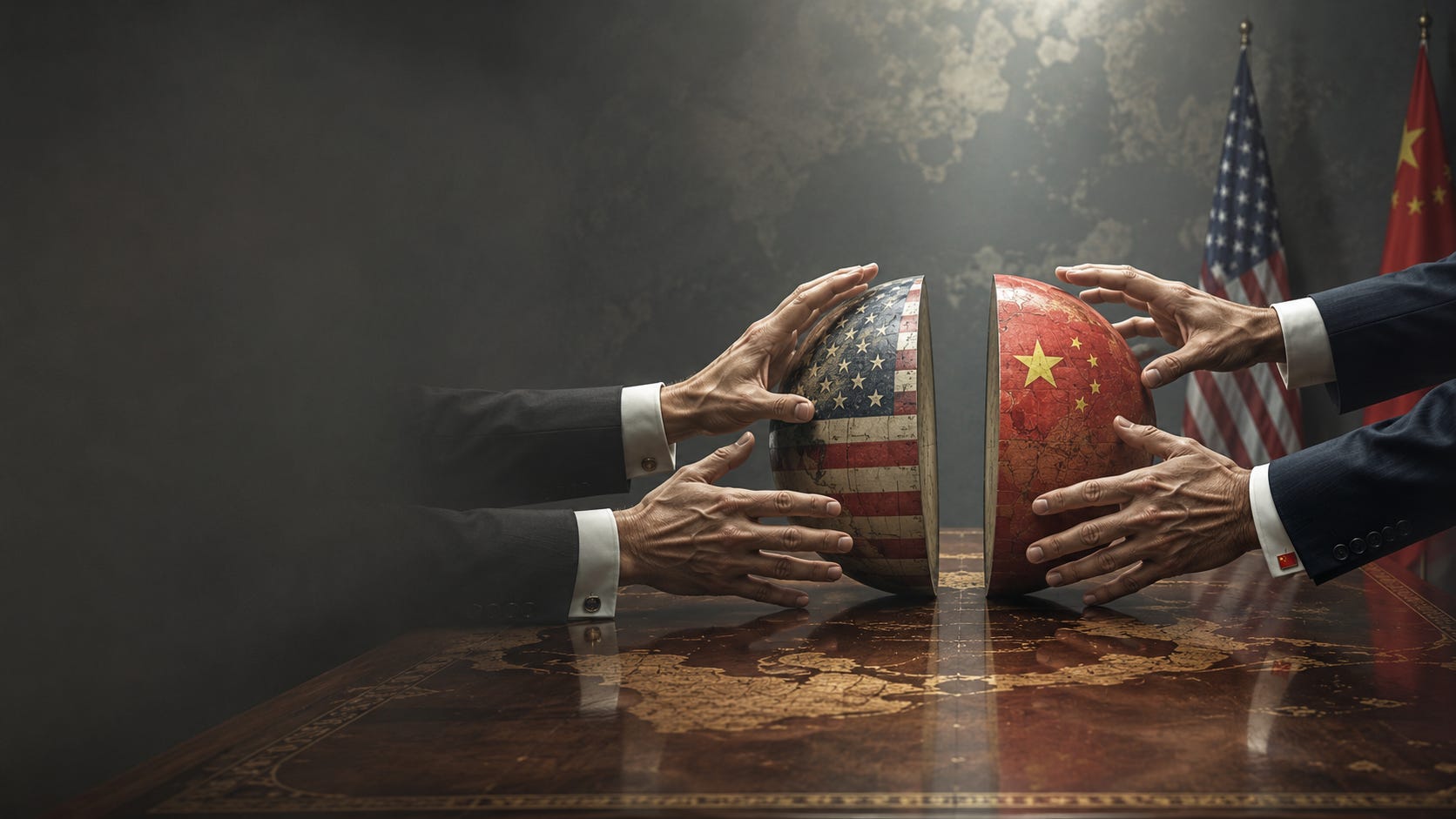
Trump has floated it. Obama’s people floated it before him. The proposal has a name: the G2. The idea is that the United States and China sit down, declare themselves the two dominant powers on the planet, and run the world together. A global duopoly. Two flags, one arrangement, everyone else shut out.
China has said no every single time.
Washington treats this as a diplomatic puzzle. A trust deficit. A communications problem the right back channel could fix. What it never asks is the more obvious question: why would any country in its right mind say yes?
The G2 is not a partnership. It is a buyout offer wrapped around a trap.
A quick note before we get into it. I'm an independent political commentator, no network, no corporate backer, just me and the people who read this. If you're already subscribed, thank you, it means a lot. And if you've been getting something out of this work and want to push it a little further, consider becoming a paid subscriber. It genuinely helps me keep doing this.
Beijing knows what saying yes would actually mean. It would mean publicly co-signing American-style imperial management at the exact moment the American empire is losing its grip on the world. Vietnam. Afghanistan. Iraq. The Iran disaster. The dollar’s slow slide from unchallenged dominance. These are not just American failures. Under a G2 arrangement, they become Chinese failures too. Beijing would be inheriting Washington’s enemies, absorbing Washington’s disasters, and standing there holding the bag when the next one hits.
That is the part the American foreign policy class never mentions when they pitch this idea. The G2 is designed, at least in part, to make China share the cost and the blame for an American-led global order that has already failed most of the people living under it. Washington wants a co-signer. It wants someone else’s credibility propping up a system that is running out of its own.
There is also a deeper problem. China has spent decades building its foreign policy identity around non-alignment, sovereignty, and the principle that no single power should dominate the global system. That is not just rhetoric. It is the foundation of everything Beijing has built with the Global South, with BRICS, with the Shanghai Cooperation Organization, with every country that has watched the United States weaponize the dollar, sanction its rivals into poverty, and bomb whoever refuses to comply. Accepting the G2 would destroy all of that. It would tell every country looking for an alternative to American dominance that China just signed up to be the junior partner in the same old arrangement.
And there is one more contradiction nobody in the American foreign policy establishment ever raises, because raising it would mean taking ideology seriously.
China claims to represent a socialist tradition. That tradition, whatever you think of how China has actually practiced it, is built on a specific idea: that working people across all nations share common interests, and that no ruling class, from any country, has the right to govern the world on their behalf. The Communist International did not call for two powerful nations to manage the globe from the top. It called for the solidarity of workers everywhere against the classes that exploit them.
A G2 is the opposite of that. It is two ruling classes sitting down to divide the world between them. One of them happens to fly a red flag. That does not change what it is.
If China’s leadership signed on to the G2, they would not be practicing socialism. They would be doing exactly what they accuse the United States of doing, just with a different flag on the letterhead.
Washington cannot understand the refusal because Washington cannot imagine a world in which it is not the senior partner in everything.
That arrogance has a cost, and working people pay it. Every dollar poured into maintaining global military primacy is a dollar not spent on wages, housing, or healthcare for ordinary Americans.
And here is the trick that was run on the public. The confrontation with China was sold to working people as a win-win. Bring back manufacturing. Defend democracy. Close the trade deficit. Who could be against that? Iowa farmers found out who could be against it when they stopped selling soybeans and pork to Chinese buyers and nobody in Washington made them whole. American working people were never asked to pay any price or bear any burden for this rivalry. They were just told it would cost nothing.
That was always a lie. And the people collecting the bill are never the ones who wrote it.
The G2 fantasy shows you exactly how the ruling class thinks. They genuinely believe two groups of elites can sit in a room, divide the planet into spheres of influence, and call it stability. They did a version of this at Yalta in 1945. They did versions of it all through the Cold War. The people living inside those spheres of influence had no say in any of it.
China's refusal is not a moral victory. China has its own ruling class, and its own workers who deserve far better than they have. We wave no flag here. If the day ever comes when China starts building an empire the way America has, then all of humanity should criticize them for it, just as plainly as we criticize Washington today. But for now, the refusal means something real. The arrangement Washington built after World War II is fracturing. The system that lets a small number of people extract enormous wealth from an enormous number of other people is no longer holding together the way it used to.
The American ruling class knows this.
That is exactly why they keep making the offer.


Nice work. G2 would be a fool's errand and a disaster for workers everywhere.