

On June 27 of last year, private equity billionaire Stephen Schwarzman wired 2 million dollars to a Super PAC backing Susan Collins. On June 28, Collins cast a deciding vote to advance Trump’s tax bill. The vote was 51 to 49.
Collins says the two things have nothing to do with each other. She says that every time the timing comes up. The timing keeps coming up, because it keeps happening.
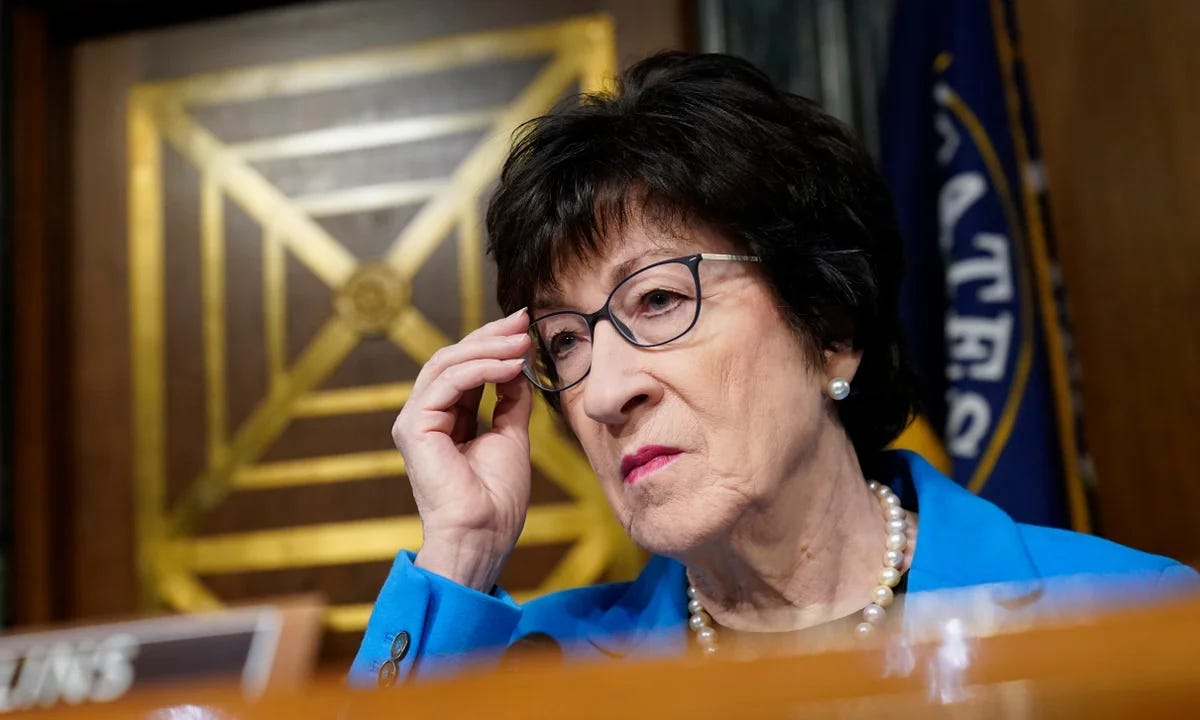
That is the cleanest window you get into how this race actually works. Forget the ads. Forget the town halls. Watch the money. Here is who is paying for this election, what they have already gotten for it, and what each candidate is offering the people who live in the state.
This piece is free, and it stays free because readers keep it going. If it is worth your time, a like and a share help more than you think. And if you want to support the deeper work, becoming a paid subscriber is the most direct way to do it. Either way, thank you for being here.
Where Susan Collins’ money comes from
Start with one number, and the precise version of it. At least 79 billionaires put 9.8 million dollars into Collins’ reelection between January 2025 and late May 2026. Count their spouses and the donor number rises to 97. That 9.8 million is roughly a third of everything her network raised. None of it came from Maine. It came from Wall Street.
The names matter, because “donors” makes you picture retirees and small business owners. These are not those people.
Ken Griffin put 2.5 million into the main pro-Collins Super PAC. He runs Citadel, a hedge fund worth more than 50 billion dollars, and one of the largest market makers in the country. He is among the biggest Republican donors in American history. He spent over 60 million in a single recent cycle. He does not live in Maine. He lives in Florida.
Stephen Schwarzman, the man from the June 27 wire, runs Blackstone, the largest private equity firm in the world. Paul Singer runs Elliott Management, a hedge fund that buys distressed debt and squeezes it. James Davis, chair of New Balance, fills out the million-dollar tier.
Most of the billionaire money backing Collins comes from one industry: hedge funds and private equity. Not a random slice of the rich. One specific industry. And that industry has a specific reason to keep her in office.
And the 9.8 million is just the direct money. It is the floor, not the total. Pine Tree Results, the Super PAC that exists to elect Collins, has already reserved roughly 24 million dollars in advertising for the run to November. The McConnell-aligned dark money group One Nation has spent more than 19 million on ads for her so far. And the national fund backing her, the Senate Leadership Fund, is itself bankrolled by billionaires, including casino magnate Miriam Adelson, who gave it 30 million, and Elon Musk, who gave 10 million. Stack the direct donations, the dedicated Super PAC, the dark money, and the national fund together and the money built up around this one Senate seat runs well past 50 million dollars.
So no, 10 million is not the number. It is the part with names attached. The rest moves through PACs built to keep those names off it.
One more stream, because it shows how organized money behaves. The pro-Israel lobby AIPAC bundled more than 538,000 dollars from 315 donors in a single filing period. That one organized source outpaced everything Collins raised from ordinary small donors. This is not about foreign policy. It is about structure. When a single-issue lobby can hand a senator more in one filing period than her entire grassroots base, you have learned who she actually has to keep happy.
What that money already bought
Donors at this level are not sentimental. They are investors. Collins has paid out for 30 years. The clearest case is one she started herself.
In late November 2017, Republicans were one vote short on Trump’s 1.5 trillion dollar tax bill. Collins had the leverage. She used it to introduce an amendment to close the carried interest loophole and spend the money on a child care credit for low-income families.
The loophole survives by being boring, so here is the plain version. A private equity manager raises money from other people, pension funds, endowments, the wealthy, and invests it. For running that fund he keeps a cut of the profit, usually 20 percent. That cut is called carried interest, and it is his pay for the job, the same way your paycheck is pay for yours. He did not risk his own money to earn it. He earned it with his work. But the law lets him call it a capital gain instead of income. So he pays around 20 percent on it instead of the up to 37 percent you pay on wages. He does the work of an employee and gets taxed like an investor.
The numbers are not small. The industry pays itself almost 120 billion dollars a year this way. Four executives at KKR took 154 million in carried interest in one year and paid roughly 26 million less in tax than if it had been a salary. The loophole can leave someone making 400,000 dollars in a lower bracket than someone making 60,000.
Collins had the power to close it. She introduced the amendment one day. The next day, a Republican aide told a Treasury official she was “no longer offering” it, according to emails ProPublica pried loose through a Freedom of Information Act lawsuit. The bill passed. The loophole lived. The childcare credit died.
Her office says the amendment had no real support and would have failed anyway. Here is the problem with that. Collins introduced several amendments that same day. Three of them passed and made it into the law. Only one vanished overnight, the one that would have cost private equity money. Her spokeswoman calls any suggestion that lobbying drove the decision completely false. You can take that at face value or you can look at which amendment was the one she dropped.
Killing it likely saved Schwarzman alone tens of millions, according to tax experts. In the next cycle, ProPublica found Collins had become the single largest Senate recipient of private equity money. She has held that spot ever since.
This is the part worth slowing down on, because it is where most people reach for the word bribe and miss what actually happened. Nobody had to sign anything. There was no envelope and no meeting in a parking garage. A senator with leverage learned what protecting this industry’s money is worth, and the industry that money belongs to has funded her ever since. Both sides understand the arrangement without ever putting it in words. That is not a failure of the system. For the people writing the checks, it is the system working exactly as designed. And the fact that none of it is illegal is not the loophole’s defense. It is the whole problem.
The 2025 vote was the same machine, new numbers. Collins voted to advance a bill that cuts taxes at the top and pays for it by stripping health coverage from at least 10 million people. Schwarzman’s 2 million landed the day before. Collins chairs the Senate Appropriations Committee, which puts her hand on federal spending for defense contractors, hospitals, and drug companies. More than a thousand organizations lobbied her office this Congress. That is the asset her donors are protecting. Not her reputation for moderation. Her power, and how reliably she uses it.
Where Graham Platner’s money comes from
The contrast is the whole story. That is why her donors are spending so hard to bury it.
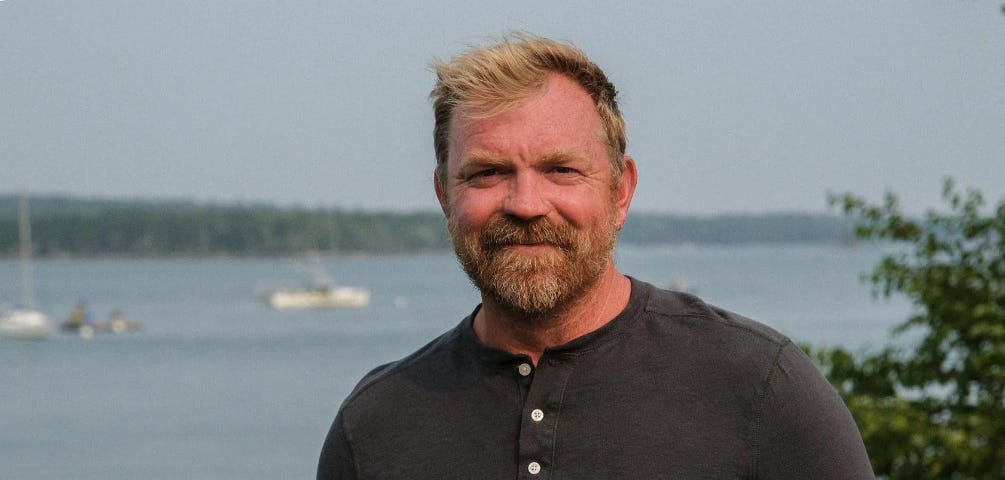
Platner is a Marine and Army veteran and an oyster farmer from Sullivan. He raised a million dollars in his first nine days, average donation 33 dollars, 98 percent of it under 100. He has out-raised Collins for multiple quarters in a row, pulling in 4.1 million in the first quarter of 2026 from about 88,000 people. Small donors giving 200 dollars or less have given him 9.6 million, at an average of 26 dollars. He takes no corporate PAC money.
A few rich names show up on his list too, including George Soros and members of the Pritzker and Walton families. Worth saying plainly. But all of it combined comes to less than 1% of what he raised. One billionaire gave Collins more than every wealthy donor gave Platner put together. That is the gap. Her money is stacked at the top. His is spread across nearly every zip code in Maine.
This is the most reliable signal in any race, sharper than any speech. Money is a standing order. Fund a candidate with 88,000 people sending 26 dollars, and that candidate answers to 88,000 people. Fund one with 79 billionaires sending millions, and the answer changes. It does not take cartoon corruption. It takes a senator who knows exactly who refills the account.
What Platner stands for
His platform is populist and direct. He supports:
Medicare for All
Raising the federal minimum wage
A minimum tax on billionaires
Banning members of Congress from trading stocks
Scrapping the filibuster
Expanding the Supreme Court
Bernie Sanders and Ro Khanna endorsed him. He calls it movement politics: if Democrats ride anti-Trump anger into power without improving anyone’s life, they lose the working class for good.
He calls himself a populist and a social democrat. His opponents reach for harsher words from his past, which I will get to. The policy is a real argument. Whether a billionaire tax and Medicare for All are the way out or a dead end is something people land on differently, and reform like this has a mixed record. But that is a fight about policy. It is a different question from who is paying for the campaign.
The part I won’t skip
Platner is not a clean candidate. Pretending otherwise would insult you.
When he launched, his opponents dug up his past and dumped it into one pile. It is not one thing. Some of it is politics. Some of it is conduct. Lumping them together is the trick.
The politics first. In old posts he called himself a communist and a socialist and backed the line that all cops are bastards. To a Republican operative, that is the whole case against him. But “he’s a socialist” only works as a disqualifier if you already decided socialism is the problem and not a reaction to it. For a voter watching 79 billionaires try to buy their Senate seat, a candidate who names the class on the other side is not the scandal. He is the appeal.
The conduct is a different matter. In the same posts he appeared to mock military sexual assault victims and made racially charged comments about tipping. He also had a chest tattoo resembling the Totenkopf, the skull-and-crossbones used by Hitler’s SS. A CNN investigation said he once acknowledged the design was the “3rd Panzer,” a unit tied to the concentration camps, though he later claimed he did not know what it was. Platner denies that, says he got it on leave in Croatia with fellow Marines who all got the same skull, and has since covered it. He apologized for the posts and said he was struggling with his mental health. Two senior staffers quit during the fallout.
That is fair to weigh. A man who cannot give a clean account of a Nazi-linked tattoo he wore for almost 20 years is carrying something real.
Here is my read. The tattoo and the posts are about who Platner was. The donor list is about what Collins will do. One is character dug out of a private past. The other is a documented, repeating pattern of public votes that move money from public programs to the people funding her. Only one of them shows up in your rent, your premium, your tax bill. The tattoo will not. The next carried interest vote will.
What the money is telling you
Strip away the ads and the noise and the race comes down to one fact. 79 billionaires, most of them in hedge funds and private equity, are anchoring a money operation that runs past 50 million dollars to keep one senator in her seat. Her challenger is funded by tens of thousands of people sending the price of two takeout meals.
Billionaires do not spend like this on sentiment. They spend it on results. Collins has 30 years of results. The 2017 emails show the moment the deal was struck. The 2025 vote shows it still runs. The donor list this cycle shows they expect it to run 6 more years.
That is what all that money is meant to keep you from looking at. So look at it.


