

George Soros has spent the last decade calling China the greatest threat to open society in the world. He says this at Davos. He says this in the Wall Street Journal. He has said, in his own words, that his interest in “defeating Xi Jinping’s China” goes beyond U.S. national interests.
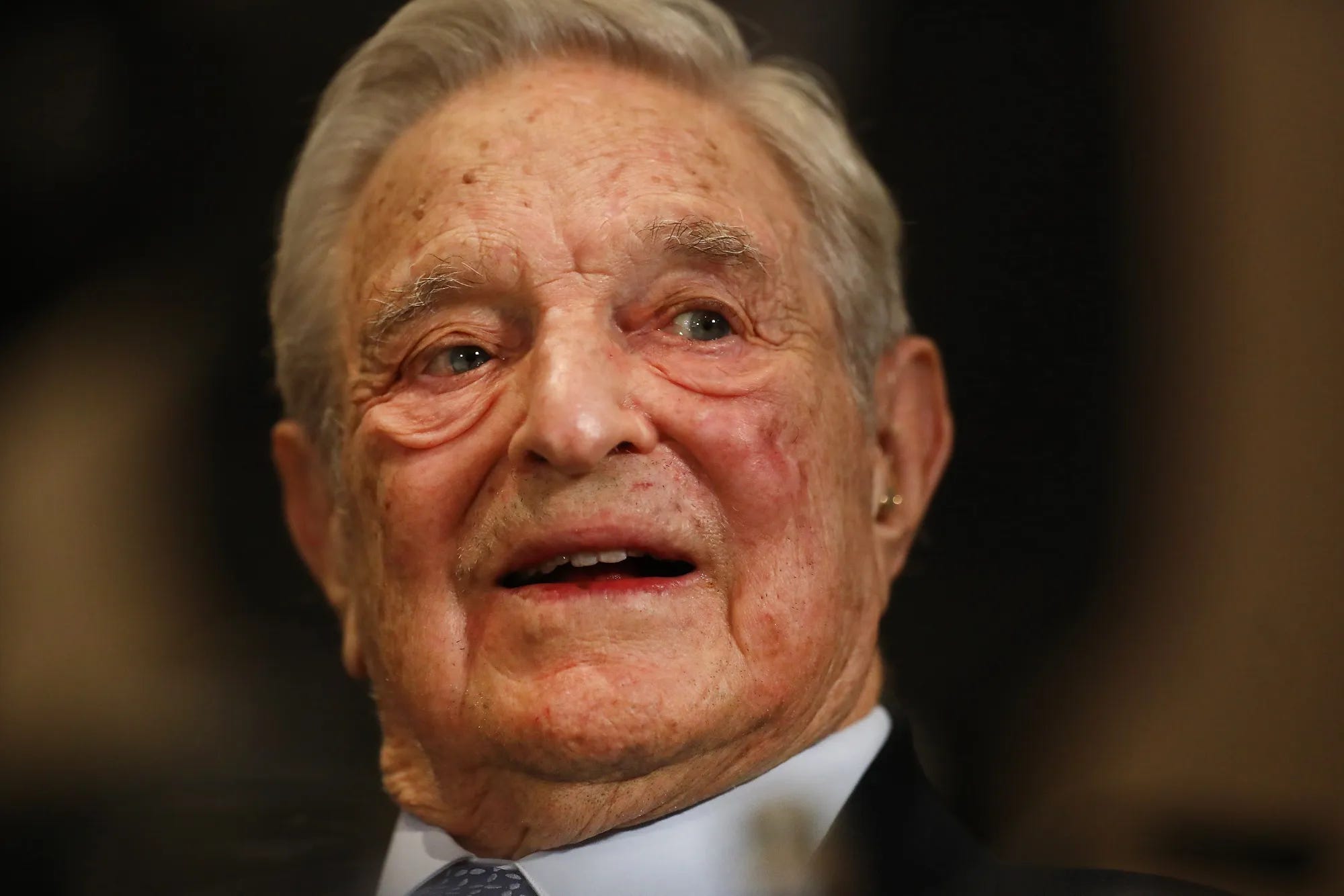
That is a remarkable thing for a private citizen to say. So it’s worth asking: what exactly is an “open society,” and who actually benefits when one exists?
Quick note before we dive in: thank you for reading and for all the support. If you find this useful, subscribe and share it with someone who needs to see it.
Because Soros is not primarily a philosopher. He is a man who built his fortune by finding countries with their guard down, and moving in fast.
In 1992, he shorted the British pound. He made roughly $1 billion in a single day while British households absorbed the damage. He called it just business. When the Soviet Union collapsed and state-owned companies were sold off for almost nothing, Soros was already there, foundations in hand. He set up the Open Society Foundations across Hungary, Poland, and Russia. He was welcomed as a philanthropist. He also got very rich. When people accused him of predatory capitalism, he said he felt “no sense of guilt” about what happened in the markets.
“No sense of guilt.” Keep that in mind the next time he talks about democracy.
His system runs on two tracks at the same time. The first is financial: get into a country while the rules are still being written, short the currency if you can, buy up assets while they are cheap. The second track is about shaping the ground first: fund NGOs, independent media, student groups, and civil society organizations that push for political change from the inside. One track loosens the soil. The other moves in to harvest it.
OSF’s own website confirms the timeline. Before the Berlin Wall even fell, Soros had already set up shop in Poland, Ukraine, and Russia. Within five years he had offices in Kazakhstan, Kyrgyzstan, Bulgaria, the Baltic States, and more. The foundation’s stated goal, in their own words, was to support the shift away from Communist rule. That shift also happened to produce the fire-sale privatizations that made his fund rich.
In Slovakia in 1998, NGOs backed by OSF ran voter campaigns that helped bring down the sitting prime minister. In Georgia, OSF funded the grassroots organizations behind the Rose Revolution that pushed out the sitting president. In Ukraine, Soros set up his foundation in 1990, before the country was even independent from the Soviet Union. By 2014, when street protests removed the pro-Russian president Viktor Yanukovych, Soros told CNN on the record that his foundation had been there the whole time and had “played an important part in events.” His words, not anyone else’s.
Nobody forced him to say that. He said it because he was proud of it.
In 1986, three years before Tiananmen, he tried the same thing in China.
He set up a foundation called the Fund for the Reform and Opening of China, backed by $1 million and the support of reform-minded General Secretary Zhao Ziyang. In its second year, the fund received over 2,000 grant applications. It was doing exactly what it was built to do: funding independent thinkers and building networks that operated outside Party control, the same playbook he had used across Eastern Europe.
Then China’s state security moved in and took the operation over from the inside. By 1989, with Zhao Ziyang removed from power, Soros shut the whole thing down and left. He has never gotten back in.
So he tried the financial track. In 1998, during the Asian financial crisis, he went after the Hong Kong dollar, the same move that had worked against the British pound years earlier. Hong Kong’s government fought back with a HK$120 billion war chest, bought up stocks, and held the line. Soros lost an estimated $1 billion.
Both tracks. Both failed. China said no and made it stick.
What came after that is the part people rarely talk about. Soros spent the next three decades building the largest private democracy-promotion network in the world, with its heaviest presence in exactly the places where his money had run into walls. In 2010 alone, he gave $100 million to Human Rights Watch. That was the biggest single donation in HRW’s history. HRW is now one of the most cited sources for critical reporting on China in Western media. The grants are all public record. Anyone can look them up.
When Soros calls China authoritarian, he is using a Western rulebook and treating it like it applies everywhere. China’s system is different from Western liberal democracy. Different is not the same as illegitimate. Calling an entire country’s way of governing itself wrong, just because it does not look like yours, is not analysis. It is bias with a podium.
And in Soros’s case, that bias has a very clear financial history behind it.
The real question underneath all of this is simple. When powerful capital calls a country “closed,” what it usually means is: closed to me. Closed to the kind of entry that lets money rewrite the rules before anyone notices.
The people actually living in these countries are never at Davos. They are never asked. They just deal with the consequences, whether that is British families in 1992, Russian workers watching their savings disappear during privatization, or anyone else in a country that became the next target for outside money looking for an opening.
Soros’s obsession with China is not complicated. It is a business grudge wearing the costume of human rights. You do not have to agree with everything about how China is governed to see that clearly. You just have to follow the money, watch where it went, and notice exactly where it got stopped.


Soros studied philosophy before converting to finance. He doesn't care about democracy, and neither does the leadership of PRC, so please don't preach. Democracy, as Soros appraises it, is clearly more fertile ground upon which to ply his trade. The real conflict is between capital and labor. Everything else is stage-prop window dressing used to obfuscate the real struggle and delay its inevitable conclusion.