

Trump says he delayed the China trip because he needs to “manage the war.”
Bullshit.
He is not managing this war. The war is managing him. He thought Iran would be quick. He thought he could hit hard, look strong, then carry that momentum into Beijing. Instead, the conflict got bigger, oil got dragged in, Hormuz became a problem, and now even his China trip has to be pushed back.
That is the story. Not the polite White House wording. Not the cleanup from Bessent. The real story is that the war stopped helping Trump and started trapping him.
This is not a calendar problem
The White House wants this to sound routine. Trump delays the visit by about a month. Bessent says it is just logistics. China says the two sides remain in communication. Everyone acts like this is just how diplomacy works.
It is not.
When the president of the United States cannot leave Washington because of a war his administration helped enter, that is not scheduling. That is a conflict breaking into the rest of the agenda. It means the war is no longer sitting in one neat corner. It is now spilling into diplomacy, timing, and strategy.
And that matters because this trip was supposed to show control. Instead, the delay shows the opposite.
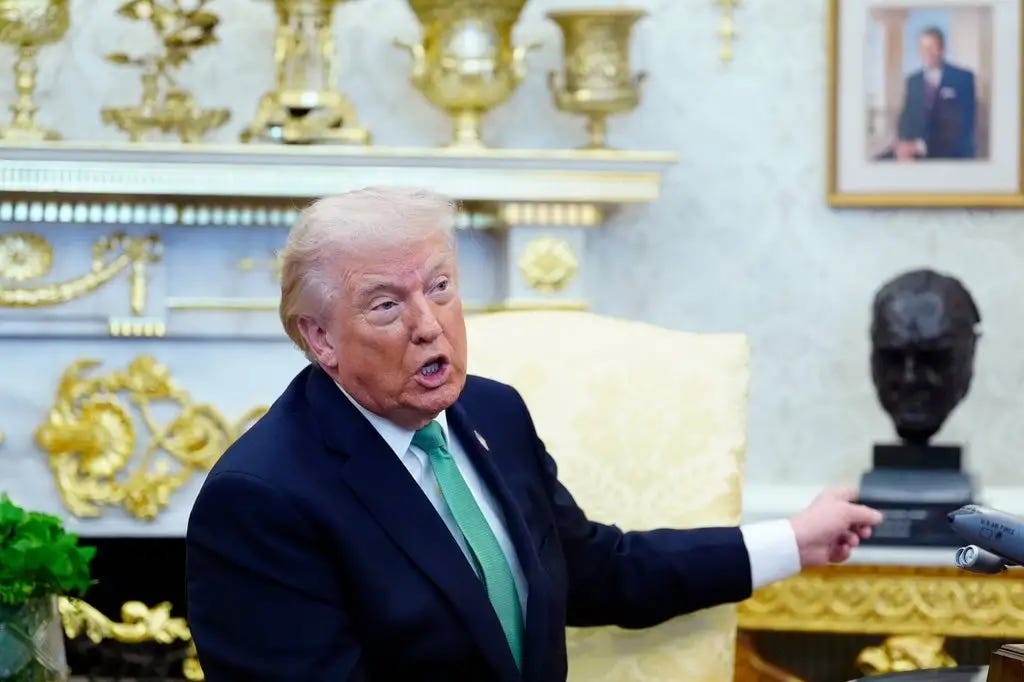
Trump thought the war would give him leverage
The basic idea was obvious. Hit Iran. Keep it short. Show force. Then go to China looking like the guy who took action while everyone else hesitated.
That was the fantasy.
Reality went in another direction. Iran did not fold. The fight moved beyond the initial strikes. The Strait of Hormuz stopped being a background detail and became one of the central facts of the crisis. Once that happened, this was no longer just a military story. It became an oil story, a shipping story, a diplomacy story, and a global pressure story.
Trump wanted something he could display. What he got was a chain reaction.
Let’s stop pretending this war was purely “America First”
This part matters, and too many people keep tiptoeing around it.
This war has Israel all over it. More specifically, it has Netanyahu all over it.
That does not mean Trump had no agency. It means the direction of pressure is obvious. Netanyahu has wanted confrontation with Iran for years. He has pushed that line again and again. And now the United States is carrying the cost of a conflict that fits Israel’s long-term priorities far more clearly than it fits the needs of ordinary Americans.
That is why this thing feels rotten. It feels like Washington, under this administration, is operating under the weight of foreign interests. Politically. Strategically. In the sense that American power keeps getting spent on agendas that do not look like they were built around the lives of American workers, American families, or American stability.
I do not think Trump originally wanted a long, messy war. I think he wanted the image of strength, spectacle, and an easy political win. But once Israeli pressure pulled him deeper, he went along with it. Maybe that is ideology, donor pressure or some flattery. Maybe Netanyahu simply knows exactly how to move him. Whatever the mechanism is, the result is sitting right in front of us.
America takes the risk. Israel gets the confrontation.
Washington lit the fire, then told everyone else to pay for water
Once Hormuz became a serious problem, Trump started calling on everybody else to help. China. NATO countries. Any country that uses the route. The message was simple enough: if you benefit from the shipping lane, you should help secure it.
That sounds reasonable until you remember who helped create the crisis.
Washington escalated. Iran responded. One of the most important oil chokepoints in the world became unstable. Then the United States turned around and started asking other countries to help clean up the mess.
About 20 percent of global oil shipments move through the Strait of Hormuz. Once that route is under real pressure, the whole world feels it. Prices move. Markets tighten. Governments start worrying. Trump did not produce a clean display of power. He produced a situation with global economic consequences, then acted like everyone else had a duty to help absorb the shock.
That is empire in decline. Make the mess, then call it shared responsibility.
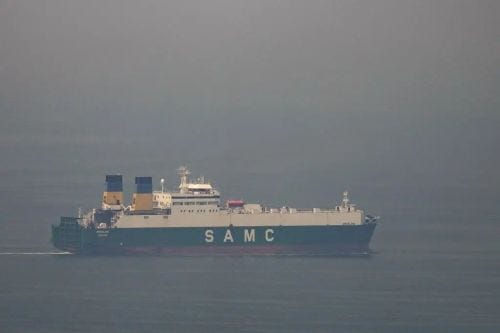
China looked at the mess and refused to step in
Beijing’s answer has been cold, polite, and disciplined.
It kept talking. It did not sign up.
That matters. China did not rush to endorse Washington’s framing. It did not volunteer for naval patrols. It did not act like Trump’s crisis had suddenly become its responsibility. It left the diplomatic door open and stopped there.
That is not weakness. That is a clear line.
China is saying: we are willing to talk, but we are not going to own your war. We are not going to subsidize your escalation. We are not going to enter a regional crisis on terms written in Washington after Washington helped set the whole thing off.
And honestly, why would it? Why should China walk into a conflict that grew out of Israeli pressure, American force, and an administration that thought it could stage-manage the region like a reality show?
Trump overpromised because he thought the war would break his way
Trump kept talking about the China trip as if it was already on track. Late March. Big meeting. Big optics. Big momentum.
China never matched that tone.
Beijing stayed vague on purpose. It did not rush to publicly lock in the date. It left itself room to wait. That now looks a lot smarter than Trump’s public swagger. Because once the trip got pushed back, it became obvious who had bet on the war producing a quick, useful outcome.
Trump talked like he had the script in hand.
He didn’t.
So this does not make China look like it was thrown off balance. It makes Trump look like the guy who sold confidence first and found out later that reality was not listening.
The war stopped being leverage and started becoming drag
This is the part that really hurts Trump.
The whole point of the war, politically, was to strengthen his hand. Use force, create fear, look decisive, then carry that atmosphere into every other negotiation. That is how this kind of power is supposed to work.
Instead, the war is now getting in his way. It is messing with diplomacy. It is dragging energy back into the center of the picture. It is exposing how little enthusiasm some U.S. partners have for cleaning up the aftermath. It is forcing Washington to negotiate while carrying the weight of a self-inflicted problem.
Once your display of strength starts reducing your room to move, it is no longer leverage.
It is drag.
That is what Trump has now. He wanted a stronger hand before China. Instead, he got a conflict that started eating into his own agenda.
This is what systemic decline actually looks like
A lot of people imagine decline as one dramatic moment. One collapse. One giant public humiliation.
Sometimes it is quieter than that.
Sometimes it looks like a country that can still bomb, still threaten, still posture, but cannot keep the consequences separated. The military side bleeds into shipping. Shipping chaos bleeds into oil. Oil bleeds into domestic politics. Politics bleeds into diplomacy and trade. Suddenly everything is connected, and nobody in Washington is really directing the flow anymore. They are just reacting to the next consequence.
That is where this gets bigger than one delayed trip.
The United States has allowed too many fronts to collapse into one pile. War, energy, diplomacy, trade, alliance management, all of it is now pressing on the same political space. That is not strategic mastery. That is what it looks like when a system cannot compartmentalize anymore.
And when a superpower loses the ability to separate problems, it starts losing the ability to shape outcomes.
Trade talks are still alive, but the atmosphere changed
That does not mean U.S.-China relations are collapsing. The Paris trade talks still happened. Both sides still called them constructive. They are still discussing tariffs, rare earths, agriculture, and trade mechanisms.
So no, this is not some total rupture.
But I also do not think we should pretend nothing changed. It changed.
The United States is still negotiating, but now it is negotiating while dealing with a war that has already started creating pressure across its own system. That weakens the atmosphere around it. It changes how the trip is perceived. It changes how American power looks. Even if the formal talks continue, the political backdrop is worse for Washington than it was a few weeks ago.
China is showing patience. Trump is showing disruption.
That difference matters.
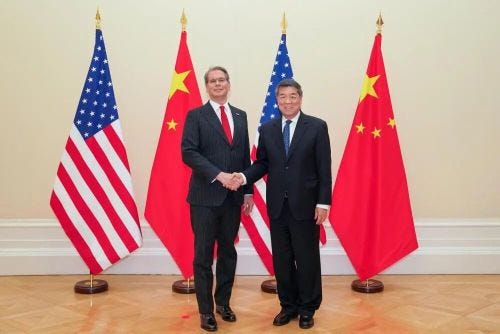
What this really shows
Trump thought this war would give him leverage before China. Instead, it turned into a bigger mess that is now running him. What was supposed to look like strength now looks like blowback.
Support my work
If you want more analysis like this, subscribe on Substack. And if you want to support my work directly, a paid subscription really helps keep this going. Thank you.


Trump is compromised by intelligence from both Israel & Russia! It’s been clearly established that Epstein worked with Mossad! Otherwise I’d be hired to teach Math at a prestigious private school!
I've read that Trump postponed the visit to China because the US Marines might be landing about the same time the China visit was scheduled. If that's the case, then it's a big deal and the President should be home at the time.