

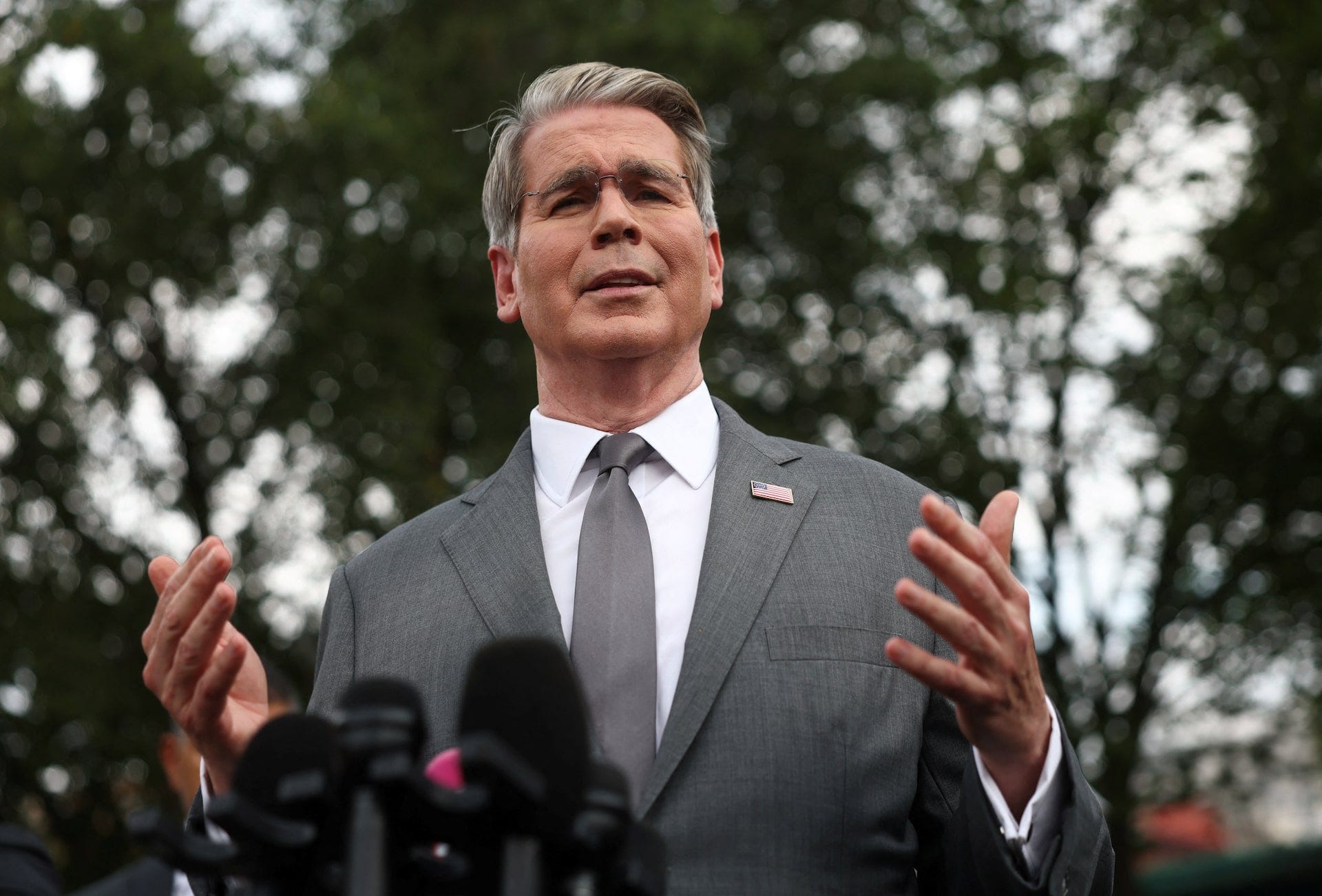
Scott Bessent went on CNBC Thursday and told the second largest economy on earth to fall in behind an American blockade. China gets half its energy from the Gulf, he said, so it would do them a big service to “get with the programme.” A day earlier Trump had promised an “economic D-Day” against Iran and warned every other government that continued business with Tehran would carry consequences.
The demand underneath the language is this. Washington is instructing a foreign government to enforce American statutes on its own territory, against its own companies, in service of American policy. Not a treaty. Not a Security Council resolution. One country’s domestic law, applied to everybody else’s soil.
It is being asked of the country Washington has spent a decade trying to wall off. Huawei went onto the Entity List in 2019, and when that did not finish the job the foreign direct product rule was rewritten so a chip fabricated in Taiwan or South Korea on American tooling could no longer be sold to it. Allies in London, Berlin and Canberra were pressed to strip Huawei equipment out of their 5G networks. SMIC was cut off from the machinery it needed for advanced chips. DJI was blacklisted. Hundreds of Chinese firms sit under export controls, and the stated goal was never disguised: preserve technological superiority, reduce dependence on China.
Notice that it is the same principle. The foreign direct product rule is an American statute telling a Korean company what it may sell to a Chinese one. Washington has been claiming jurisdiction over other people’s commerce for years, and it is now asking Beijing to accept that claim one more time, and to help enforce it against one of Beijing’s own suppliers.
For most of the past twenty years, that claim held.
American sanctions law only binds Americans. What gives it global force is dollar hegemony. Almost all cross border trade eventually passes through a dollar account, and dollar accounts sit in banks that need access to New York. Designate a company, and any bank anywhere that keeps serving it risks losing that access. Losing it is corporate death. Nobody is charged with anything. Nobody goes to court. One government decides, and the rest of the world complies because the alternative is being locked out of the currency it has to trade in.
That is American hegemony in practice. Not the carrier groups. Control of the money everybody else is required to use.
It worked inside China too. Chinese state oil majors quietly stopped buying Iranian crude. In January 2025 Shandong Port Group announced it would turn away US sanctioned vessels, and Beijing was left explaining that it had ordered no such thing. No treaty required any of it. The dollar did.
Then it stopped working. The China to Iran oil trade has spent years moving out of dollars. It settles largely in yuan, through small independent refiners in Shandong that hold almost no exposure to the American financial system, routed through middlemen who never touch New York. When Treasury designated Hengli Petrochemical and four other refiners in April, it was cutting off companies that had built themselves to barely touch the dollar in the first place.
Beijing then went further. On May 2 the commerce ministry issued its first blocking order in the five years those rules have existed. Inside China, complying with those American sanctions is now itself illegal.
So Washington stopped relying on the payment system and sent the Navy. The Strait of Hormuz has been effectively closed since late February and under formal US blockade since April 13. When the financial weapon cannot reach, enforcement turns physical, and physical enforcement costs ships, money, and eventually people.
The dollar is not collapsing. It still holds roughly 57% of global reserves, down from above 70% at the start of the century, and it sits on one side of nearly 89% of all currency trades. Nothing replaces that soon. What changed is narrower and worse for Washington. Obedience became optional for an economy large enough to take the punishment.
Hegemony of this kind runs on one calculation. Obeying an American sanction has to cost less than refusing it. That math only holds while whoever refuses stands alone. Iran alone can be cut off. Iran and China together is a different problem. Iran, China, and every government watching this and taking notes is the end of the arrangement. American dominance has never required obedience from everyone. It requires that a bloc big enough to survive the punishment never forms.
Hegemony was never built for the man filling a tank in Ohio. It lets the Treasury borrow at rates no other government on earth can get, and routes global finance through American banks that take a fee on the way past. What working people in the US get from it is the enforcement bill: the deployments, the blockade, the price shocks, and now a standoff with their largest trading partner that nobody put on a ballot. In Iran the same weapon lands on shopkeepers and pensioners, not on the men who set policy. Sanctions get sold as the alternative to war. This round produced a naval blockade in five months.
That machine was built out across Obama, Trump, Biden and Trump again. The secondary sanctions bill moving through the Senate right now carries both parties.
Xi is expected in Washington in September. The question before then is whether Treasury designates a major Chinese bank for keeping those refineries funded. That would stop being about Iranian oil and become the two largest economies on earth attacking each other through the financial system. If Washington holds off, the demonstration is finished, and every capital watching writes down what it saw.
The number that matters is not the dollar’s share of reserves. It is how many governments now treat compliance with American hegemony as a choice rather than a fact.


„Washington is instructing a foreign government“
„dollar accounts sit in banks that need access to New York“
„So Washington stopped relying on the payment system and sent the Navy.“
The US-defined world order appears to be accurately described here—more so than in the many partisan articles found in respected newspapers. Then comes a challenging sentence:
“American hegemony … requires that a bloc never form that is large enough to withstand the punishment.”
When it is suggested that such a bloc could be formed, the architects (the creators) of the bloc are perceived as independent agents pursuing only their own interests—a notion that is merely wishful thinking. The aforementioned punishment is not recognized as the obstacle to bloc formation that it actually is.
In reality, there are a number of countervailing conditions that require further clarification. Consider the following points:
Chinese Foreign Minister Wang Yi emphasized the importance of embracing a win-win approach for the future of humanity …
https://english.news.cn/20240220/f6e1aca53d914785920ce23c211a0275/c.html
Beijing can’t easily afford to escalate any economic struggle with Washington.
https://foreignpolicy.com/2026/05/13/china-economy-us-trade-negotiations-trump-visit/
China Is Sabotaging the World That Enables Its Rise
Enrico Fardella and Sergey Radchenko – Foreign Policy July 15, 2026
https://www.foreignaffairs.com/china/china-sabotaging-world-enables-its-rise
The previously mentioned wish can also be expressed this way:
“It is how many governments now treat compliance with American hegemony as a choice rather than a fact.”
Perhaps some governments try that choice, perhaps it will not exist anymore; after all, are Western states not doing a great deal to ensure that such a choice will not be available?
My "Denial File" just exploded.