

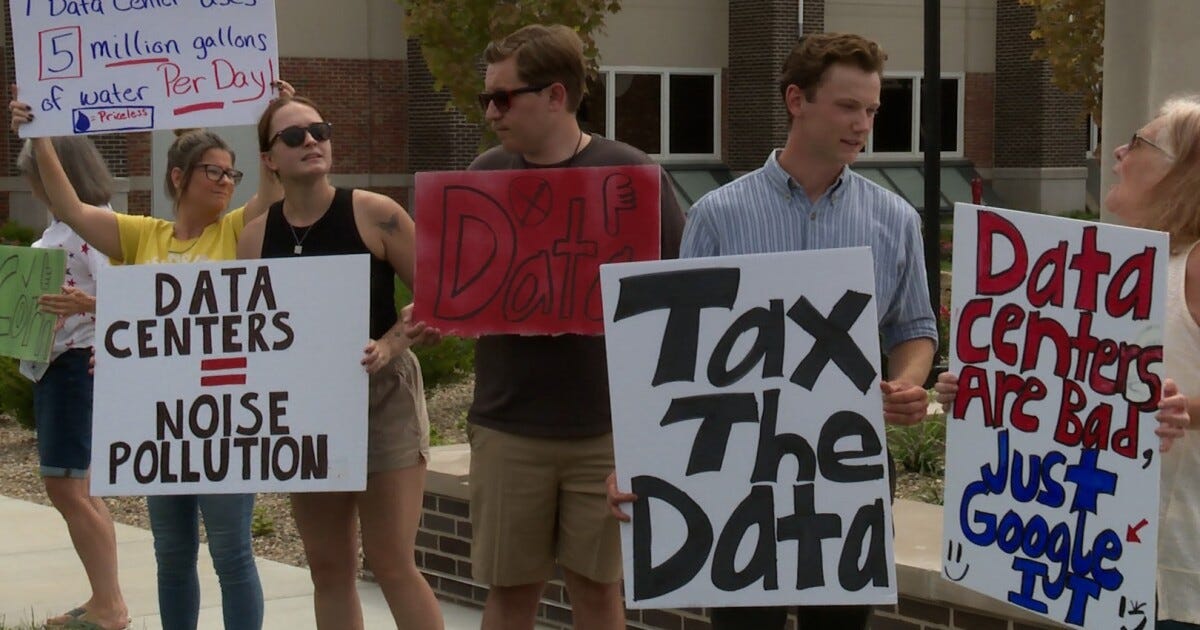
In July, protests against data centers hit 42 states. Look at who showed up. MAGA voters. Former Tea Party organizers. Environmentalists. Union workers. Suburban homeowners worried about their wells and their bills. These people fight about everything, every day, online and off.
Not this.
What put them in the same county meeting rooms? Not Trump. Not immigration. Not the culture war. The electric bill. The water. A company from Silicon Valley moving into their county without asking anyone who lives there.
A utility bill does not care how you voted.
This is not just anti-AI. This is anti forced subsidy.
The tech industry wants you to believe these protesters fear technology. Listen to what they actually ask. Who pays for the grid upgrades? How much tax did this company get waived? How much water will it draw? How many permanent jobs stay in town?
Here is one answer. JPMorgan Chase got nearly 77 million dollars in tax breaks for a data center in New York. Permanent jobs promised: one. At the public hearing, nobody showed up. Officials sat through 20 minutes of silence, closed the meeting, and approved the deal two weeks later.
Not a fluke. An Ohio expansion worth 136 million dollars is projected to create 10 full-time jobs, and even Republican Senator Bernie Moreno demanded the company hand its subsidy back. Nationally, these deals cost the public over 2 million dollars per permanent job.
For decades, the deal was simple: tax breaks buy jobs. Data centers killed that deal.
The China shield
Ask about the cost and watch what happens. They reach for China.
Kevin O’Leary is backing a data center project in Utah reported at 100 billion dollars, spread across 40,000 acres. When locals raised water and power concerns, he went on TV and said states slowing data centers down are handing the AI race to China. Opposition became obstruction of national defense.
Here is the part that gives it away. O’Leary himself admits that when a normal data center taps the grid, “the electrical costs for their church and the community and the residents all go up.” His words. That is why people push back, he says.
So he knows the cost is real. He just wants you to swallow it for the race.
From Musk’s xAI to the compute plans worth hundreds of billions sold as American AI leadership, the script repeats: wrap the private interest in the flag. A man with a fortune riding on server farms tells you the real threat to America is your question about your water bill. This was never about China. China is the word they deploy so that asking who pays sounds unpatriotic.
Your utility company is the second winner
You probably think the power company is stuck in the middle, forced to raise your rates. It is not.
American utilities are regulated monopolies, and the law guarantees them a rate of return on infrastructure they build. Every power plant and transmission line built for Big Tech is guaranteed profit. The more they build, the more their shareholders make. Serving data centers is not a burden on your utility. It is the best business opportunity it has seen in decades.
Harvard researchers went through nearly 50 regulatory proceedings and found utilities cutting discounted deals with data center companies through special contracts, reviewed in processes so opaque the public cannot follow them, then spreading the costs across ordinary ratepayers who legally cannot switch providers. Their conclusion: subsidies for trillion-dollar companies are being hidden inside your power price, a wealth transfer to the shareholders of Big Tech and utilities alike.
The servers are theirs. The profit is theirs. The bill is yours, and both sets of shareholders collect on it.
That is the mechanism no cable segment will walk you through.
Most of what I write here is free, and I appreciate you reading it. If you want to support this project and help it go further, please consider becoming a paid subscriber. Thank you. It means a lot.
You may comment. You may not say no.
Someone will point to the public hearings. Yes, you can speak. The question is whether you can decide.
When residents say yes, developers call it community support. When residents say no, developers reapply, lobby the state, rezone, rename the project, or sue. A Michigan township rejected rezoning for a 16 billion dollar project tied to Oracle and OpenAI. The developer sued. A settlement followed. Construction proceeded.
Communities are allowed to comment. They are not always allowed to decide. Local democracy is respected when the answer is yes. When the answer is no, the lawyers arrive.
They share an enemy. Not a future.
Do not romanticize this coalition. The right wants local control and an end to backroom deals. The left wants clean energy, union jobs, and corporate accountability. They oppose the same projects for different reasons, and they will split when the fight turns to solutions.
But this moment already proved something. When politics runs on cultural identity, ordinary people treat each other as the enemy. When it runs on water, power, land, and bills, they start seeing a common interest.
For years, AI was an abstraction: chips, compute, national rankings. Now it is concrete. It shows up in the electric bill, the water dispute, the industrial park going up next door. Tech companies promised investors a productivity revolution. Residents received an infrastructure invoice first.
The question of the AI age is not whether America builds more computing power. It will. The question is whether that infrastructure gets governed as a public system, or whether the public simply gets ordered to pay for someone else’s private empire.
The servers are private. The bill is public. That is what people are revolting against.


