

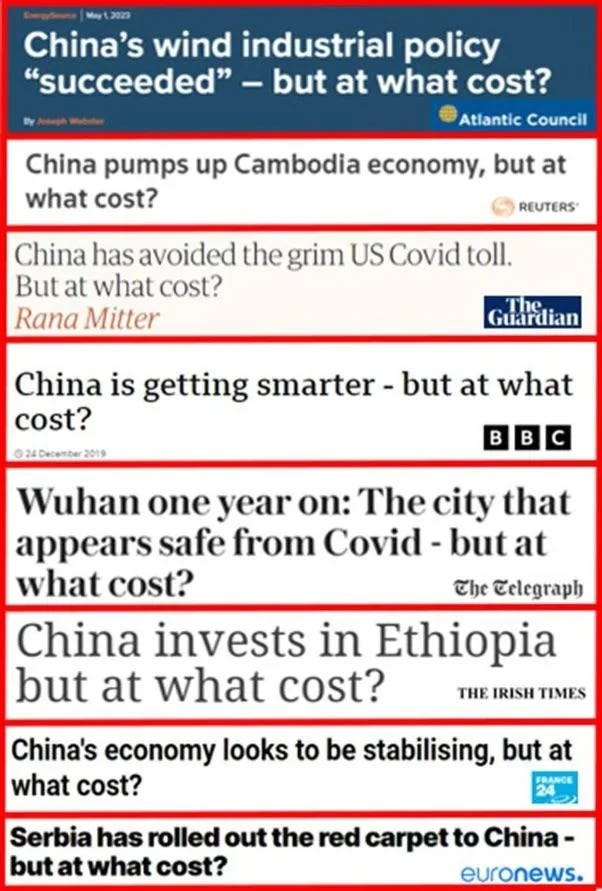
These days, whenever China pulls something off, the first reflex in Western media is not to ask what China got right. It’s just, at what cost? Who got sacrificed? Who paid for China’s rise?
Sounds like they’re trying to show some concern. It’s always a trap. The question assumes that when a country gets stronger, somebody underneath, someone on their knees, had to get crushed.
So let me throw the question back. When the United States built the interstate highways, industrialized everything, and put its military on every continent, was anyone asking, day after day, who paid for America?
It’s not that complicated. A person can only explain the unfamiliar by using the world he already knows.
Why does the West automatically go looking for a hidden victim every time somebody else rises? Because that is exactly how Western society got here. Enclosure, driving peasants off their land. The slave trade, swapping human lives for profit. Colonialism, centuries of colonialism. Western wealth was built by standing on other people.
So in the Western mindset, you don’t get rich this fast without sacrificing someone. Every accusation is a confession. When you accuse someone else of something, it’s usually the thing you have done yourself, the thing you know, the thing you believe in your gut has to be true. When the West accuses China of making someone pay, it’s really a reflection of its own history.
Of course, I’m not saying China had no cost. There is a cost. No country modernizes without one. Since 1949, China went from a farming society to an industrial one. Hundreds of millions of migrant workers left their villages for the cities. Families split apart for years. We all talk about the hukou system sorting city residents into two tiers. There was serious air and water pollution. To this day, local governments still have debt problems. All of this is the cost. Nothing to hide about it.
But you have to look at what came next. Once the pollution showed up and got really serious, the state pooled money and resources into renewables, solar, EVs, cleanup. The strain on migrant workers got fixed, slowly, through social security, poverty programs, infrastructure. The cost did not disappear. But most of it got carried and managed by the state, instead of dumped on one person to shoulder alone.
Now look at the United States. The US has been upgrading too, progressing too, these past decades. Globalization, financialization, offshoring the factories. In the end it made a lot of money. But who pocketed it? And who was paying all the bills?
All the gains over the years settled at the very top. A small handful of people, a small handful of capital and donors. And the cost got handed down, bill by bill, to regular working people.
Look at the small things. By the Federal Reserve’s own survey, more than a third of Americans can’t cover a surprise 400-dollar expense. A car crash, a breakdown, a kid who needs an ER visit, and you’re broke. America is not poor. It’s the richest country on earth.
Almost half of American renters spend more than 30% of their income on housing and utilities. More than 12 million of them hand over half their paycheck just to keep a roof over their heads. Then there’s student loans, and medical debt. Medical debt is one of the biggest reasons people go bankrupt in the States. Manufacturing got offshored. Whole stretches of the Rust Belt hollowed out. The jobs are gone, but people still live there, where the jobs used to be.
That is what “who pays” looks like when you actually point at the right target. It’s not country versus country, China versus America. It’s the people at the top deciding how the bill gets passed down.
What scares the Western elite is that China’s existence proves one thing: how you split the cost is a choice. And that choice is made by the people who hold the power. For decades, American elites have told their own people that there’s nothing we can do. It is what it is. That’s just the market. The cost is going to land on you, and you have to learn to live with it.
They keep telling you capitalism is the perfect system for society, and there is no alternative. They want the workers to keep their heads down. But the moment another way of splitting the bill exists anywhere else in the world, that “no alternative” is exposed as a lie. The reason Western elites keep throwing propaganda at China is the thing they’re really fighting for: the power to define what counts as a good society. Whoever gets to define the correct direction gets to tell you to be quiet and accept your place.
To be fair, where did the cost of America’s rise go? The 400-dollar emergency. The half a paycheck for rent. The medical debt. That is the cost of American development. The system just dumps that cost onto its own working class.
Every country’s development has a cost. But the real question is who carried the cost, and who walked off with the gains. Did the wealth from that development get redistributed back to ordinary people? Did the country actually do anything for its own people while it got bigger? I think that is the only way to test, or to judge, whether a country is any good.
It’s never about country versus country. It’s always about the working people, ordinary people on one side, and the ruling class, a small handful at the top, on the other side. And the government is the instrument of the ruling class. That class struggle has never once stopped. Whether you talk about democracy versus authoritarianism, or freedom versus tyranny, those are just labels. The real fight is always the people versus the ruling class.


The Impact of Stopping the Search: If an out-of-work person stops actively looking for a job—whether due to exhausting benefits or other reasons—they exit the active labor force and are no longer counted in the standard unemployment rate. What is the REAL unemployment number in the United States? No one knows, and the government doesn't care.
One of the best articles. 🎯🎯🎯