


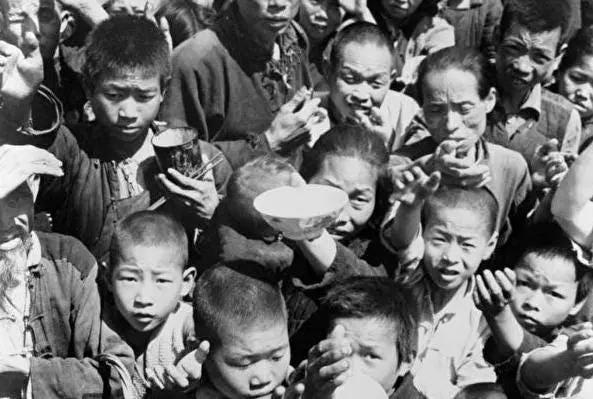
Ask most people in the West what happened in China between 1959 and 1961 and you get the entire history in one breath.
Mao brought in communism, took the farmers’ food, killed 70 million people.
Done. History solved. Now you never have to think about it again, which is the point.
Really appreciate you reading this, and if you want more breakdowns like this one, a free subscribe goes a long way. And if you can support the work a little further than that, honestly it is a real boost of confidence, and it is what keeps this project moving. Either way, thank you for being here.
The number does not survive contact
The 70 million figure comes from Jung Chang and Jon Halliday’s 2005 biography of Mao. It covers his entire time in power, not the famine. Their own famine figure is 38 million.
When a seminar at UC San Diego tried to reconstruct how 70 million had been calculated, they found no method in the book at all. Guesses, double counting, circular reasoning. Andrew Nathan at Columbia called the authors magpies, putting every shiny piece into the nest regardless of where it came from.
Some estimates run from 15 million to 55 million depending on the years counted and how an excess death is defined, with newer work clustering between 30 and 46 million. And from Chinese report, it was around 10 millions death related to the famine. It is also not the same claim as one man deliberately killing 70 million people, and only one of those two claims is supported.
China criticized this officially, in writing
Another piece of the Western story says Mao is untouchable inside China. That is false.
In 1981 the Communist Party adopted its official resolution on Party history. The economy fell into severe difficulty between 1959 and 1961, it says, mainly due to the errors of the Great Leap Forward and the struggle against Right opportunism, together with natural calamities and the Soviet government’s scrapping of contracts.
Errors first. Weather second.
The same document calls the campaign against Peng Dehuai entirely wrong and says it cut short the correction of left errors. Deng Xiaoping’s remarks on the drafts state that Mao bore the chief responsibility.
The Party’s own verdict is more detailed than the slogan built on top of it. That tells you what the slogan is for.
What the country had to work with
The People’s Republic was founded in 1949 on a ruin. Decades of invasion and civil war. Wrecked rail and irrigation. Hyperinflation that had destroyed both the currency and the tax base.
And as the Nationalists retreated to Taiwan, they took the one asset that could actually be spent abroad. Somewhere between 3 million and 5 million taels of central bank gold crossed the strait, along with silver and foreign currency reserves. Factories cannot be loaded onto a ship. Farmland cannot. Gold can.
That distinction decided what China could do in an emergency. Land, labour and coal do not buy Canadian wheat. Hard currency and foreign credit buy Canadian wheat.
China had almost none. Beijing’s published figures show foreign exchange reserves of 157 million dollars at the end of 1950, and 46 million dollars at the end of 1960, at the very worst of it.
And it was locked out of the market anyway
Washington revoked the general export licence for China in December 1950 and ran a total trade embargo. Not a targeted sanctions list. A total embargo, with pressure on allies, shipping restrictions and controls on financial transactions.
Britain and Western Europe dropped the harsher China-specific controls in 1957. The United States kept its own running into the 1970s.
The embargo did not create the shortage. It decided what a shortage would cost. A country with reserves and open credit lines meets a failed harvest by buying its way through it. China was denied that option by design, and Washington understood that was the point.
The Soviet rupture
Khrushchev denounced Stalin in 1956 and opened an ideological gap that never closed. Mao rejected the idea that China should copy the Soviet industrial model and began arguing for a Chinese road, driven by mass mobilization, that would move faster than Moscow said was possible.
The Great Leap launched in 1958 with that argument inside it. Political competition helped set the targets, and the targets were fantasy.
In 1960 Moscow pulled its experts and tore up contracts. The Politburo responded by accelerating repayment of Soviet loans, compressing the schedule from 16 years down to five, and setting up a trade group to hold down imports and gather goods for export.
Read that again with a famine already underway.
What the weather explains, and what it does not
There were genuine droughts and floods. The 1981 resolution lists them, and it is not inventing them.
Yang Jisheng went through the meteorological records directly and put the maximum contribution of natural disasters at roughly a third of the shortfall in grain production. A third is severe. In a farming economy with no reserves and no way to import, a third can kill people on its own.
It also leaves two thirds.
Where the shortage became mass death
Economists Xin Meng, Nancy Qian and Pierre Yared found that in 1959, the year the famine began, Chinese food production was still nearly three times what the population needed to survive. And rural areas producing more food per person died at higher rates, a reversal that appears in no other period.
The grain existed. It was taken.
Procurement quotas were set against inflated harvest reports and could not adjust downward when the real harvest came in short, so the most productive villages were stripped hardest. Meng, Qian and Yared attribute 32% to 43% of famine mortality to the procurement system by itself. Meanwhile the grain kept leaving the country: 1.92 million tons exported in 1957, 4.1 million tons in 1959, an all-time high, in the middle of the collapse.
Local cadres inflated their harvests because the system paid them to. When Peng Dehuai raised the alarm at Lushan in 1959, he was destroyed for it, and every official watching learned that reporting hunger was a political act.
The official Party history published in 2011 still carries the consequence: nine counties in Henan’s Xinyang region recorded death rates above 10% in 1960. Henan’s own first secretary submitted a self-criticism to Mao in January 1961 reporting more than 2 million dead in his province, over a million in Xinyang alone.
Beijing was not doing nothing. Beijing was blind, and had blinded itself
Economists Ziying Fan, Wei Xiong and Li-An Zhou traced the mechanism. Local officials competed to inflate grain yields to match what Mao wanted to hear, and the central government, reading its own falsified numbers, did not organize systematic famine relief until roughly two years after the famine began. During those two years the center was still moving grain out of the worst-hit provinces, while local cadres inside those same provinces quietly handed local stock back to the peasants.
When the center finally saw it, the policy turned hard. Urban populations were sent back to the countryside from September 1960. Central inspectors went into Xinyang county by county. In 1961 China reversed course and became a net grain importer, taking in 4.4 million tons, paid out of reserves it could barely spare.
And the dying stopped.
Weather and the embargo are both in this story, and both made it worse. Drought and flood cut production. The embargo removed the exits. But neither one explains the timing. The American embargo was still fully in force in 1961. The weather had not transformed. What changed was policy, and when the policy changed the dying stopped.
A system that could be switched off two years late could have been switched off two years earlier. What stood between those two dates was not the harvest and not Washington. It was a machine that had made truth-telling a career-ending act, and then believed the lies it had paid for.
What the West was doing while this happened
Nothing. And not because anything was being hidden from it. Because nobody’s decisions depended on knowing.
In February 1961 Agriculture Minister Alvin Hamilton told the House of Commons that the Canadian Wheat Board had sold 40 million bushels of wheat and barley to China, roughly 60 million dollars, soon expanding into credit sales and a far larger deal. John Diefenbaker was a committed anti-communist and approved it over American objections, because the prairies had surplus grain and China had turned into a buyer.
Files released by Library and Archives Canada show what the men approving it believed. A confidential foreign ministry assessment on Chinese food shortages found no evidence that the country as a whole was starving, and described China as “practically immune from the dangers of drought and flood.” A Canadian grain delegation toured five cities in 1961, ate bread in all of them, and reported that people looked adequately clothed and fed. In Washington, an April 1961 intelligence estimate told the President that widespread famine did not appear to be at hand.
That is not a cover-up. A cover-up would at least require somebody to have looked. Washington kept a total embargo running through the entire catastrophe, and as late as May 1962 its stated position was that it would be prepared to reconsider if Beijing came and asked.
Not one Western government moved because Chinese farmers were dying.
Twenty years later those same farmers became the West’s leading exhibit that communism kills. Nobody counted them while they were starving. They became countable the moment they were useful. That is the cheapest moral capital there is, and it is still being spent.
What the slogan is for
Put the whole thing back together and you get a wrecked treasury, no hard currency, a total American embargo, a collapsing alliance and an accelerated debt, real droughts, fantasy targets, falsified harvests, rigid extraction, a general destroyed for telling the truth, and a government that could not see through its own reporting system for two years.
Then watch it compress into three characters. A dictator, victims, and an ideology described by western media.
That is not education. It is crowd management. The audience never has to learn what a procurement quota is. It only has to remember a name, an ism and a number.
And the technique does not stay in China. A public trained to receive foreign suffering as one villain and one number will accept that sanctions are bloodless, that poverty is a character flaw, that any country standing in the way is a hostage-taker. The same reflex works at home. Institutions that can flatten a famine will flatten a wage collapse, a premium hike or a police shooting the same way. One bad actor, one headline, no mechanism, nothing left to examine.
Ordinary people pay for that habit every time. In 1959 the men who set the quotas did not go hungry. The men who filed the false harvest reports did not go hungry. The farmers who grew a surplus and handed it over did.
Whoever holds the rules, somebody else pays the bill.


for me, the memory of this famine is from my elders' stories. My uncle told me, that they used to catch farm rats to eat, they joke about the farm rats were way more clean then city rats. and there were story about a dad killed and eat his son, he was sentenced to death, before his death, he said, he just want to feel what meat tasted like one more last time.
there were many stories like this, maybe thats why food is so cheap and affordable in china these day, no more people go hungry.
No one seems that interested in counting up the numbers of people capitalism has killed, starting with the Industrial Revolution in Europe, and expanding outward to include colonial genocide. Those were not socialist projects.