

I was still writing about Houston when Maine happened.
That is the part I cannot get past. The Houston shooting was seven days old and I had the notes open. Before I finished, an ICE agent in Biddeford, Maine put four bullets through a windshield at seven in the morning and killed a 25-year-old delivery driver who was not the man they were looking for.

Most of what I publish here is free, and it stays that way. If you want more of these breakdowns, hit subscribe. And if you can go a step further and become a paid subscriber, it genuinely keeps this project running. Whatever you choose to do, thank you. I appreciate it more than you know.
On July 7, an ICE officer shot and killed Lorenzo Salgado Araujo at a traffic stop in Houston. He was 52 and had been in this country more than 35 years. ICE said he weaponized his van. The men riding with him say that is false. He was not the target.
On Monday, an ICE agent shot and killed Johan Sebastián Durán Guerrero in Biddeford. He was 25, raised in Bucaramanga, Colombia, working two jobs, father to a three-year-old. DHS says he entered in September 2023 and was granted a work permit in May 2025, and made a point of adding that a work permit is not legal status. He was not the target either. A neighbor with a clear view of the intersection says he heard Johan Sebastián say, I tried to stop.
Then watch the story move. Homeland Security Secretary Markwayne Mullin told Senator Angus King that Johan Sebastián had weaponized his vehicle. King repeated it to reporters because it came from the secretary. Hours later, Mullin told King the man was not the target after all. That evening, roughly 12 hours in, DHS put something in writing and the word weaponized was gone. Now the car had attempted to flee and an officer fired fearing for public safety.
Those are two different claims, not two versions of one. A car aimed at an officer is a threat. A car driving away is a car driving away, and ICE’s own policy tells agents not to fire at vehicles. Representative Chellie Pingree says DHS acknowledged the man was driving away and the officer was not endangered. There is no footage, so the story that changed twice in 12 hours is also the only record there is.
So ask the real question. Why did he not hesitate.
Hesitation is not a character trait. It is what a consequence feels like from the inside. An officer slows down because somebody will pull the footage, because a prosecutor will read the report, because someone will make him explain why he fired at a car that was driving away. Take all three away and you do not get a worse man. You get a man doing different math.
Monday morning had none of the three. No body camera, so no footage to pull. King says he was told cameras might show up in 45 days. Maine’s attorney general is investigating, but from the outside. If a Biddeford cop had fired those shots, the case would be Maine’s. This one belongs to the FBI and to the DHS inspector general, which is DHS looking into DHS, and King said why in plain terms. Because it was a federal operation.
Then add the pressure. DHS leadership and Stephen Miller called for 2,000 arrests a day. Last month, weekend arrests averaged around 600. This Saturday it was more than 1,300, and Sunday more than 1,100. That target tells every officer what gets counted. Nothing in the building tells him what it costs to be wrong.
So it does not much matter who that agent is. Put the most careful man in the country in that uniform on Monday morning and nothing in that building would have slowed him down either. A police force that answers to the public builds the brake in on purpose. A force that answers to the power that sent it out has no reason to, and ICE did not. Killing a man in the street with no real consequence is not a modern government having a bad week. It is what enforcement looked like before anyone had to answer for it.
Which brings me to Susan Collins.

Collins chairs the Senate Appropriations Committee, which holds jurisdiction over every dollar of discretionary spending in the federal government. She calls it the most powerful committee in the Senate. That is her line, delivered in front of a new fire station last month, and it is the whole argument for sending her back.
In June she voted 70 billion dollars to ICE. Asked why, her office pointed at what was inside: 20 million for body cameras, 2 million for de-escalation training, 20 million for detention oversight. Five weeks later a man was killed 20 miles from her district office by an agent who did not have one. She says a shutdown slowed the paperwork.
Either she is the most powerful appropriator in Washington, or she could not get a camera onto an ICE agent in her own state. She put a fire station in Sweden, Maine. The 70 billion arrived on time. They are still waiting for the cameras.
On Monday a man died. That night she called Mullin to ask him to stop non urgent vehicle stops. By Tuesday she announced she was encouraged that he agreed. Protesters were outside her Biddeford office by the afternoon chanting vote her out. Nirav Shah, one of the Democrats running for her seat, said the only thing there was to say: “a single late-night phone call isn’t going to cut it.”
You vote the money through. You name the guardrail. The guardrail does not show up. A man dies. You put out a statement saying you are encouraged. The 42 million was never a guardrail. It was what made 70 billion votable. One of those numbers was real the day it was signed. The other one was a schedule.
A 25-year-old man left his apartment at 7 in the morning to go to work. He had a work permit the federal government issued him. He was not the man they were looking for. A minute later he was being pulled out of the car onto the pavement, his face covered in blood. Footage shared online shows agents pulling his arms behind his back to cuff a man who was no longer moving. Neighbors described his wife and daughter crying in the street. One watched a little girl in pajamas, beside herself, held back from the tape. The man with the clearest view of it said, nobody should have to see what I saw. By that night the intersection was open again. The only thing left was blood on the crosswalk, and somebody had written THIS IS BLOOD next to it in chalk.
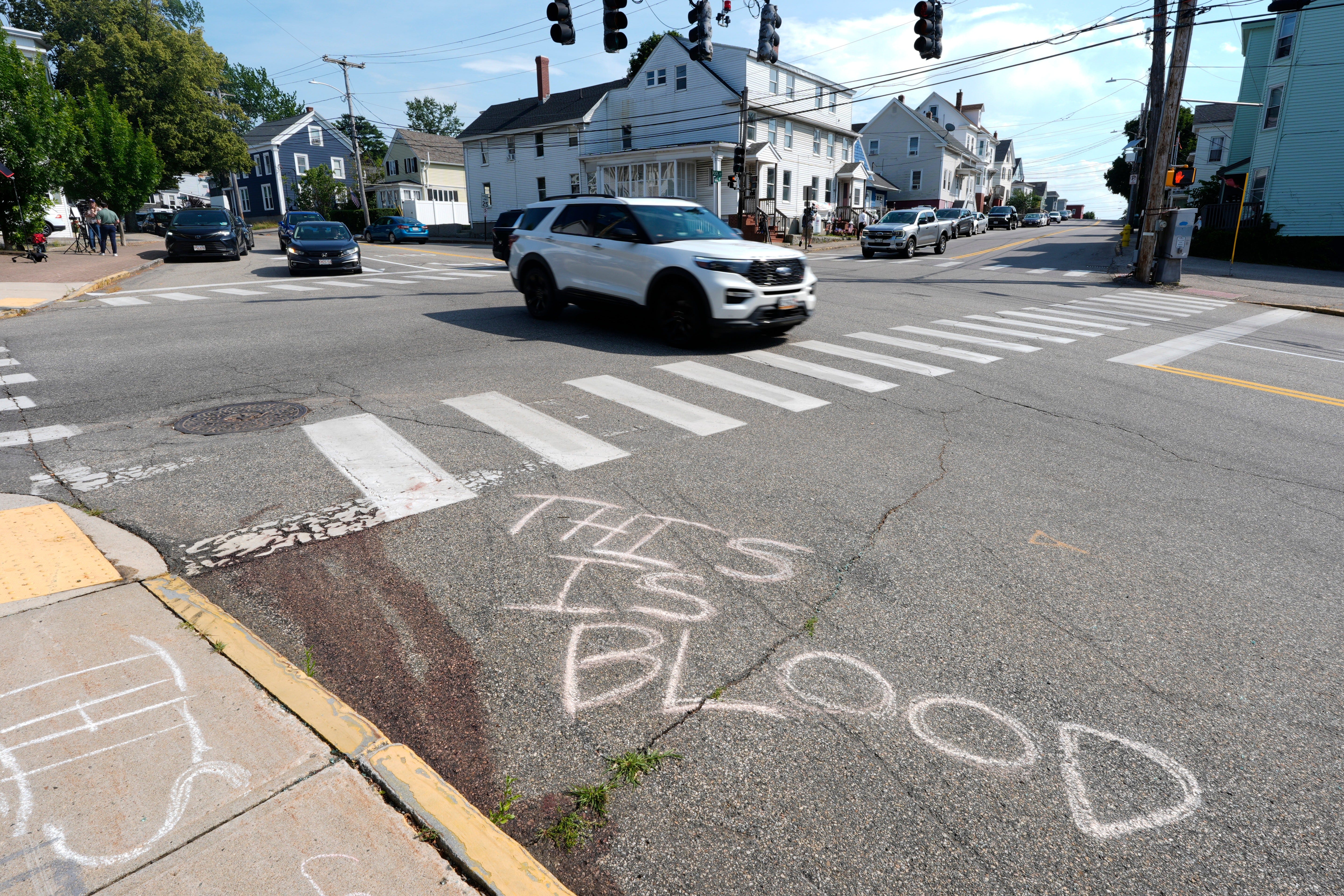
Whatever the inspector general concludes six months from now, here is what happened on Pool Street on Monday. A government killed a working man on his way to a shift, in front of his neighbors, and then took 12 hours to decide what to say about it. That is the fact. Everything else is procedure.
Mullin paused vehicle stops on Tuesday, which is an admission that Monday’s tactic was already unsafe on Sunday. But the pause covers vehicle stops. It does not cover home arrests, worksite arrests, or foot pursuits. The 2,000 a day target has not moved. The pressure did not go anywhere.
Defund ICE.


