

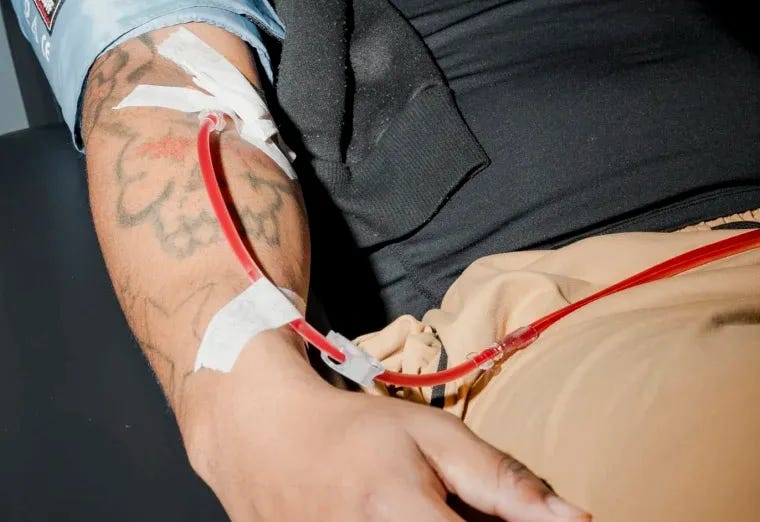
Sky Tucker is 25, a community college student in St. Louis, and for seven years she sold her plasma twice a week. Asked what went through her head during those sessions, she did not talk about saving lives. She talked about whether she was going to get her next meal, and whether she could feed her cats.
That plasma went into an industrial fractionation line and came out as human albumin. Some of it reached a hospital in Henan province, in central China, where a store worker named Ge Lan paid about 46 dollars a bottle to keep her mother alive after stomach cancer surgery. Her mother used 72 bottles in two months. That came to seven months of Ge’s income.
Two working people on opposite ends of the same supply chain. Neither of them is the one making money. The people making money are four multinational corporations and the shareholders behind them.
CNN ran that story on August 23 and framed it as a Chinese vulnerability. More than 60% of China’s albumin market is supplied by foreign manufacturers, and every drop of it is made from plasma drawn in the United States. All true. Also the least interesting fact in the piece.
Here is the question the framing walks straight past. Why does one country control 70% of the world’s plasma supply?
Not because Americans are unusually generous. Because American capitalism went looking for a commodity, found one inside the bodies of poor people, and built an industry on it. The raw material is poverty. There were 601 collection centers in 2016. There are more than 1,200 now, roughly the number of Denny’s locations in the country and nearly double the number of Costcos. Collection climbed from over 35 million liters in 2015 to about 62.5 million liters last year. The global industry is worth 43 billion dollars. In 2023, blood products were America’s ninth largest goods export at 37 billion dollars, ahead of coal and gold. American donors can sell twice a week, 104 times a year. Chinese donors are capped at once every two weeks, 24 times a year.
And the centers do not land randomly. John Dooley and Emily Gallagher found that even after controlling for local poverty and unemployment rates, the strongest predictor of where a new plasma center opens is how many payday lenders and pawn shops are already operating there.
Read that again. Capital treats the density of predatory lending as a market signal. Somebody sat down, built a model of where Americans are desperate enough to sell pieces of their own body, and opened storefronts on those blocks. That is not a scandal inside the system. That is the system working exactly as designed. The people who walk in skew under 35, unemployed, without a college degree, Black and male.
For about 150 years, socialists have said that capitalism sucks the blood of the working class. It was supposed to be an accusation about wages and hours, about what gets drained out of a person over a lifetime of labor.
It is not a metaphor anymore.
A needle goes into the arm of a poor American twice a week. The fluid comes out. Four corporations refine it, price it, and ship it to three continents. The worker gets 50 dollars and a scar. Capitalism has always taken the surplus off your labor. That was the arrangement, and it was already a bad one. This goes past that. It takes the surplus, and then it comes back for what is inside the body that did the work.
Then it sells the medicine back. Immunoglobulin made from American plasma is billed in American hospitals at roughly 100 to 350 dollars per gram. Sell the raw material for 50 dollars, buy the product back by the gram. Working people get exploited going in and coming out, and both ends of that circuit are somebody’s margin.
Now the part that should end every conversation about Western values.
The World Health Organization argues for unpaid plasma collection on ethical grounds, partly to shield poor communities from coercion. Most of Europe agrees. European governments restrict or ban payment because they have decided that the human body is not a commodity.
Then they import from America.
Four companies run most of the American collection system: Grifols of Spain, CSL of Australia, Takeda’s BioLife of Japan, Octapharma of Switzerland. Every one of them is headquartered in a country that restricts at home precisely what it does in the United States. The Economist reported that the French government, which has taken a public stand against a commercial European blood industry, is the sole shareholder of a company that owns six paid plasma centers on American soil, collecting fluid for use in France.
That is liberalism with the receipts attached. The principle stays home. The exploitation gets outsourced to somebody in St. Louis who needs 50 dollars this week. European capital did not reject the commodification of the human body. It just decided the bodies should be American.
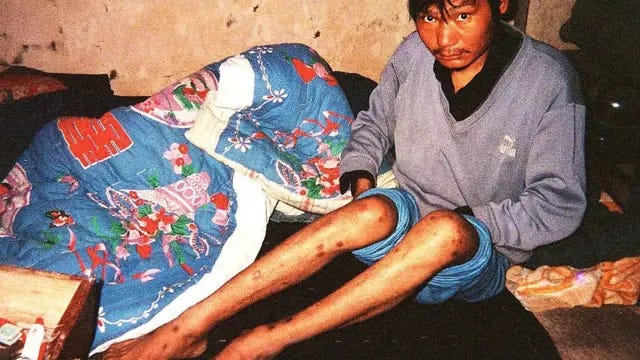
China’s shortage is real, and it has a specific origin. In the 1990s the government of Henan province built an economic strategy on plasma and pushed hundreds of thousands of poor farmers to sell. Needles were reused. The province reported its first HIV case in 1995. By 2004, Henan officials admitted that 25,000 former plasma sellers had been infected, and Gao Yaojie, the doctor who exposed it, spent the rest of her life insisting the real number was far higher.
What followed was a clampdown. Not an end to payment, China still pays plasma donors, but a cap of 24 donations a year and collection locked to designated areas. A country of 1.4 billion now has somewhere between 1.5 and 3 million active plasma donors. The United States, with a quarter of that population, has around 4 million. China runs short by roughly 6,000 tons a year.
So here is the comparison nobody in the coverage wants to draw. One country had a catastrophe and made it harder to extract plasma from the poor. The other never had the catastrophe, built a 43 billion dollar industry on the same act, sold the output back at a markup, and now gets to describe the arrangement as leverage.
Whether the paid plasma industry exploits people or rescues them is treated in the reporting as an unsettled debate. It is not unsettled to Michele Goodwin, the 60 year old single mother in Massachusetts who sold plasma twice a week for over a year to help put two kids through college and was too ashamed to tell anyone where the money came from. It is not unsettled to Sky Tucker. It is only unsettled to the people who never have to walk into one of those buildings.
This is not a left or right story, and it is not really a China story either. Nobody in Washington is moving to shut this down, because in neither party does it register as a scandal. It registers as an export. The division that matters here has never been Democrat against Republican. It is the people who sell plasma against the people who own the centers, and only one of those groups has anybody in that building working for them.
Peter Jaworski of Georgetown says the industry grows 6% to 8% every year and nothing looks likely to slow it for the next decade. Understand what that sentence actually is. It is a financial forecast that depends on Americans staying broke. If wages rose, supply would fall. The business model requires the hardship. That is not a side effect of the model, that is the model.
So the next time you hear that America has found new leverage over Beijing, check where the leverage comes from. It is not innovation and it is not productivity. It is 4 million working people selling the fluid out of their arms twice a week to cover rent and groceries, and a hegemon counting that as a strategic asset.
And look at what this arrangement requires you to be. It needs wages flat, or the 50 dollars stops mattering. It needs rent climbing, or you do not come back on Thursday. It needs the block stocked with payday lenders and garbage food so there is nothing else within walking distance. The poverty is not a failure the industry works around. The poverty is the supply.
Do you understand how bleak that is? Not the hardship, you already know about the hardship. The design. Somebody sat in a meeting, drew this, and it is running on schedule.
Under this system the working class is not just labor. It is a blood bag. That is capitalism, stated plainly, with the needle still in the arm.


The entire system is geared to keep people poor. The issue is technology is changing so quickly this will become obsolete soon too. The only way forward is a system which genuinely cares for its people.
No surprise there