

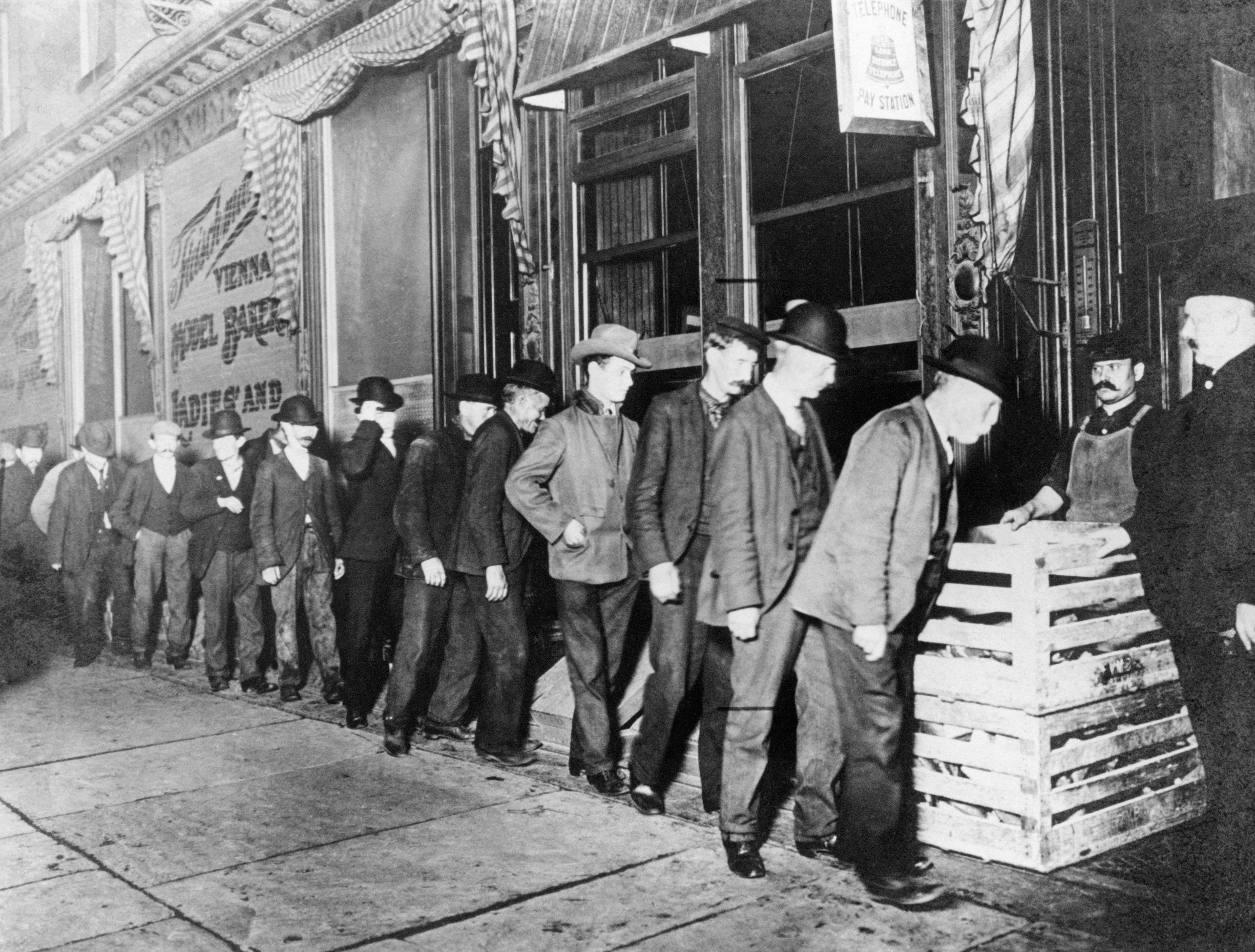
Let me start with the ugliest fact I know about the United States, and honestly across the board internationally. The people who got robbed blind are usually the ones defending the robbery.
When you find a man working two shifts in a warehouse, no benefits, back broken by 45, and you tell him that he is being exploited, he will not thank you. He will confront you, saying the company gave me a job. If they hadn’t hired me, my kids don’t eat. Nobody forced me. I decided to work for this company. The thing is, he does not see that the boss skims a cut off every hour he bleeds. What he sees is a benefactor. The factory, the boss, they feed him, so he calls it kindness.
The same logic applies to the renters too. The renter would say the building belongs to the landlord, that paying rent is simply the deal, that there’s no theft in it anywhere. He has lived in this arrangement his whole life, and everything feels natural to him. Once something feels normal, it starts to feel fair. So when you come to him and tell him, look closer, the split between what you earn and what you are allowed to keep was designed by the people who benefit from you staying where you are, then the renter is probably gonna treat you not as someone trying to help him. He’s gonna treat you as a troublemaker. He will tell you that he’s doing fine, that he clears his paycheck every week, and he wonders why you have to stir things up.
A worker who has never been taught to look honestly, to look closely at his own position, does not understand that he is being exploited. He does not know that he is a slave to the arrangement he lives inside. This is not an insult. It’s a plain description of where he actually stands. He has been told the same story his entire life, and that story never once tells him what is being done to him. So he will protect the employer. He will treat the person trying to explain the exploitation to him as the enemy. The person being robbed ends up guarding the robber. And that’s the oldest and the most reliable trick in American life, and it still works on tens of millions of people every single day.
And that is why anyone who tries to organize workers is never fighting only one side. He is fighting two sides at the same time. Above him is the employer, who has money, power, lawyers, courts, everything. Below him are the very workers he’s trying to help, who often turn on him and treat him as the troublemaker, the problem. He gets crushed between the owner on one side and the workers on the other side. And it is always the workers, the ones being exploited, who fight him the hardest. And that is why real organizing is exhausting and thankless, and that is why it fails far more often than it succeeds.
I really appreciate you guys reading my content, and thank you for all the support. Please subscribe. And if you want to support a little further to help the cause, consider becoming a paid subscriber. Thank you so much.
A lot of people don’t talk about this. The core problem is not the conflict between the boss, the ruling class, and the workers. Everyone can see that conflict. We see that. The deeper problem is the distance between one worker and another. Two people stand in exactly the same position, same social level, at the very bottom of the same system, and they still will not stand together. The real gap is not between the landlord and the tenant, it’s between one tenant and the next one. It’s not between the owner and the worker. It is between one worker and the worker standing right beside him. And that’s the gap where the entire system survives. The system wants that gap.
When a worker is injured at work and can no longer do the job, his position opens up, and the management starts looking for a new person. Within a day, there will be a line of people outside of the building waiting to apply. None of those people lining up are there to check on the injured man. They are there to replace him, to get his position. These are his own coworkers, people from the same neighborhood, working the same shift, living the same hard life. The moment one worker goes down, the others step over him to compete for his job.
This is not some cruelty I’m talking about. This is the way the labor market right now was deliberately built. In most of the states, employment is at will, which means that an employer can fire workers for almost any reason on almost any day. The job market right now is designed to keep unions weak and to leave each worker bargaining alone, with no one standing behind him, with no support. Especially in the gig economy, the person working next to you is not a colleague. He is a competitor. He’s competing directly against you for more orders, more runs, for the next job at a lower price, because he needs that money as badly as you do. That’s how the system is set up right now. When one worker falls, the rest are set against each other to fight over the empty position, instead of standing together to protect it.
The union membership in the United States fell to 10% in 2025. In the private sector, where most workers actually are, it’s down to 5.9%, close to the lowest ever recorded. In 1983, it was 20%. Over the course of a single working lifetime, organized labor was cut by more than half, and a large share of the workers who lost that protection cheered the whole time, because most of those workers had been told that the unions are a threat to their own freedom.
If you look at the other side of the spectrum of the economy, the owners are never divided against each other. The ruling class does not attack each other or tear itself apart over any of this. It usually works together. They are in the same lobbying groups and the same industry associations, and the same donor money flows into both political parties. Because both parties keep this arrangement in place. The goal is always to keep wages down and keep workers divided. At the top of the system, there’s no real fight between red and blue. There’s one class that understands its own interests and defends them no matter what. At the bottom, there are tens of millions of people who have been convinced that the person on the other side of politics is the real reason their life is hard.
This worker-against-worker fight has simply been given a new name. You have red state against blue state, native-born against immigrant, city against rural towns, one generation against the next, boomers versus zoomers. Each of these, they tell you this is one of the most important moral battles of your life. And every one of them convinces you that you should be angry at the person who stands in the same position you do. The immigrant who works in the restaurant does not freeze your wages. Some other worker far away, two states away, did not raise your insurance premium. But you have been brainwashed and trained to treat them as your enemy, while treating the people who actually set your wages and your premiums as neutral, or even as being on your side, just because they talk nice to you.
Workers of the world, unite. Marx said it, not because unity is easy. It is because unity is one of the hardest things that never really happens on its own. The rich come together naturally because they have a common purpose. They understand their interests are the same. Everyone else has to be brought together slowly and deliberately. One conversation, one difficult conversation at a time, against every instinct the system has trained and brainwashed into them since childhood.
I did not grow up in the United States. I can see, very clearly and plainly, what you have been trained to accept without even noticing. The word class was deliberately pushed out of public life. And the people who pushed it out are exactly the people you should be confronting.
In order to change, you have to understand that it does not change based on who wins the next election. It changes based on what ordinary people are finally able to see. The hardest and the most important work is not marching. It’s not even voting. It is the slow and difficult work of getting a worker to recognize that he is being exploited, in plain terms, that he is a slave to an arrangement built against him. And to see the worker standing right next to him as an ally, not a competitor for the same scraps.
And that is the real fight, and that is why the system spends so much money and effort to keep ordinary people like you and me angry at each other. The people in power are not really afraid of your vote. They are not afraid of your vote. They’re afraid of the day that you stop competing with the people beside you and start standing together with them.
The ruling class, the oligarchs, the corporations, they will win for as long as you keep fighting with each other. That is the mechanism. And now you see how it works.


And it's the hardest thing. You're right and even as we see it, we have been so divide, our knee jerk reaction, you see it here everyday, is to snap back at the other victim.
They have worked hard at dividing us. They have led us in directions that are diametrically opposed. It works well for the oligarchy and makes it hard to find common ground. Even if that common ground is as plain as the nose on your face.
Until we understand how we got here, we won't find our way out.
I'd add that leadership is important. If we have leaders in our "class" that can explain and inspire, it's half the battle.
I wrote an article yesterday that was addressing both Dems and Reps. I have a very small following, but I'm hoping people will start trying to bring us together to oppose the actual enemy.
Thank you for articulating what I've felt for years. I don't get validation for trying to organize a teacher strike against school shootings, I get ostracized and demonized by my colleagues, snitched on, and formally reprimanded by administration. People love their chains. I have much more success with students. Explaining the McDo CEO made $735 million last year, but has never made a burger in his life, while they made $30k is clear exploitation. Solidarity.