

If you only read the headlines, this looks like de-escalation. The United States and Iran agreed to a two-week ceasefire window, talks are expected in Islamabad, and officials are already presenting this as a path toward an end.
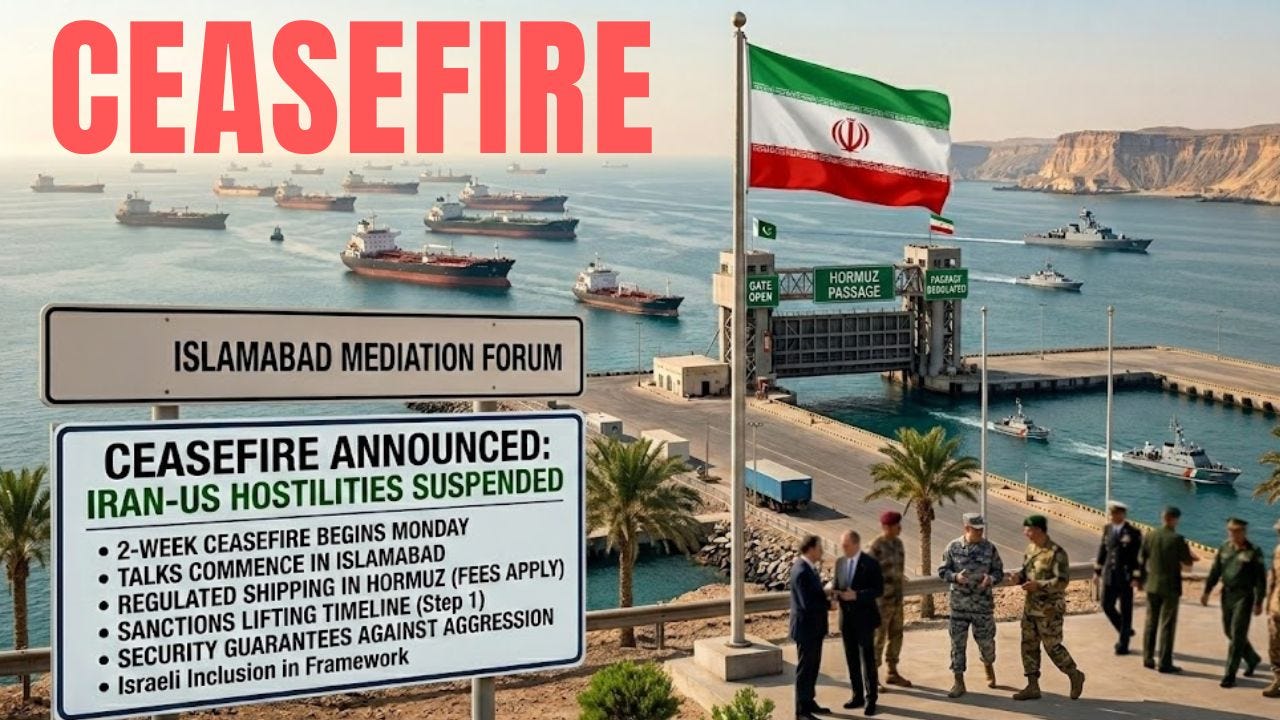
But the deal is much narrower than it looks. This is not a full regional ceasefire. It is a last-minute pause with conditions attached, conflicting interpretations already emerging, and Lebanon still under fire. That is the real story. If this kind of briefing helps you keep the pieces in order, subscribe and stay with me here.
How the ceasefire was forced into place
Three things shaped this pause.
First, Washington pushed the war to the edge of wider escalation. Trump demanded that Iran reopen the Strait of Hormuz and threatened strikes on Iranian infrastructure, including power stations and bridges. At the same time, Vice President J.D. Vance said the war would end soon, but that the outcome still depended on Iran. The message was simple: the US was threatening escalation while keeping talks alive.
Second, the UN became part of the fight over how this war would be framed. A Security Council resolution backed by Bahrain and supported by Washington would have encouraged coordinated action to protect shipping through Hormuz. China and Russia vetoed it, arguing that the text ignored the roots of the conflict and could be used to justify further escalation.
Third, the ceasefire only emerged at the last moment. As Trump’s deadline approached, the US and Iran agreed to a two-week pause, with talks set for April 10 in Islamabad. But this was never an unconditional stop to the war. It was tied to Hormuz, tied to talks, and tied to temporary restraint.
The central contradiction: what does this ceasefire actually cover?
This is the most important question now.
Israel welcomed the US-Iran ceasefire, but Netanyahu’s office made clear that Lebanon is not included. That immediately changed the meaning of the deal. If Iran is paused but Lebanon is not, then this is not a regional ceasefire. It is a selective pause on one front while another front remains active.
That directly clashes with Iran’s reported position. Tehran’s proposed framework, passed through Pakistan, reportedly called for the war to stop across all fronts, including Lebanon. So from the beginning, both sides have been describing the same ceasefire in different ways.
That contradiction is already visible on the ground. Even after the announcement, reports from Lebanon described new Israeli strikes, including attacks near civilian and medical sites. So the reality is simple: one side is calling this a ceasefire while still reserving the right to keep hitting Lebanon.
China and Pakistan helped create the pause
Pakistan played a central role in the final diplomatic push. It asked for more time, pushed for the two-week framework, and helped pass terms between the sides.
China’s role appears to have been quieter, but still important. Multiple reports say Beijing urged Iran to show restraint and flexibility in order to make the pause possible. Trump himself, when asked whether China had pushed Iran toward talks, said, “I hear yes.”
That matters because China’s role here was not to join the war, but to help prevent a wider one.
Hormuz may reopen, but stability has not returned
The Strait of Hormuz remains one of the biggest pressure points in this crisis. A major share of global oil and gas passes through it, so any disruption quickly becomes a global economic problem.
Iran has signaled that shipping can resume for the next two weeks, but only under controlled and temporary conditions. So this is not a return to normal. It is a temporary reopening inside an active crisis.
That may calm markets for now, but it does not remove the underlying risk.
Another signal: Washington is no longer setting the terms
Trump’s shift on Iran’s reported 10-point proposal is one of the clearest signals in this entire sequence. He described the proposal as a “workable” basis for talks, even though the reported terms include demands the US would normally reject outright, including guarantees against future attacks, sanctions relief, compensation, continued enrichment, and a larger Iranian role over the Strait of Hormuz.
Iran then pushed the claim further. Iranian state-linked reporting and international coverage say Tehran’s Supreme National Security Council framed the ceasefire as a victory and said Washington had, in principle, accepted core Iranian conditions. Those reported conditions include no further military action, acceptance of Iran’s enrichment activity, sanctions relief, withdrawal of US combat forces from the region, and an end to military action across all fronts. That does not mean all of this has been independently confirmed from the US side, and it certainly does not mean Washington has formally signed onto every term. But even getting to this stage tells you something important.
Washington is no longer speaking as if it can simply impose terms. It is now bargaining under pressure, trying to turn a tactical pullback into something that can still be presented as a win. Trump is still publicly claiming total victory, but that claim now sits next to a very different reality: the White House is talking about Iranian terms as a basis for negotiation.
What This Suggests
This war has not ended. It has only shifted into a narrower and more fragmented phase. Diplomacy is moving, but military pressure has not stopped. Iran has gained time, Washington has gained an opening, and Israel appears determined to keep military freedom in Lebanon. If the talks fail, this ceasefire may end up looking less like the start of peace and more like a brief intermission before another round of war.
If this kind of briefing helps you make sense of fast-moving events, subscribe and stay with me here. And if you want to support this work more directly, consider upgrading to a paid subscription. This story is still moving, and I’ll keep tracking it.


As is too often the case, Israel has wiggled its genocidal way through a loophole.
There’s no ceasefire, imo. The US cried uncle. Hopefully this leads to the US pulling out of this conflict and to attention shifting to the genocidal actions of Israel and the US in Gaza, the West Bank, and Lebanon.