

I often cover breaking news and geopolitical events. But sometimes the most important information doesn’t come from headlines. It comes from long policy documents that most people never read.
One of those documents is China’s Government Work Report, released every year during the country’s annual political meetings known as the Two Sessions.
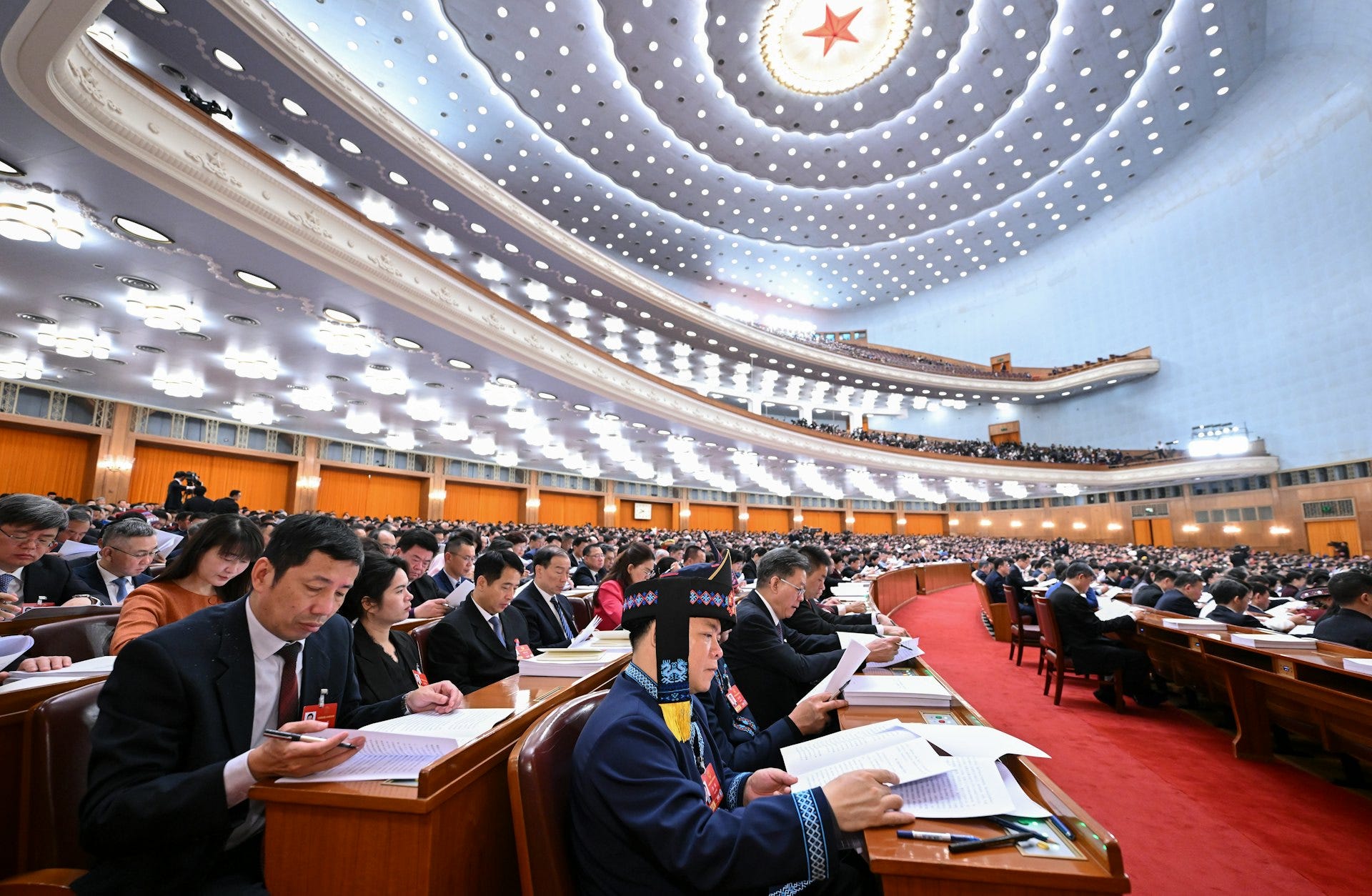
These reports may not be exciting to read, but they are extremely useful if you want to understand where China’s economy is going. They outline what happened in the previous year and what the government plans to focus on next.
That’s why I’m going through it and breaking it down in plain language.
If you find this kind of analysis helpful and want more explanations of major global economic developments, consider subscribing to the newsletter. And if you’d like to support the work more directly, upgrading to a paid subscription really helps me keep producing deeper analysis like this.
Now let’s look at what the 2026 report actually says.
You can download the full report here,

Looking Back at 2025
A Year of Economic Stability
The first section of the report reviews China’s performance in 2025.
According to the report, China’s economy grew about 5 percent, bringing total GDP to roughly 140 trillion yuan. More than 12 million urban jobs were created, and unemployment remained relatively stable.
Several industries were highlighted as areas of strong growth. These include electric vehicles, advanced manufacturing, artificial intelligence, robotics, and other high-tech sectors.
China also continued expanding charging infrastructure for electric vehicles and increasing industrial automation.
Another priority was food security. Grain production reached record levels, helping maintain stable domestic supply.
The overall message in this section is that despite global economic uncertainty, China believes it maintained stable growth while continuing to upgrade its industrial base.
The Economic Targets for 2026
Stability Remains the Priority
The report then outlines China’s main goals for the coming year.
For 2026, the government is targeting GDP growth of around 4.5 to 5 percent.
At the same time, policymakers aim to create more than 12 million urban jobs, keep inflation relatively low, and maintain stable food and energy supplies.
For Western readers, these targets may look modest. But for an economy the size of China’s, maintaining growth in that range still represents enormous expansion.
The emphasis throughout the report is stability. The government is clearly trying to avoid sharp economic fluctuations while the global economy remains uncertain.
Fiscal Policy
Record Government Spending
One of the clearest signals in the report is the scale of fiscal policy for the coming year.
China plans to push total government spending to around 30 trillion yuan, the largest in the country’s history.
Much of this spending will support infrastructure projects and long-term government bond programs designed to stabilize growth.
Unlike the political battles over government spending often seen in Washington, fiscal policy in China is generally used as a centralized economic management tool.
The goal is to keep investment moving and prevent sudden slowdowns in economic activity.
Expanding Domestic Consumption
Shifting the Growth Model
Another key theme of the report is expanding domestic consumption.
For many years, China’s economic growth relied heavily on exports and investment. Policymakers now want household consumption inside China to play a larger role.
Programs aimed at supporting consumer spending, improving household income, and expanding service industries are part of this effort.
The long-term goal is to build a more balanced economy that is less dependent on external demand.
Technology and “New Productive Forces”
The Next Phase of Industrial Development
Technology development remains central to China’s long-term strategy.
The report repeatedly refers to what policymakers call “new productive forces.” This term includes industries such as artificial intelligence, advanced manufacturing, green energy, and digital infrastructure.
Research and development spending continues to grow, and the government is encouraging collaboration between universities, research institutions, and private companies.
The broader objective is to move China further up the global value chain while reducing dependence on foreign technology in critical sectors.
Industrial Policy and Manufacturing
Infrastructure and the Energy Transition
Manufacturing continues to be a central pillar of China’s economic model.
The report highlights continued investment in high-tech manufacturing, robotics, semiconductors, and electric vehicles.
China is also expanding infrastructure in areas such as transportation networks, digital connectivity, and energy systems.
But in the report, infrastructure does not only mean roads or railways. A major focus is the modernization of China’s energy network.
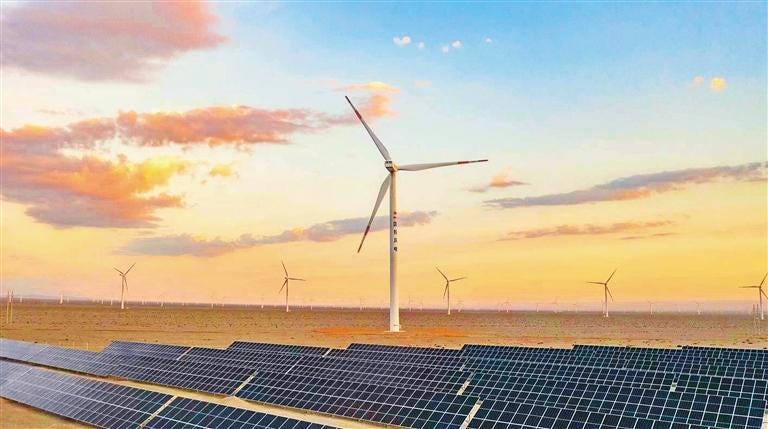
The government is working toward what it calls a “new power system.” This includes building smarter electricity grids, expanding large-scale energy storage, and increasing the use of renewable power such as wind and solar.
These upgrades are necessary because renewable energy sources are intermittent. A more advanced power grid and stronger storage capacity help ensure electricity remains stable even when renewable generation fluctuates.
At the same time, China’s transition away from fossil fuels will not happen overnight. The report emphasizes improving the clean and efficient use of existing fossil energy while gradually expanding renewable energy capacity.
The strategy is a managed transition: limit the growth of the most carbon-intensive industries while expanding renewable power and modernizing the energy system.
Social Policy and Demographic Pressure
Responding to an Aging Population
The report also addresses several long-term social challenges.
Like many developed economies, China is facing declining birth rates and a rapidly aging population.
To address these trends, the government is expanding a number of social programs designed to reduce the financial burden on families.
These include increasing support for healthcare coverage, raising pension benefits for retirees, and expanding childcare services and early education access.
The idea is simple. If raising children becomes less expensive and social support systems become stronger, families may feel more secure about having children.
At the same time, stronger healthcare and elder-care systems help the country adapt to a growing elderly population.
The Bigger Picture
China’s Long-Term Economic Strategy
If you step back and look at the entire report, a broader strategy becomes clear.
China’s leadership is trying to balance several priorities at once.
Maintaining stable economic growth.
Strengthening domestic consumption.
Investing in technological capability.
Modernizing infrastructure and energy systems.
And adapting to long-term demographic changes.
This reflects a long-standing approach in Chinese economic governance: using policy tools and long-term planning to guide economic development.
Why This Matters Globally
China is the world’s second-largest economy. The policies outlined in this report will influence global supply chains, commodity markets, and technology competition.
Understanding documents like the Government Work Report helps explain how China’s leadership is thinking about the economic challenges ahead.
While global discussions often focus on geopolitical tensions, reports like this reveal something more practical.
China’s policymakers are focused on maintaining economic stability while continuing to build long-term industrial capacity.
And those choices will shape the global economy far beyond China’s borders.
If you want deeper breakdowns of major global economic and political developments, consider subscribing to the newsletter.
And if you’d like to support this work and help me keep producing independent analysis like this, upgrading to a paid subscription makes a real difference.
Thank you for reading, and feel free to share the article if you found it useful.


Given all the chaos in western countries, especially the US, the Chinese economy looks the most stable and robust. I can see how the sound reasoning of their economic plan could spread into all aspects of society, including scientific achievement. I'm betting the first settlements on the moon will be Chinese. I hope I live long enough to see that, a remarkable human achievement.
This is amazing information. This is the sort of stuff that Western Marxists who are uncritically and reactionarily distrusting of China and all other existing "socialist" countries, for that matter, need to read.
We have a problem of inaction, falling into idealist, "purity" checks of countries actually working towards socialism, all while having no real, actionable and dialectical program across the United States and Western Europe to change the people's world view away from liberalism.
The more I study China, its programs, its constant and unwavering auditing of these programs, themselves, and those in charge of working to complete the tasks outlined in these programs, I realize how little liberal democracies actually do.
Liberal democracies, at least in the few times when they show that they might care about the plights of its people, usually don't do much beyond some necessary posturing, dishing out some "reassuring" words, and then just slipping into complacency with no accountability.
Thank you for your thoughts, Neil. This sort of governance is desperately needed in much of the developed world. I hope more and more folks learn and make no mistake about where capitalist countries fail and where socialist ones, when they're allowed to thrive despite capitalist meddling, succeed.