

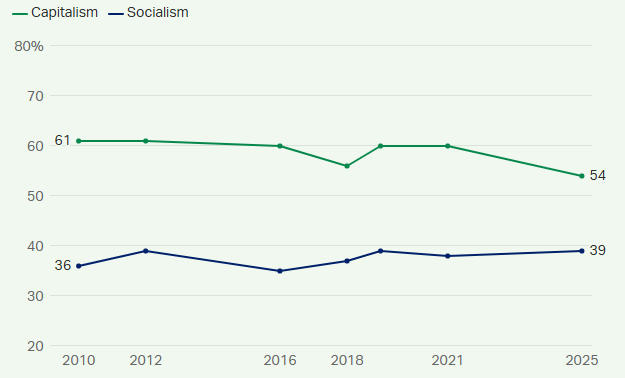
Polling shows 39% of Americans view socialism favorably, while favorable views of capitalism have been sliding. When U.S. Treasury Secretary Scott Bessent was asked about that shift, his answer was blunt: people are warming to socialism because they do not own stocks.
He then used the moment to plug “Trump Accounts,” a proposal associated with Donald Trump and framed as a pro-ownership policy. The pitch is simple: give children a starter amount invested in a low-cost S&P 500 index fund, allow families to contribute more over time, then claim this will rebuild faith in the system.
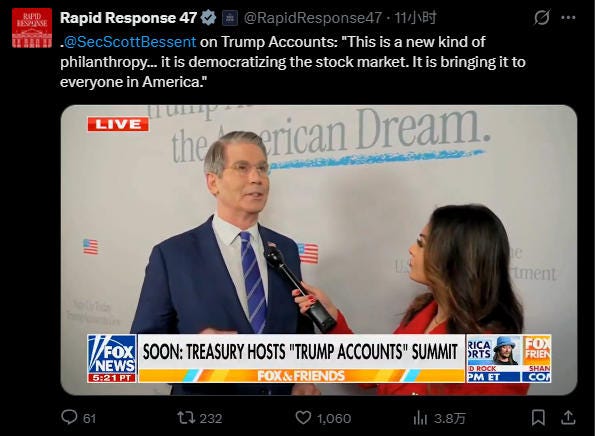
In other words: if you can get more people tied to the market, you can reduce the demand for alternatives.
That is the public message. What matters is the reflex behind it.
This is not analysis. It’s blame-shifting.
“You like socialism because you don’t own stocks” is not a serious diagnosis. It is a deflection. It takes a public legitimacy problem and re-labels it as a personal flaw.
Not satisfied with the system? That’s on you.
Not optimistic about capitalism? That’s because you did not participate.
Not buying the story? That’s because you did not buy the asset.
This is the ruling class speaking in its most familiar language: don’t talk about what the system does to people. Talk about what people failed to do inside the system.
They do this because it protects power. If the problem is personal, the system stays innocent.
“Go get market exposure” is detached from real life
Bessent’s framing assumes investing is mostly a mindset choice. It’s not.
Even passive index investing requires surplus. It requires a cushion. It requires enough stability to tolerate volatility without needing the money next month.
A lot of working-class people don’t have that cushion. Many younger adults aren’t choosing between an index fund and savings. They’re choosing between rent and groceries. They’re choosing between medical bills and the credit card minimum. They’re choosing between car repairs and staying current on debt.
So when a Treasury Secretary says skepticism is caused by “no stock exposure,” he’s talking from the safe zone. He’s ignoring the material reality that keeps people out of the market in the first place.
A system that keeps people one emergency away from collapse cannot demand that they behave like calm long-term investors. That is not a mindset problem. That is a class position.

The class pivot they refuse to make
Here’s the line they will not cross: naming who gets squeezed and who benefits.
If you talk seriously about why people are turning away from capitalism, you have to talk about material conditions: wages, rent, healthcare costs, debt burdens, and basic security. You have to talk about bargaining power. You have to talk about what happens when gains concentrate at the top while risk and insecurity spread downward.
That conversation points upward. It points at owners, executives, major shareholders, and the political class that protects them.
So instead, the ruling class changes the subject.
They make it about “participation.” They make it about “financial literacy.” They make it about “attitude.” They make it about “buying in.”
Because the moment you admit the real issue is distribution and power, the next question is unavoidable: who designed it this way, and who keeps it this way?
The real move is political: turn anger into portfolio management
“Trump Accounts” is being marketed like inclusion. Functionally, it’s legitimacy management.
When people start questioning capitalism, one response is structural reform: deal with wages, housing, healthcare, and debt. Reduce the pain that produces skepticism.
The other response is cheaper and safer: bind people emotionally to the market. Make them small shareholders, even tiny ones. Give them an account. Give them a reason to root for the S&P.
Once someone’s identity is tied to an index fund, public anger is easier to redirect. The question shifts from “are the rules fair?” to “is the market up?” It turns political frustration into personal portfolio anxiety.
This is why elites love market-based fixes. They do not have to redistribute power. They only have to redistribute attachment.
“Ownership society” is a story, not a transfer of power
Supporters call it an “ownership society,” but ownership is being watered down until it becomes a feeling, not power.
Owning a small slice of an index fund does not change who controls corporations. It does not change who sets wages, who decides layoffs, who raises prices, who funds politics, or who writes the rules.
It gives you exposure, not control. It gives you a stake narrative, not leverage.
That is the point. Symbolic inclusion without real redistribution.
The causality is backwards
Bessent’s comment implies: no stocks causes socialist sympathy.
It’s backwards.
A lot of people don’t invest because they can’t. Not because they don’t understand investing. Their income is eaten up by survival. Rent, bills, healthcare. It’s always hanging over their head. There’s no room for risk.
So lower participation is not the cause of skepticism. It is one symptom of the same condition: a working class squeezed hard enough that long-term optimism becomes irrational.
People are not rejecting capitalism because they missed a finance class. They are rejecting it because they’ve lived inside the current version of capitalism and recognized their place in it.
Closing
This is class politics, not financial education.
If the system actually worked for most people, the leadership wouldn’t need to shame people for not believing in it. They wouldn’t need to reframe structural pressure as personal failure. They wouldn’t need to sell market attachment as civic therapy.
The question is not whether more Americans should own stocks. Many should, if they can do it safely.
The real question is why a government responds to collapsing trust not by fixing wages, housing, healthcare, and debt, but by telling people to buy in and stop complaining.
If a society needs everyone to become a tiny shareholder just to tolerate the rules, the problem is not the people. The problem is the rules.


The uppermost 1% of wealthy Americans own 50% of the value of stocks traded on Wall St. The lower 50 % of earners hold about 1% of that value. Who does Squat Pissant think he's fooling?
For decades now, the message: what’s yours is negotiable and what’s mine is up for management. . Legitimacy management, yep.
For decades, highly paid writers have shaped the message: you are the problem, not the system. Those human writer jobs? Caught in the A I mire.
At one time these ideas used to be normal.
Normal to reuse and recycle. ….Normal to not chase the newest thing.
Normal to drive an old car. ….Normal to eat leftovers. ….When that’s normal, corporations panic.
Because when simplicity becomes normal,
the machine stutters. ----Profits tremble.
This mindset didn’t appear by accident. Decades ago, 50 years and counting.
In the 1970s, college economics courses shifted from teaching shared prosperity to protecting wealth at the top. --- A friend, a high school economics teacher in the 80s and 90s taught these kids that it’s ok to protect the wealth at the top. The echo lives on.