

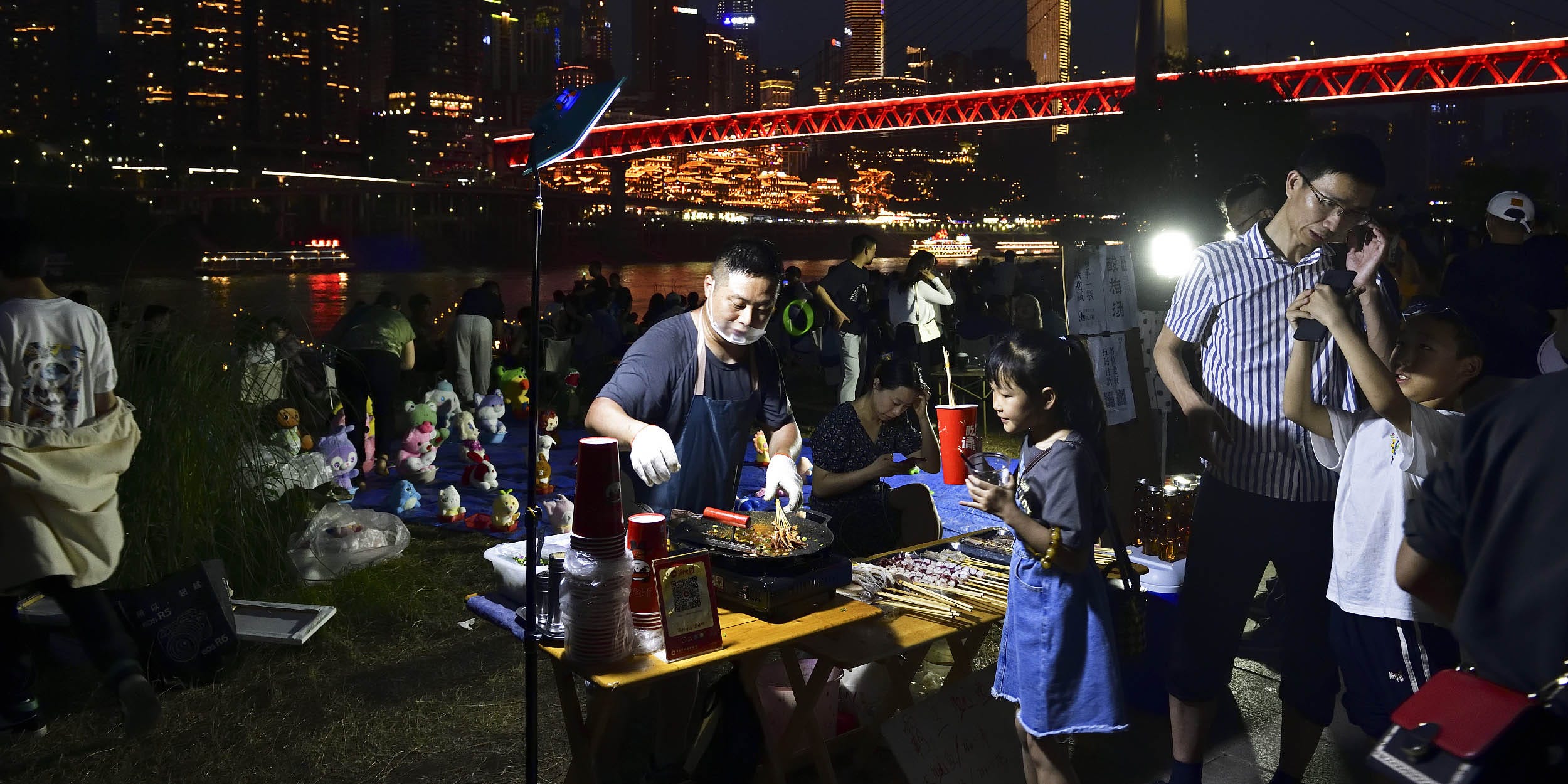
At 56, Xie Qing was out of work in Jiangxi province. He wanted to sell food but could not afford the equipment. According to a local employment-service account, staff helped him get a pushcart, taught him how to make and sell bo zai gao, a steamed rice cake, and found him a place to start. He did not open a restaurant. He opened a stall.
You see this kind of business across China: breakfast outside apartment buildings, fruit near neighborhood entrances, snacks at night markets. People need affordable ways to earn, customers want convenience, and cities decide whether to make space for both.
A stall needs customers and somewhere to stand
A vendor can start with a cart instead of leasing and renovating a storefront. That changes who gets to try. A worker who cannot afford a shop may still be able to buy ingredients, make something people want, and sell it close to home.
Lower starting costs matter when wages stop or a family needs extra income. A quick breakfast or vegetables close to home saves customers a trip. The business serves the neighborhood while the neighborhood gives it customers.
Here is the role of government. In a 2020 policy on flexible employment, China’s State Council encouraged small businesses that require little investment. People selling agricultural products or everyday goods at government-designated times and places do not need a business license. The policy also calls for simpler approvals and entrepreneurship training. The government decides where the stalls can operate and removes a registration hurdle for these kinds of sales.
Local governments can turn that policy into a place to do business. Under Jiangsu’s food-vendor rules, officials may set vending areas and hours, provide stalls, water, electricity, and waste collection, and require registration and health standards. A marked space, running water, and a place for trash are small things until your income depends on them.
Think about what this means for an unemployed person. The city can tell her to find a job. It can also decide whether there is a legal spot where she can try to create one.
What retraining looks like when it reaches the street
Back in Jiangxi, the support went beyond a pep talk. In one 2025 program in Shangrao, 30 people identified as having difficulty finding work received vending equipment, including carts, refrigerators, and cooking equipment, alongside practical guidance. In Yushan County, eligible participants could receive equipment worth up to 5,000 yuan, free training, and follow-up support.
This is the distinction I care about. A class on entrepreneurship is cheap to announce. Actually helping someone find equipment, learn a product, understand the risks, and reach customers takes work. The cart and the legal place to use it may matter as much as the class.
Tax policy can lower the barrier too. Under the current value-added tax rules, qualifying small-scale taxpayers are exempt from VAT when their monthly sales are at or below 100,000 yuan. That gives a small business breathing room while it finds customers.
A question for North America
North American cities have their own barriers to getting a stall running. In Vancouver, a 2026 downtown stationary food-vending permit costs C$1,545.04 plus GST, on top of the application fee. A roaming pushcart permit outside downtown costs C$209.21 plus GST, and requires insurance. Then come the cart, supplies, and a place where customers can find you. The type of stall changes the price. City policy sets that price.
New York has begun expanding access to food-cart permits after years of limits and waiting lists. The next step is to make those permits usable: affordable vending spaces, practical training, shared equipment, and low fees for people starting with very little. Let the smallest businesses keep more of their first earnings with low or zero taxes.
This is one way to prevent people from becoming homeless. There is a stretch between losing a paycheck and losing a home: overdue rent, borrowed money, an eviction notice. That is the time to teach practical ways to earn, lower the cost of starting a small business, and tax its first small earnings as little as possible. A little more income could keep a family in its home.
There is dignity in learning a skill, making something people want, and paying your own bills. Give people the tools and a fair place to use them. Build more affordable homes at the same time. Families need both an affordable place to live and a way to earn enough to stay there.
This is a great informative story Neil. It’s amazing the level of obstruction for lower class people to become entrepreneurial. We can learn from articles like this.
Thank you!
Neil's content is so good. The working class is oppressed in ways we don't even realize.