

The debated budget is where Medicaid lives. Food assistance is in there. So is the housing voucher your neighbor is on, the clinic that keeps your county from being a medical desert, the school lunch. Every dollar in it is provisional. It gets scored, defended, means-tested, attacked as waste, and eventually cut.
The other budget is interest on the national debt. Nobody votes on it. No committee holds a hearing on whether the bondholders deserve it. It goes out on schedule, and this year it runs about 1.2 trillion dollars, more than the entire military.
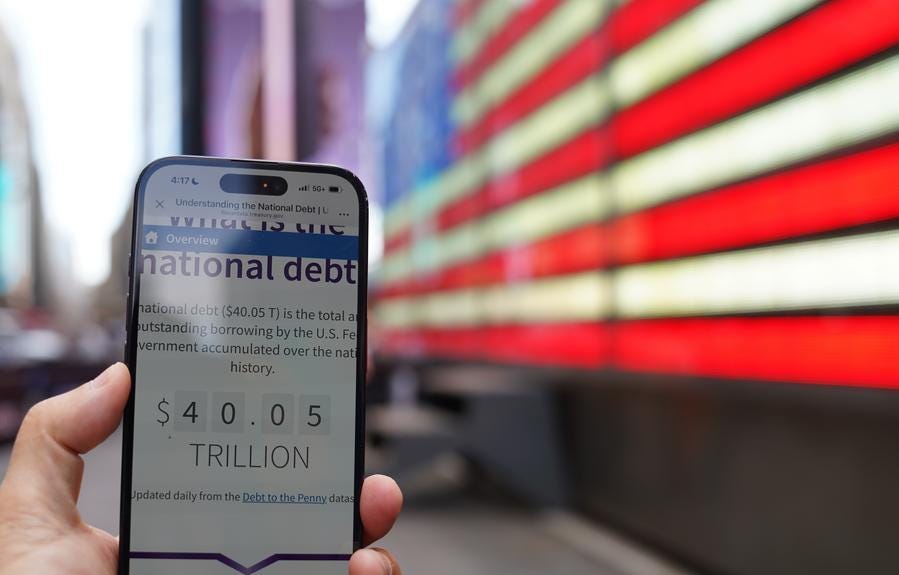
The federal debt crossed 40 trillion dollars this week and every outlet ran the number like it was the story. It isn’t. The story is which of those two budgets is allowed to grow forever, and which one they go rummaging through when somebody says the word savings.
Interest cannot be cut without defaulting on the people who own the debt. Eligibility can be cut by writing one sentence into a bill. Money owed to capital is structural. Money owed to labor is political.
Berkshire Hathaway held 339 billion dollars in Treasury bills at the end of last year, the biggest non-government position anybody tracks. Every quarter the government wires it a payment, funded by withholding taxes taken out of paychecks before workers ever see the money. No hearing. No work requirement. No caseworker asking Berkshire to prove it still qualifies.
The wealthiest 1% of American households holds 38.4% of the government bonds households own. The top 0.1%, one household in a thousand, holds about 1.1 trillion dollars of it, roughly half of what the entire top 1% owns. That is who is on the other end of the payment nobody debates.
Congress passed the One Big Beautiful Bill Act in July of last year. The first half added over 4 trillion dollars to the debt, most of it tax cuts, which means the automatic payment just got permanently bigger. The second half cut 1.1 trillion dollars out of Medicaid and the ACA marketplaces and called it fiscal responsibility. Roughly 10 million more people lose coverage over the next decade.
Same bill. Same signature. Same afternoon. Borrow for the tax cuts, then point at the borrowing and take away the insurance.
The second half is not a forecast. It’s a calendar. On October 1 this year, the administrative cost of food assistance shifts onto state budgets, so states start hunting for ways to shrink their rolls. On December 31, Medicaid enrollees begin re-verifying eligibility twice a year instead of once. On January 1, 2027, the work requirements land.
Arkansas ran that experiment in 2018 and dropped 17,000 people in three months while employment sat still. The paperwork was never a filter for the undeserving. The paperwork is the mechanism. People who qualify miss a notice, miss a deadline, get dropped, and it lands on the ledger as fiscal discipline.
People keep asking about Japan and China selling off Treasuries. Japan’s answer is boring. Its central bank is finally raising rates after decades near zero, so Japanese money has somewhere at home worth going. China’s answer is the one worth your time, and not for the reason it usually gets told.
In 2022 the G7 froze Russia’s foreign reserves. American debt is treated as the safest asset on earth, and that reputation never rested on the United States being able to pay. It rested on nobody being able to refuse to pay you. That weekend established there was an exception, and the exception was political. Central banks have been buying gold ever since, not because gold earns anything, but because gold doesn’t require anybody’s permission to move.
That decision got made in Washington conference rooms. No working family was in the room. The bill still travels downward. Buyers reprice the risk, the Treasury pays more to move its debt, and Treasury yields set the baseline for mortgage rates and car loans. Freezing reserves was an exercise of power, and the cost of exercising it lands on people who hold none.
So the working class pays twice. Once through withholding, which funds the coupon. Once at the bank, borrowing at a price set in a market it has no seat in.
The trade press calls this a debt problem. A problem implies somebody made a mistake. This is a working arrangement, running exactly the way it was built to run, and arguing about which party ran up the number is how you spend your life not noticing the design.
You know which budget you’re in. The working class one. The political one. The one they go looking through when they need to find savings.


