

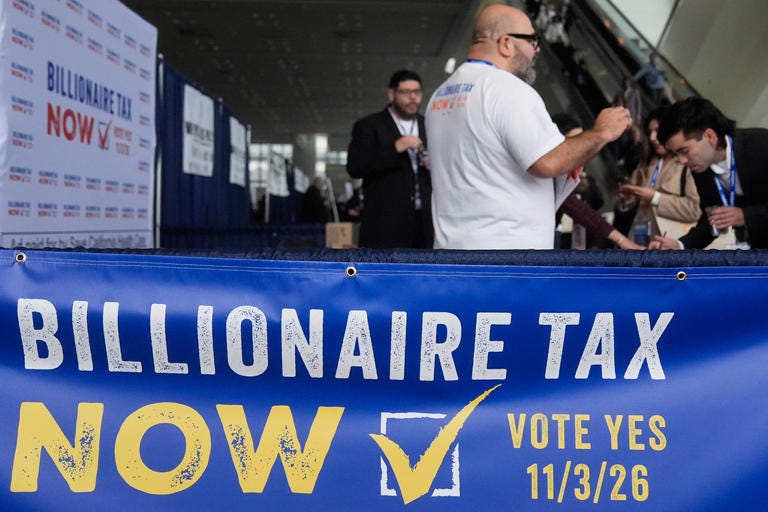
California just voted against taxing billionaires.
Proposition 40 would have imposed a one-time 5% wealth tax on residents worth more than $1 billion. 90% of the revenue would have gone toward healthcare, helping offset federal funding cuts.
But nearly 53% of California voters rejected it.
What makes the result interesting is who voted against it. According to the Associated Press, roughly 70% of voters aged 65 and older opposed the proposal. Higher-income voters were also more likely to reject it.
Someone earning $200,000 a year is nowhere near becoming a billionaire. Even someone earning $500,000 is still dependent on their income unless they have accumulated enough assets to live without working.
Yet many people who would never have paid this tax opposed it.
Why would they worry about taxing someone whose wealth is thousands of times greater than their own?
The Billionaires Didn’t Have to Fight Alone
The opposition to Proposition 40 was among the most expensive campaigns in California history.
Billionaire-backed groups raised hundreds of millions of dollars to defeat the tax and promote two competing ballot measures. Google co-founder Sergey Brin alone contributed more than $100 million to a major opposition committee.
Their message was familiar.
Tax billionaires, and they might leave California. Businesses could lose investment. Jobs could disappear. The state could lose valuable tax revenue.
And who delivered that message?
Not just billionaires defending their own fortunes.
Opposition advertisements featured teachers, nurses, and firefighters. California Governor Gavin Newsom, a Democrat, opposed the tax. So did the California Teachers Association and several other organizations associated with public services.
Some had independent concerns about the proposal’s design and its effect on long-term public funding. But their opposition also helped present the tax as a threat to ordinary Californians rather than simply a financial cost to billionaires.
Then came another warning.
Proposition 40 included a provision allowing lawmakers, with a two-thirds majority, to amend parts of the legislation as long as the changes advanced its original purposes.
Opponents warned that the tax could eventually expand to ordinary people’s savings and assets.
Legal experts pointed out that substantially expanding the tax beyond billionaires would face significant constitutional restrictions. The proposal did not give lawmakers unrestricted authority to tax everyone.
Still, imagine someone approaching retirement, with a paid-off home, a pension, and some investments.
They hear that the government wants to tax wealth. Then they hear that the rules might eventually change.
They’re not billionaires. They may never become billionaires.
But they have spent decades building whatever financial security they possess, and they don’t want to risk losing it.
That concern is understandable.
The political question is how that concern becomes connected to protecting billionaires’ fortunes.
Your Tax Bracket Is Not Your Class
A doctor earning $300,000 a year is not necessarily a capitalist.
Neither is an engineer making $250,000, or a retired teacher receiving a pension.
Income alone does not determine someone’s class. Their relationship to the means of production matters.
Who owns the businesses, factories, technology, and productive assets? Who controls production and investment? And who receives the profits generated through other people’s labor?
Under capitalism, workers sell their labor. Their work contributes to the creation of economic value, but ownership gives capitalists control over productive assets and the distribution of profits.
A highly paid engineer can still be laid off when management decides to reduce costs. Meanwhile, a major shareholder can continue receiving returns from ownership without personally performing the labor that generates those returns.
Of course, some high-income executives also own significant shares and exercise real control over companies. Their class position may be quite different.
But a high salary doesn’t automatically make someone a capitalist.
And retirement doesn’t automatically transform a worker into a member of the ruling class.
Yet capitalism creates a peculiar contradiction for both groups.
Workers Depend on the Capital They Don’t Control
During your working years, your livelihood depends on wages.
Your employer decides whether to invest, expand production, relocate operations, or eliminate your position.
You perform the work, but you usually have little control over those decisions.
Then you retire.
Your income may come from Social Security, a pension, savings, or investments. Some retirement arrangements are relatively insulated from financial markets, while others depend heavily on corporate profitability and asset prices.
So even after leaving the workforce, many former workers remain economically connected to capital they do not control.
The relationship changes, but the insecurity can remain.
This helps explain why a worker or retiree might worry when wealthy investors threaten to relocate their capital.
They don’t necessarily admire billionaires. They don’t have to believe they’ll become billionaires themselves.
They may simply worry about what happens to employment, public revenue, or financial markets when capital moves elsewhere.
And those concerns aren’t entirely imaginary.
Private investors control enormous amounts of economic activity. Governments depend on tax revenue. Workers depend on employment, and many retirees depend partly on financial assets.
But consider the contradiction.
The people who control capital can make the consequences of challenging their wealth a source of anxiety for people who don’t control it.
That is a powerful political advantage, even before a single campaign advertisement is purchased.
How Economic Power Becomes Political Power
California’s billionaire tax provides a useful example of how that advantage operates.
The tax was intended to help finance healthcare amid substantial federal funding cuts. Its supporters argued that concentrated wealth could help protect services used by millions of Californians.
Opponents emphasized the risk that wealthy residents might leave, reducing investment and future tax revenue.
There was a genuine fiscal disagreement. California’s nonpartisan legislative analysts projected tens of billions of dollars in temporary wealth-tax revenue, alongside the possibility of a smaller ongoing reduction in income-tax collections.
But the billionaire-backed campaign did more than oppose one tax.
It also supported Proposition 42, a measure designed to prohibit new state taxes on financial assets and other personal property, while restricting most retroactive taxation.
As Proposition 40 was defeated, Proposition 42 was leading in the vote count, although the result had not yet been formally certified.
Newsom opposed the billionaire tax and supported Proposition 42, despite the California Democratic Party’s support for Proposition 40.
Consider what that means institutionally.
The wealthy had the resources to campaign against an immediate tax increase while also promoting a constitutional restriction on future tax policy.
The contest extended beyond how much money they would pay this year. It concerned which revenue-raising options California could use in the future.
And that is where private economic power becomes political power.
Wealth allows its owners to finance campaigns, build political relationships, and influence public debate. Their control over investment and taxable assets also gives their policy preferences economic consequences that governments must consider.
Ownership provides the economic leverage. Concentrated wealth provides the political resources.
The two reinforce each other.
Who Pays for Protecting Capital?
There is another side to the debate that deserves just as much attention.
What happens if California cannot replace the federal healthcare funding being cut?
Hospitals, patients, healthcare workers, and families who depend on public coverage face financial and medical risks.
The proposed wealth tax raised legitimate questions about capital relocation, revenue estimates, and long-term funding. But rejecting it does not eliminate the healthcare funding problem.
It leaves policymakers to find another source of revenue, reduce spending, or change the structure of services.
Those choices also distribute economic costs.
And that is what makes this a class question.
Wealth doesn’t simply determine how much money someone possesses. Ownership determines who can make economic decisions, who can threaten to withdraw investment, and who has the resources to influence public policy.
The people who depend on employment and public services often have much less control over those decisions, even when they earn comfortable salaries.
The Problem Goes Beyond a Wealth Tax
Even if Proposition 40 had passed, California’s basic economic structure would have remained intact.
Major corporations would still be privately owned. Workers would still depend on employers. Investment decisions would remain largely in the hands of shareholders and executives.
A wealth tax redistributes some accumulated wealth. It doesn’t fundamentally change who controls the means of production.
That is the distinction between addressing inequality through taxation and challenging the ownership structure that continually produces economic inequality.
Public healthcare, stronger social insurance, and greater worker control over economic decisions offer different ways to reduce dependence on concentrated private wealth. Each requires its own financing and institutional design.
California’s vote does not prove that everyone who opposed the tax was defending billionaires out of misplaced loyalty. Voters had different concerns, and the available data cannot establish each person’s motivation.
But the controversy illustrates a recurring contradiction within capitalism.
Workers can recognize that wealth is concentrated in too few hands while fearing the economic consequences of challenging those who control it.
Capitalism concentrates productive ownership, makes millions of people’s livelihoods dependent on private investment, and gives capital owners unusual influence over the political decisions that affect their wealth.
That dependence can then become an argument for preserving the very distribution of economic power that created it.
When the wealthy can make their own departure a threat to everyone else’s economic security, their wealth becomes more than private property. It becomes political leverage.


