

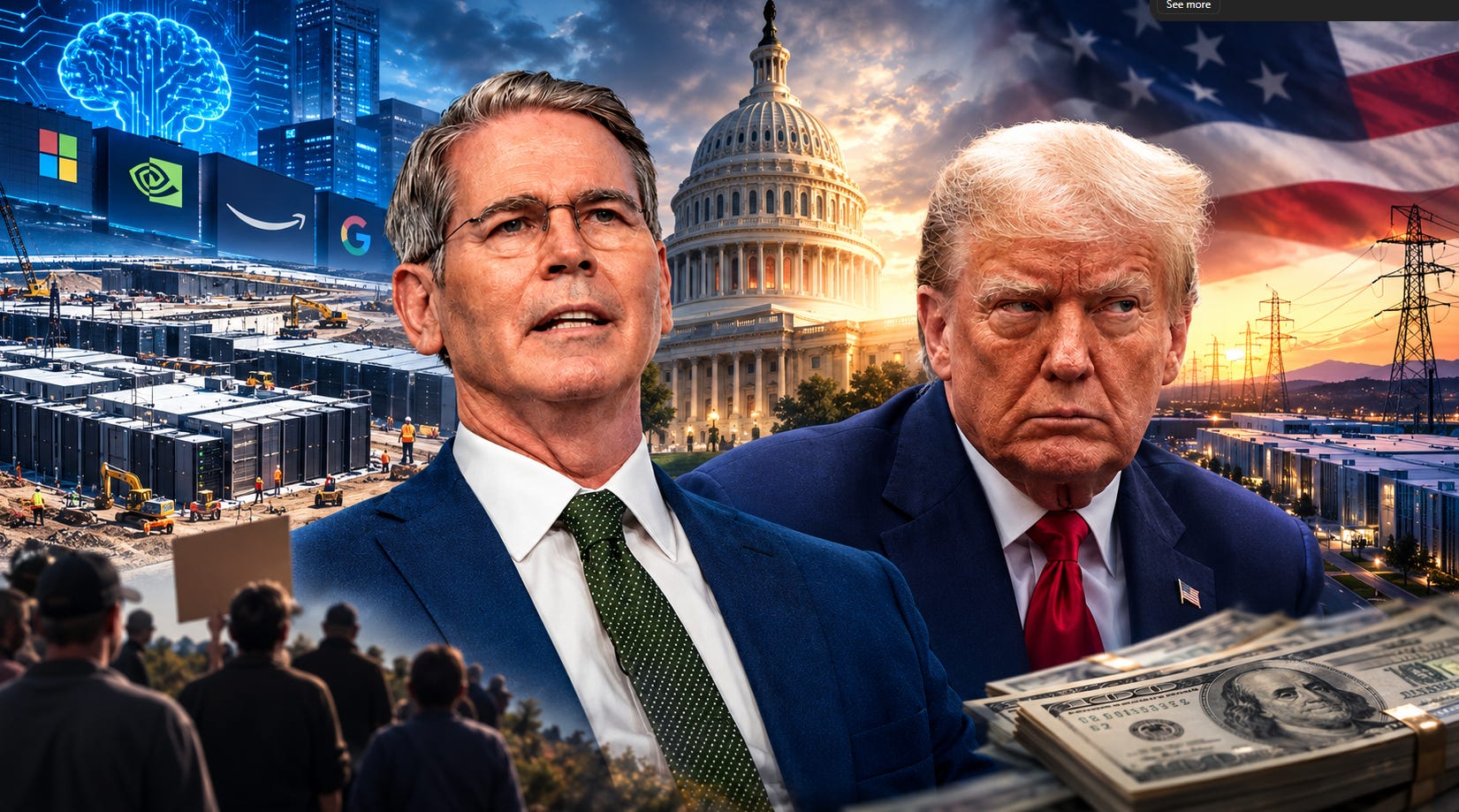
Treasury Secretary Scott Bessent recently said that Chinese AI is doomed because it comes from government planning, while American AI grew on its own. I understand the logic, but the problem is that at the same time, he was out there in public defending data center construction, and suggesting that the residents fighting those projects might be repeating foreign propaganda. If the market truly grows on its own, it does not need Scott Bessent to step in and handle complaints from all the homeowners and residents.
So let’s take his own question seriously. Is American AI really free of government?
Federal land has been opened for data centers, and energy permits are being fast-tracked for them. The Defense Department is signing contracts with these companies worth hundreds of millions each. Loans, grants, tax breaks, subsidies, and long-term purchase agreements are already authorized and sitting in the toolbox waiting to be used. And Washington already traded CHIPS Act money for roughly 10 percent of Intel, which makes the government a part-owner of the company. Once government takes equity in the chipmaker, the next step is taking equity in the AI companies, and it just makes sense.
The US government is helping this market grow. It never grew on its own.
Is there a mistake in the comparison?
Bessent’s real argument is that Beijing will never give up control. It will never allow a founder to build something powerful enough to threaten the government. Whether that assessment is accurate or not, it also implies something about the American side.
Beijing makes sure tech capital has no hold over policy, so it keeps the companies at a distance. Washington treats tech capital as a partner, so they work together. In both cases the state is standing right there in the room, and the difference is only which direction it is pushing. Bessent calls the American version freedom. I think it is very fair to call it a merger. The state merged with the tech oligarchs.
A government that keeps capital at arm’s length at least still thinks of itself and capital as two separate things, and it does not get its policy written by the corporations it is supposed to oversee.
A government that clears land, approves power, offers grants and takes equity has become part of the corporation. Its policy is shaped by that corporation and by the people who own it. So if Bessent’s concern is a state that refuses to let go of control, He wants you to conclude that America’s system is the better one. It is not. This is a country where the government and private business run the operation together, and where policy direction gets shaped by the people who own the companies. That is oligarchy. America is not a better example.
Nobody kidnapped the government
There is a saying that Washington got captured by the tech companies. I think that version is too simple, and it makes the government sound like a victim. It is not.
Nobody dragged the government onto this train. It got on by itself, and then it sped the whole thing up.
Once you get on the train, you lose the ability to get off. Washington can no longer let this industry fail the way that normal businesses fail, because it has way too much riding on it. Too much of the stock market, too much of its own credibility, and now everything sits with a handful of the same companies.
This is not even a partisan issue. Both sides hold the same position. Sanders wants the government to hold a majority stake in AI companies, for reasons of fairness and distribution. Trump has expressed interest in the government owning a piece as well. They both agree that Washington should be a shareholder in these companies. The only argument left is how much to own and how to split the profit.
This is not a business. It is money nobody is allowed to lose
People usually mix up two separate things. Whether AI is useful, and whether the trillions of dollars already spent on it can actually earn a return, are completely different questions. I think AI is useful. I highly doubt the second one.
The real gap is between what these companies have already promised to spend and what they are actually making. They have signed multi-year compute and data center contracts stretching years into the future, while annual revenue is still in the low tens of billions. At the same time, the price of running these models keeps falling year after year. Usage goes up, revenue per use goes down, and the cost of building keeps climbing.
Now add the Chinese models to that picture. Their tokens are far cheaper than anything an American company can offer, and they are open. That is where the panic comes from. It is not that the American models are worse. It is that the price they need to charge to justify the spending is a price the market no longer has to pay. Meanwhile the data centers still have to run, the infrastructure still has to be built, and the bill keeps growing into the future.
Which leads to the strangest part of all of this. The technology may genuinely change the world, and the people paying for it today may not be around to collect. The technology can succeed while the money fails.
And once the money gets big enough that nobody can afford to admit the loss, it stops following business logic. The question is no longer whether this investment will pay off. The question becomes how expensive it would be to stop. Not expensive in dollars. Expensive in politics.
So who is the one who actually has to be kept quiet?
Opposition to data centers has become one of the few genuinely bipartisan movements in America. The reasons behind it are completely material. Electricity rates, water use, land, noise. There is nothing ideological about any of it.
Which is exactly why it gets answered with ideology. Oppose a data center and you are told you are handing the AI race to China, and maybe doing someone else’s work while you are at it. That is not confusion on their part. They know exactly what they are doing. When people organize around a bill they can actually see, the fastest way to break that up is to turn it into an argument about China, about socialism, about whose side you are on. A material reality has one obvious question at the center of it, which is who pays. An ideological fight has no center at all, and that is the point.
And that is the answer to Bessent’s own question about control. In this arrangement, the side that has to be managed is not capital. It is you. Beijing keeps its companies out of policy. Washington does not need to, because the companies and the government are on the same side. What Washington has to manage is the neighbor who shows up at the county hearing to ask why the power bill went up.
The bill already arrived. It just didn’t come with an invoice
Your retirement account is already in this trade. Data centers cost far more to build than these companies make, so the building is paid for with borrowed money. That debt did not stay in Silicon Valley. It went into bond funds, pension funds, and your local bank. Nobody asked if you wanted a piece of it. You already own one.
The stock market has the same problem. A few companies now make up so much of the index that spreading your money around does not really spread your risk anymore. If you have an index fund or a 401k, a big chunk of it is riding on one story. Open your account and look.
And your power bill is the only part of this that has already shown up. Everything else is still coming. The rate increase is here now.
Stop asking when it pops
If the bubble crashes, the rescue money comes out of public spending. Balance sheets get protected, public services get cut. We have seen this before, in the bank bailouts of 2008.
If it does not crash, then your power bill, your taxes, your property tax, your local budget and your retirement savings keep it alive for the next ten or twenty years. The cost gets socialized onto you, one round of spending at a time, and there is no point in sight where it stops.
Crash and you pay for the burial. No crash and you pay for the life support. Both roads end at the same register.
Which brings us back to the original question. Every government has some control over the companies inside its borders, and every government intervenes in its market to some degree. Intervention is not evil by itself. The question is who it intervenes for.
When workers lose their jobs, when rent goes up faster than wages, when the hospital bill shows up, Washington tells you that this is the market and you have to deal with it yourself. When tech capital is facing a few hundred billion in possible losses, Washington turns it into a matter of national security and an ideological fight, and suddenly everybody has to deal with it together.
It is not that the government refuses to step in. It is that you are not on the list of people it steps in for.
China bad because govt directs policy for business! 😡
USA good because business direct policy for government! 😊
💥🦅💪🤡