

The war in Ukraine is still going on. People are dying, cities are smashed, families are scattered.
And in Washington, the conversation has already moved to a different question:
Not how to end the war in a just way, but how to turn the mess into a deal.
Trump’s team is selling something they call a peace plan. Once you read what has actually been reported, it does not feel like diplomacy. It feels like a two trillion dollar term sheet.
The basic structure is simple:
Reopen Russia’s two trillion dollar economy, with American companies at the front of the line.
Turn roughly 300 billion dollars of frozen Russian state assets into a controlled “reconstruction and investment” pool.
Use that to slowly bring Russia back into the system and eventually back toward something like the old G8.
The word on the brochure is “peace”.
The logic underneath is profit and leverage.
1. Who is really writing this “peace plan”
If this were a serious peace project, you would expect seasoned diplomats, military people, regional experts.
That is not what is happening.
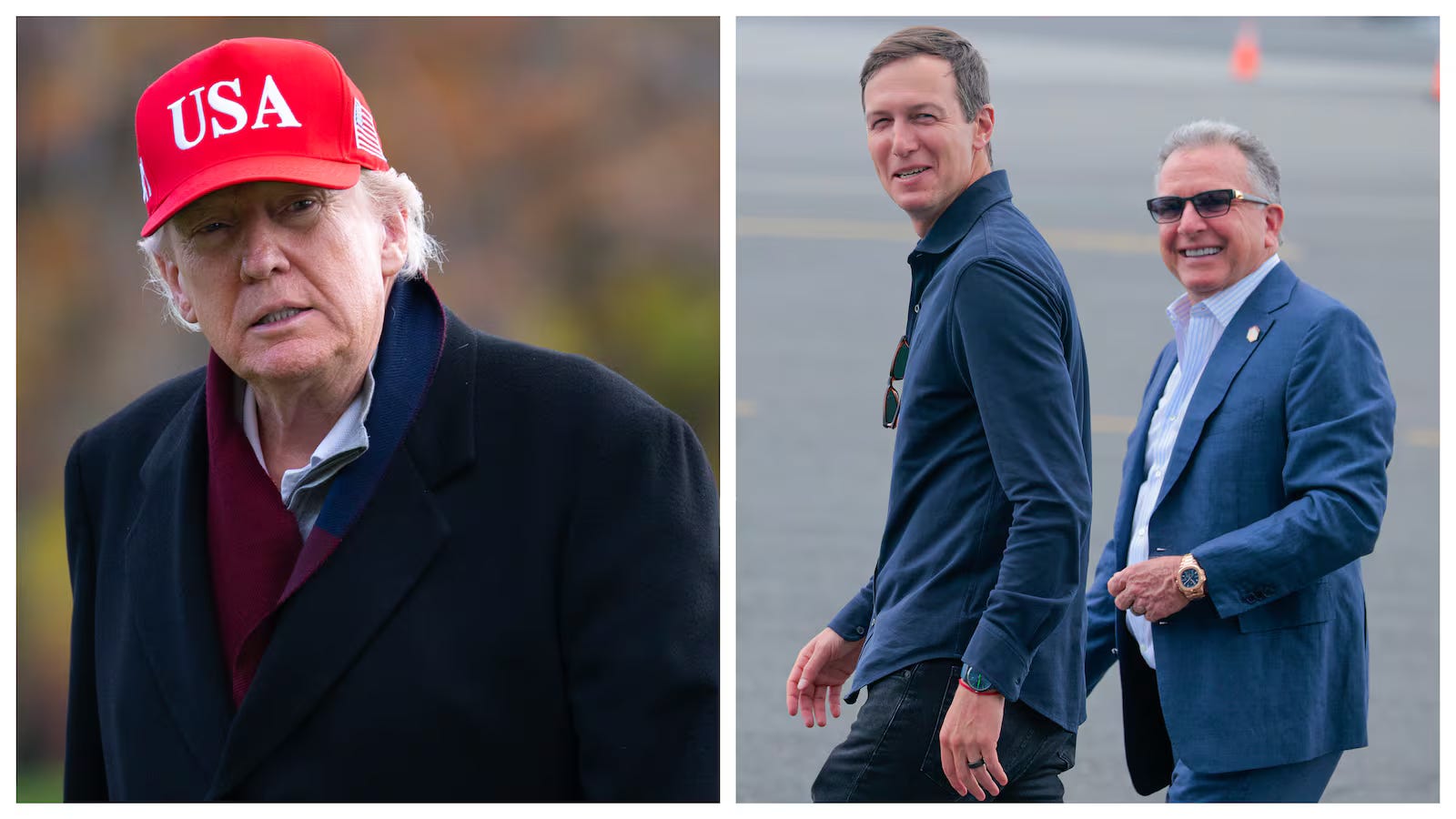
Trump sent two people:
Steve Witkoff, a real estate developer and long-time friend.
Jared Kushner, his son in law, who now acts like a private foreign ministry in human form.
They have been talking to Kirill Dmitriev, a Russian financier close to the Kremlin who is already under Western sanctions. These are not humanitarian talks. These are “post war economic cooperation” talks. Miami, Doha, Geneva. Hotel lobbies, private rooms, all the usual places.
Then they call Zelensky and read a 28 point plan to him over the phone. Not a negotiation between equals. More like “here is what we drafted, react to it.”
Later reporting shows something even more blunt. Parts of this American peace plan line up neatly with a Russian “non paper” that set out Moscow’s ideal endgame and was quietly handed to U.S. officials.
So the core conversation looks like this:
Russian power on one side.
American capital and Trump’s circle on the other side.
Ukraine listening in.
You can call that many things. Neutral mediation is not one of them.
2. What is inside the “peace” if you read it like a deal
If you stop treating this like a moral project and read it like a term sheet, the structure is easy to see.
First asset: Russia’s economy.
Sanctions have pushed a lot of Russian value into distressed territory. Energy, minerals, Arctic shipping routes, pipelines, big infrastructure, future industrial projects. The plan talks about reopening Russia’s two trillion dollar economy and “positioning American business” to lead. That is code for who gets early access once the ban is relaxed.
Second asset: frozen reserves.
Around 300 billion dollars of Russian central bank assets are frozen in Western jurisdictions. On TV, politicians say “we will make Russia pay for reconstruction.” On paper, what you have is a big pot of money that needs managers, structures, fund vehicles and project selection. That is where banks, funds, and contractors appear. That is where the fees live.
Third asset: reconstruction itself.
Everything broken in Ukraine can be turned into a line item. Power grids, ports, rail, roads, housing, data centers, new energy systems. You can make money on financing, on insurance, on construction, on technology, on the concessions that follow. And once you write a path for Russia back toward the G8, you send a clear signal that Russia is not permanently toxic. It is a damaged asset that can be cleaned and sold again.
At that point, you are not talking about “ending a war.” You are talking about how to manage the after market.
