

Juan Orlando Hernández was not a random criminal. He was president of Honduras from 2014 to 2022. A U.S. jury convicted him of conspiring to traffic roughly 400 tons of cocaine into the United States. The Justice Department estimated that this equals around 4.5 billion doses of cocaine. Prosecutors said he was at the center of one of the largest and most violent drug trafficking conspiracies in the world.
In plain language, he helped flood American streets with poison and helped kill Americans by the thousands.
He was sentenced to 45 years in U.S. prison.
Now Donald Trump says he plans to pardon him.
So do not tell anyone this is about “stopping drugs”. He is not stopping drugs. He is choosing who is allowed to profit from them.
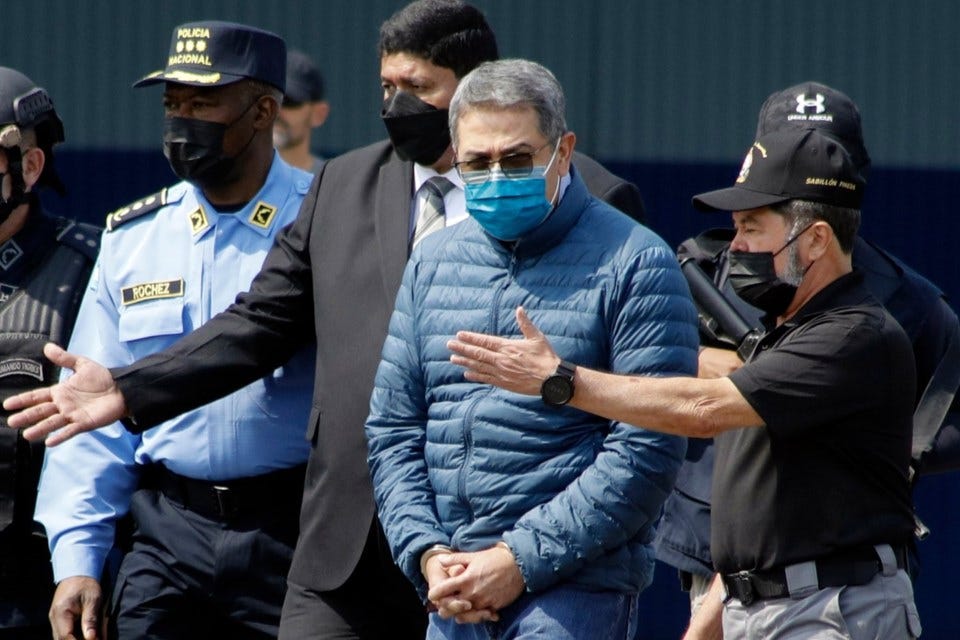
Partner first, drug lord later
For years, Hernández was introduced as a reliable partner of the United States. He attended summits, posed for photos, signed security agreements, talked about “cooperation” and “fighting crime”. U.S. money, training and political support flowed into his government.
All this happened while his own brother, Tony Hernández, was already on U.S. radar as a major trafficker. U.S. agencies had files on the family. Prosecutors now say that as president, Juan Orlando Hernández used the army and police to protect cartel shipments and secure trafficking routes in exchange for bribes and political backing.
So the timeline is simple.
When he was useful, he was a partner.
When he became a liability, he became a kingpin.
The behavior did not transform overnight. The label did.
Now Trump wants to flip the label again. From convicted drug boss back to protected ally. That is not a mistake. That is how the system works.
The drug war is not a war. It is management.
For decades, the United States has been talking about a “war on drugs”. Armies, coast guards, DEA, and intelligence agencies, all wrapped in war language and moral language.
If you look closely at who gets punished and who gets protected, the real pattern is obvious.
At the bottom, poor users and small dealers are hammered. Black and Latino neighborhoods are heavily policed and heavily incarcerated. A few grams can destroy someone’s future. Addiction is treated mainly as a crime problem, not as a health crisis.
At the top, people who help move tons of product through the system can still be invited to international meetings, called “strategic allies” and protected for years. When they fit U.S. interests, they are partners. When they stop fitting those interests, they suddenly become symbols of evil. And if the political winds change again, they can even be considered for pardons.
So the drug war is not really a war on drugs. It is a way to manage populations and territory.
It punishes the powerless.
It negotiates with the powerful.
Hernández is not proof that the system failed. He is proof that the system is working exactly as designed.
Who pays for those 400 tons?
If you look at this through class instead of slogans, the cost of those 400 tons lands very clearly.
In the United States, the cost shows up as overdoses, broken families and neighborhoods stuck in a cycle of addiction and incarceration. The people living in those places do not control foreign policy. They do not get to sit in courtrooms with teams of lawyers. They will never receive a pardon.
In Honduras and across Central America, the cost shows up as communities trapped between cartels and the state. Ordinary people live under constant threat from gangs and heavily armed groups. Parts of the police and military act as muscle for the same networks that move the drugs. Many people are forced to flee, then get blamed as “illegal migrants” when they arrive at the U.S. border.
The people at the top of this chain have a very different experience. Presidents, ministers, bankers, advisers and business elites live in gated neighborhoods with private security and private clinics. For them, cocaine is not a personal disaster. It is a business risk inside a lucrative system.
That is why one man at the center of a 400 ton cocaine pipeline can even dream of a presidential pardon, while a teenager caught with a small amount cannot even dream of a clean record.
What a real drug policy would look like
If there is such a thing as a real drug policy, it does not start with bombing boats or making dramatic statements on social media. It starts inside your own borders.
First, it makes it very hard to run a drug business domestically. That means going after the entire chain, not just grabbing the easiest targets. Large scale traffickers, financiers, logistics operators, mid level distributors and street level dealers all face consequences. Case by case, proportionate, but consistent. If you turn drugs into a business model, the system makes that a very bad business to be in.
Second, it draws a hard line between dealers and users. A dealer makes money from other people’s damage. An addict is already the damage. Those are not the same thing. You can be severe toward traffickers and still treat addiction primarily as a medical and social problem. That means real rehab, long term support and a path back into normal life instead of a permanent criminal label.
On this point, the current U.S. model is close to the worst of both worlds. It is often selective or soft toward serious traffickers when they are politically connected, and harsh toward addicts and small dealers who are easy to arrest and easy to forget.
There are other approaches. In a lot of East Asian countries, internal policy is much tougher on trafficking networks. The message is simple: if you allow large scale drug networks to grow inside your borders, your society will eventually be destroyed from within. Severe punishment is used to choke off the business. At the same time, at least in principle, addiction is treated as something that requires rehabilitation, not just endless punishment for its own sake.
Of course, that model also has real risks. States can abuse “drug crimes” as a cover for political repression. Harsh punishment without due process is just another way to crush dissent. If you are serious, you need both sides: serious, predictable punishment for those who run the trade, and serious, predictable support for those who are already addicted.
Without both, you do not have a drug policy. You only have theater.
Culture is part of the battlefield
There is another uncomfortable piece people like to ignore: culture.
Look at how often Hollywood comedies treat drugs as a joke. Characters get high, make a mess, wake up in chaos, and somehow it all resolves into a fun story about friendship, freedom and a “crazy night”. To older viewers, it may look harmless. To younger viewers, it looks like a script for how to live.
Drugs equal fun. Drugs equal personality. Drugs equal a good time.
You cannot build a culture where drugs are constantly presented as entertainment and then act surprised when addiction spreads. Culture is not neutral. If media can be used to sell wars and consumerism, it can also be used to shape how people think about drugs.
If a state was serious about fighting drugs, it would not only talk about police and prisons. It would also pay attention to what its own cultural machine is teaching people to admire. You do not need pure propaganda. You do not need to ban every movie with a joint in it. But you cannot keep selling the idea that doing drugs is fun, cool and harmless, then pretend you are waging a moral war against “poison”.
Right now, the message is split. On one side, you have judges and politicians talking about crackdowns. On the other, you have a constant stream of content where getting high is just part of the joke. That contradiction is not random. It reflects the same hierarchy: addiction is something to profit from at the top and something to punish at the bottom.
This is not a mistake. It is a hierarchy.
Put it all together and the pattern is not confusing at all.
A president who helped move 400 tons of cocaine can be treated as a partner, then as a criminal, then as a candidate for a pardon, depending on political needs.
A poor user or low level dealer can be treated as a disposable problem, locked away and forgotten, regardless of the bigger system they are trapped in.
That is not a war on drugs.
That is a hierarchy of who is allowed to run the trade, who is allowed to escape punishment, and who absorbs the damage.
If you still want to call this a “drug war”, then at least be honest about which side it is actually fighting.