

1. AI gets the headlines. Blue-collar workers take the hit.
If you listen to American media right now, you would think the main victims of the economy are coders and bankers scared of AI.
But the latest Labor Department data that Newsweek used tells a different story.
Blue-collar work is sliding backward again.
Manufacturing, construction, mining and logging, transportation and warehousing, utilities
put them together, and blue-collar job growth just turned negative for the first time since the pandemic. The White House is still talking about “reviving the blue-collar boom from Trump’s first term.” The charts say that boom is dead.
This is not about feelings. It is about the shape of those bars.
2. What the charts really show
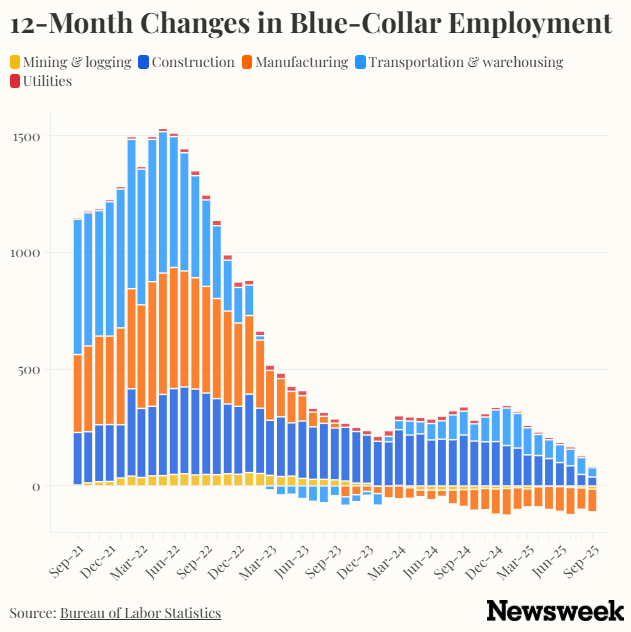
Twelve-month changes
On the left side of the first chart, from late 2021 into 2022, the bars shoot up. Blue-collar jobs surge by more than a million over twelve months. That looks like a miracle until you remember what happened.
That was just reopening after COVID. Factories called people back. Construction sites restarted. Warehouses rehired. It was make-up growth, not a new era.
Move your eyes to the right side. Through 2023, the bars shrink. In 2024 and 2025 they hug the zero line and slip below it. The twelve-month change turns negative.
So the real story is simple: one short rebound, then return to decline.
Monthly changes
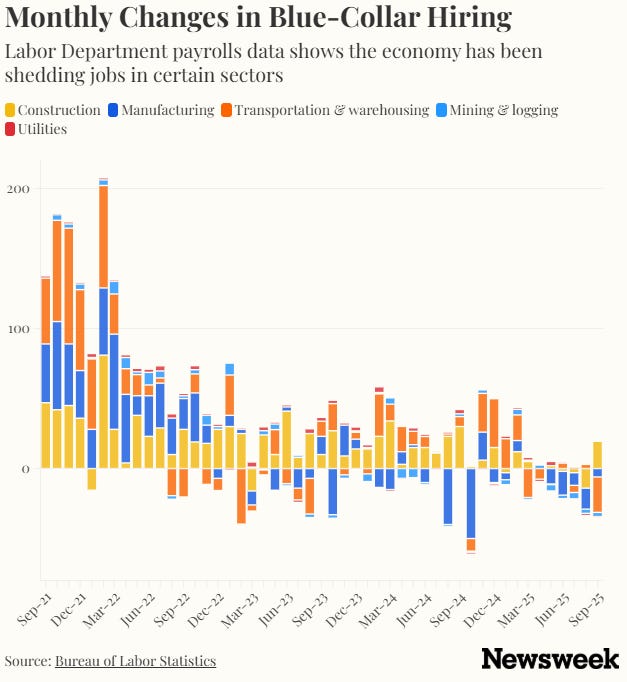
The second chart zooms in month by month. At the start, you see big positive bars. By 2023, the gains are small and uneven. By 2024 and 2025, negative months are normal, especially in manufacturing and transportation.
This is what collapse looks like in slow motion. Not one crash, just a steady drift from healthy growth to flat to “actually, we are losing jobs.”
If someone still calls this a “blue-collar boom,” they are selling you a campaign slogan, not reality.
3. Trump’s policies: big talk, bad environment
Trump did not create fifty years of manufacturing decline. But his current policy mix does not protect workers. It makes their situation more fragile.
Tariffs
Tariffs are marketed as “standing up for American workers.” In practice they create chaos.
If you own a factory and have no idea what your input costs or export rules will be six months from now, you do not build new plants or hire long term. You wait.
Tariffs also act like a tax on consumers. Prices rise, people buy less, and employers freeze hiring. So a policy that supposedly protects workers ends up cutting their spending power and scaring off investment.
Immigration crackdowns
Construction depends heavily on immigrant labor. When immigration rules are tightened in a blunt, political way, projects stall. Developers slow down or cancel. That means fewer future jobs for everyone, including local workers.
On paper this is “protecting American jobs.” On the ground it is fewer projects and weaker job growth in one of the last blue-collar sectors that was still breathing.
Automation
Economists in the Newsweek piece point out that manufacturing output is up while manufacturing employment is down. More stuff is being made with fewer humans.
That is the result of decades of automation and pressure to cut labor costs. Trump celebrates the output and the profits, calls it proof that “America is winning,” and ignores the workers who disappeared from the line.

4. This has been a 50-year project, not a 2025 accident
Manufacturing jobs have been shrinking as a share of total employment for more than half a century. That was not random. It came from clear choices:
Crush unions and weaken collective bargaining.
Move production offshore whenever possible.
Financialize the economy so trading paper pays more than making things.
Treat labor as a cost line, not as human lives.
Trump is just the loudest salesman for the end stage of that model. He wraps it in flags and religious language, but still protects capital first and lets workers fight over the leftovers.
So when economists say those “good old manufacturing jobs” are not coming back, they are not being dramatic. They are describing a system that does not want them back.
5. So what now? Three levels of “solutions”
If the article stops here, it is just depression porn. So let us talk about what “solutions” actually exist, from a worker’s point of view.
Level 1 - band-aids
This is what every administration offers.
Tax credits, training programs, infrastructure bills, tariffs with patriotic branding. Some local areas get a new plant or highway. A few years of decent jobs appear.
Then the cycle repeats. Ownership stays concentrated, profits outrun wages, and jobs vanish in the next downturn or tech shift. Band-aids matter for survival, but they do not change the direction of the system.
Level 2 - reforms inside capitalism
This is the space of democratic socialists and social democrats.
Stronger unions and labor laws
Higher minimum wages
Public health care and education
Industrial policy that keeps key production at home
Higher taxes on the rich to fund all of this
This can produce a softer, more livable capitalism. It is worth fighting for. For workers, it means more security and real bargaining power.
But it has limits. Capital pushes back. Every election becomes a fight to defend basic protections. Production is still driven by private profit.
You get a safer cage, not a different game.
Level 3 - a real turn
If you want a real, long-term fix, the question becomes blunt:
Who controls production and investment?
A serious turn would mean:
Public or cooperative ownership in key sectors like energy, transport, housing and health care
Real worker power inside firms, not symbolic seats
Long-term planning based on jobs and social needs, not just quarterly earnings
Political rules that break the grip of big money so workers can actually form parties that represent them
That kind of shift is not a policy tweak. It is a change in who holds power.
In China, big turns happened after revolution and under a government that could redirect the system from the top. The U.S. does not have that starting point. Any deep turn there will be hard, slow and ugly. But pretending it is not needed is just lying to workers.
6. The honest bottom line
If you are a blue-collar worker in America right now, this is the reality:
AI panic is loud, but your jobs have been under attack for decades.
Current policies add more chaos instead of stability.
No single president is going to rebuild a 1960s style industrial middle class for you.
There are still things worth fighting for right now: stronger unions, better wages, health care, safer conditions, less division among workers. Those are real gains.
But anyone who tells you that a new “blue-collar boom” is just one election away is selling you a fantasy.
The charts in that Newsweek article already told the truth. The boom is over. The question now is whether workers stay scattered and hope for a hero, or start organizing for something much bigger than the next campaign slogan.
Revolution happens after institutions change. If you want to know what institutions have changed, and how, ask an old person. Someone who remembers life before email, when sending snail mail to a pen pal in another country was something special. When the only video you saw was broadcast on one of three broadcast television networks owned by media corporations who made money by selling ads. When your small town had a local daily newspaper, which made money by selling ads. When seeing President Nixon's complaint about a "damnable lie" on the front page of the daily small town paper upset your grandmother.
Which is to say that the media institutions have changed, and continue to change. The legacy media is owned by corporations that also have businesses besides media. The world wide web allows other media platforms to replace legacy media. In a nation of over 300,000,000 people, a 1% audience share for a TV program is considered astounding. But every day, people take their supercomputer from their pocket and communicate with other people around the world. You can forget about manufacturing consent. But organizing protests? Boycotting? Disinvesting? It's happening.
The US is heading towards the end of its hegemony in the world. The US people are in for a very bad time. The US government is losing legitimacy. The trillion dollar corporations are losing legitimacy. The billionaires are losing legitimacy.
People say we need direct election of the President, but removing the Electoral College requires amending the Constitution, which was written by slave owners to protect slavery. Well, if the Constitution can't change to keep up with society, then we need a new Constitution. After all, the current Constitution was not the original constitution of the US. A new constitution could establish direct elections, proportional representation and human rights. That would be revolutionary.
Shutting down the government was about hiding the labour situation from the public. The failure of Trump as an idea.