

The U.S. bombardment of Iran was launched without a real public case, without Congress, and without a political endgame. That is not “messy governance.” That is deliberate contempt for accountability.
And the ugliest part is this: the people in charge are not confused. They are not panicking. They are doing what the U.S. power system does best - convert violence into leverage, then outsource the cost to civilians.
I. Democrats Are Not Opposing the War. They’re Keeping Their Hands Clean.
If Democrats actually wanted to stop a war, they would have forced a confrontation before the first strike. Immediately. Publicly. Relentlessly. They would have dragged Congress back into session and made unauthorized war a constitutional crisis.
They didn’t.
Here is the record:
Feb 20: Reuters reports Congress could vote on a War Powers resolution “as soon as next week.”
Feb 26: Hakeem Jeffries says a vote will happen after Congress reconvenes “next week.”
Feb 28 to Mar 1: strikes begin.
Afterward: Democratic leaders demand briefings and lecture about War Powers.
That sequence is not bad luck. It is political hygiene.


Because an urgent vote before the bombs fall forces real choices and real fingerprints. It splits the party. It exposes the hawks. It exposes the donor class. It creates a record that voters can use.
So leadership waited.
Once war becomes a fact, “opposition” becomes safe theater. Members can hide behind a unified language. Leadership can posture without blocking. Everyone gets to look principled while doing nothing that could actually slow the machine.
Schumer’s framing makes the scam obvious: criticize the process, repeat “Iran can’t have nukes,” and keep both exits open.
If the war “works,” they claim national-security seriousness.
If the war goes sideways, they pin the wreckage on Trump.
Either way, Democrats cash in. War becomes a political asset.
No, it’s not a conspiracy. It’s worse. It’s normal.
II. Trump Has No Plan for the Iranian People - That’s the Point.
Trump doesn’t even pretend to have a real strategy for the Iranians. He has threats, strikes, and slogans. That’s not a plan. That’s a tantrum with missiles.
The Atlantic spells this out: the bombardment was launched without explanation, without Congress, without building public support, and without a coherent strategy for the Iranian people or a plan that would let them shape a legitimate state afterward.
And Trump’s messaging proves it.
In early January, during the uprising, he urged Iranians to “take over their institutions” and hinted help was coming. Then his envoy Steve Witkoff swung the other direction - talking about deals and Iran being welcomed back into the “League of Nations.” Then Vance narrowed it down to a single sentence: the U.S. cares about nukes, and regime change is “up to the Iranian people.”
So what is the policy? Uprising? Deal? Shrug? Bomb?
It’s not policy. It’s improvisation. The only consistent thing is force.
Real regime change requires answers: who holds security together, who runs ministries, who controls courts, how do you prevent a vacuum, how do you stop a “transition” from turning into armed factional competition.
Trump has nothing. Airstrikes don’t create legitimacy. They create collapse.
III. If the Supreme Leader Falls, You Don’t Get Freedom. You Get a Vacuum.
People keep repeating the same childish fantasy: remove one leader and democracy magically appears.
That is not analysis. That is propaganda for people who don’t have to live in the aftermath.
Iran is a complex state with multiple pillars and a multi-ethnic society. When central authority cracks, power doesn’t flow to “the people.” It flows to whoever has organization, guns, and networks.
Then comes the fatal trap: any successor becomes a target. Whoever steps forward draws a bullseye - from external strikes and internal rivals. That doesn’t create moderation. It creates paranoia, militarization, and fragmentation.
This is how “regime change” turns into regime destruction. Iraq and Libya already ran that experiment. The hard part isn’t toppling. The hard part is not burning the country down afterward.
IV. Israel’s Real Goal: Keep Iran Broken
Now the part you want named: Greater Israel.
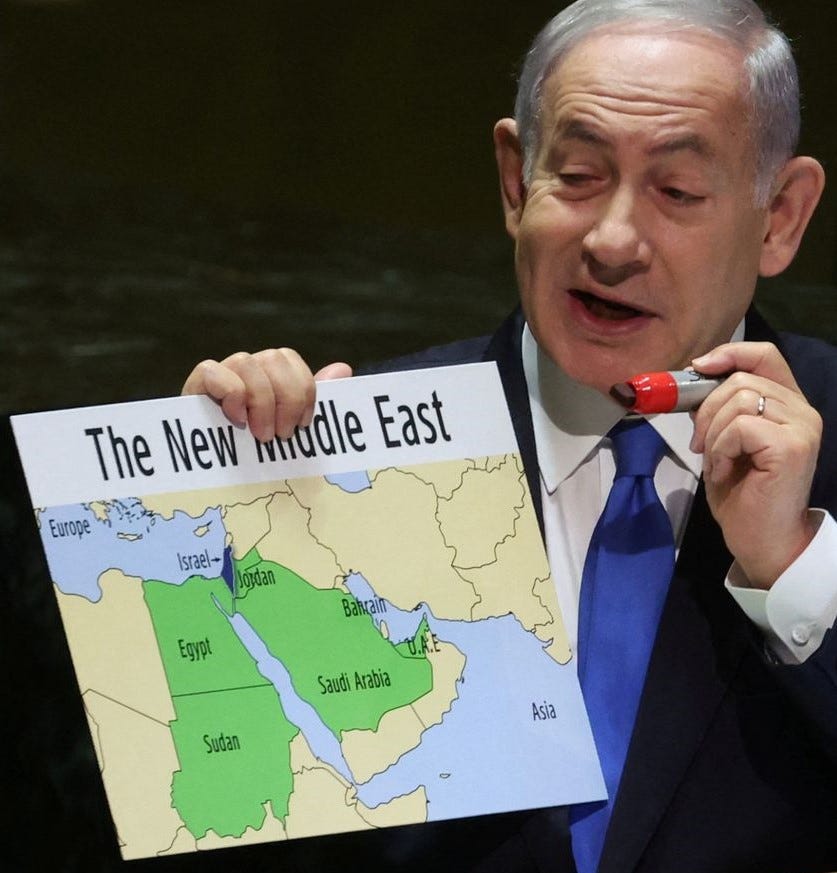
People will call it conspiracy. Fine. They can play vocabulary games. The reality is in the pattern.
Israel’s long-term strategic interest is not building a stable Iran with a legitimate government. Its interest is weakening Iran’s capacity - its deterrence, its networks, its strategic depth. That is what expands Israel’s freedom of action across the region.
A rival stuck in internal collapse is a rival that can’t resist.
So yes - whether you use the phrase “Greater Israel” or not, the outcome that serves Israeli expansionary leverage is the same: a Middle East with fewer strong constraints and more permanently crippled opponents.
And if Iran fractures, Israel doesn’t pay the cost. Iranians do.
V. Everyone Calculates. Civilians Pay.
Democrats calculate elections. Trump calculates spectacle. Israel calculates regional dominance.
Who calculates Iranian civilian life? Nobody with actual power.
No transition architecture. No reconstruction framework. No legitimacy design. No stabilization plan.
Just bombs, narratives, and the quiet assumption that civilians will absorb the consequences.
They talk about deterrence and nuclear thresholds. They never talk about hospitals, policing under vacuum, food supply chains, or what happens when a society breaks and stays broken.
Because the people are not the point. They’re the price.
A Message to Iranians - and to Anyone Dreaming of Revolution
Outside powers will always claim they’re “helping.” The real question is whether they are empowering your society or feeding off your collapse.
An egg, if break from the inside, it’s a new life. If it break from the outside, it’s food. What are you right now?
More stories you might missed,


