

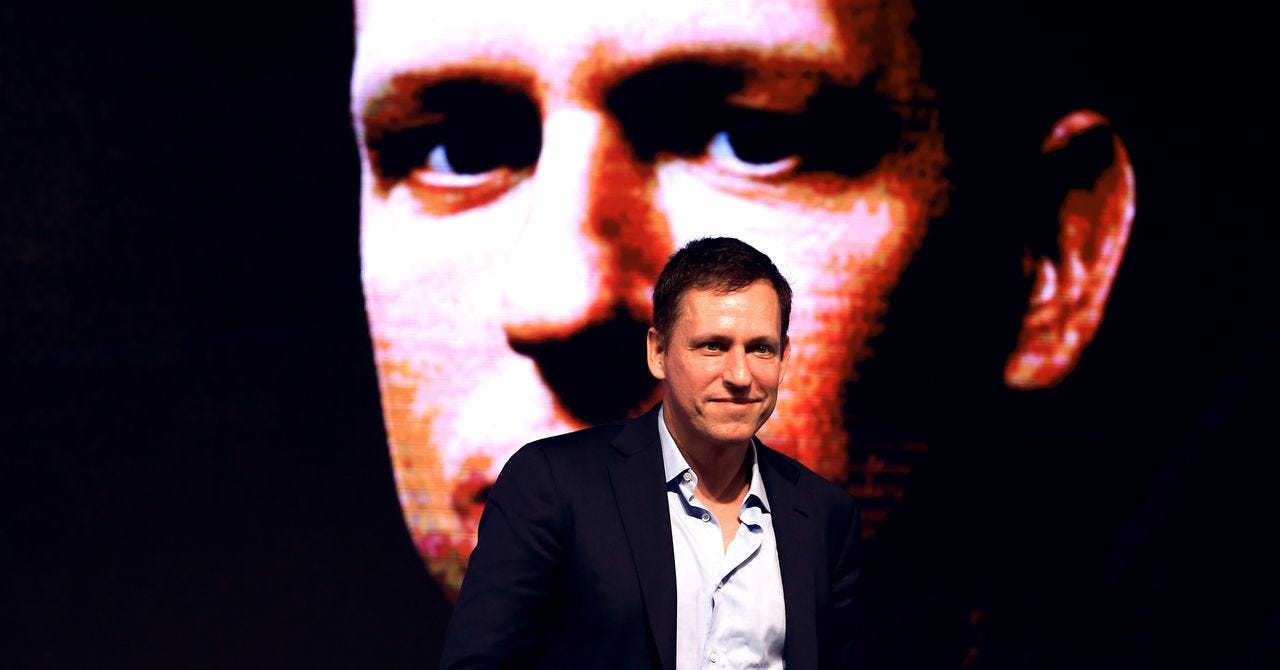
Peter Thiel says he wants less government. In 2025, governments supplied more than half of the $4.5 billion in revenue earned by Palantir, the company he co-founded and chairs.
Apparently, government looks better when it is signing checks.
In a 2021 interview, Thiel said: “I think we should have less government, more individual rights, freedom.” Meanwhile, his company sells tools that help government track people. That raises a simple question: who gets more freedom in this arrangement?
Look at the business, the tax advantages, and his own words about democracy. They support a harsh conclusion: the freedom he champions gives capital more room to operate, while his company profits from helping government exercise power over others.
Your taxes. His contracts.
Palantir makes software that brings together information from different sources and helps customers analyze it. Governments buy it for purposes including military operations and immigration enforcement.
In April 2025, ICE awarded Palantir a $30 million contract to build a system that identifies undocumented immigrants and tracks people leaving the country voluntarily.
For the government, that is an enforcement tool. For Palantir, it is business.
The company says its software has protections against government abuse. Fine. Someone outside the company needs to check whether those protections work. A contractor’s promises cannot replace people’s ability to find out what government is doing with their information and challenge its use.
The people being tracked cannot choose another provider. ICE chooses the software. Public money pays for it.
That is the problem buried underneath all the talk about freedom. Government can restrict people’s lives, and a private company can earn money helping it do so.
Your retirement savings. His $5 billion.
Thiel’s Roth IRA shows another side of the same class advantage.
A Roth IRA is a retirement investment account: you generally put in money already taxed, and can later withdraw investment gains tax-free if you meet the rules.
According to ProPublica, Thiel used his account to buy early PayPal shares for about $1,700 in 1999. Sale proceeds stayed inside it and funded further investments, including Facebook and Palantir. By 2019, the account was worth roughly $5 billion.
Contribution limits restricted what he could put in, but did not cap the growth inside. His access to cheap founder shares helped turn a retirement account into a tax shelter for billions.
Most workers cannot buy those shares. They save whatever is left from their wages. The rules may carry the same name, but the opportunities are worlds apart.
What happens when ordinary people vote?
Thiel gave an unusually direct answer in a 2009 essay: “I no longer believe that freedom and democracy are compatible.”
He pointed to growing numbers of welfare beneficiaries and the extension of voting rights to women as obstacles to libertarian politics. He later clarified that he did not support taking anyone’s voting rights away.
But consider the complaint. People who depend on public services have reasons to vote for them. Workers have reasons to demand labor protections. Voters can demand that billionaires pay more tax.
These decisions limit what wealthy people can keep and what businesses can get away with. They also give ordinary people some power over decisions affecting their lives.
When those choices clash, whose freedom counts?
Near the end of that essay, Thiel described making the world “safe for capitalism.” His words.
The public should be asking what happens when keeping capitalism safe requires shielding it from the public’s demands.
Capitalism makes this profitable
Thiel may sincerely believe in freedom. He can also make money from a company that helps government enforce its authority. Both can be true. His sincerity does nothing for the person being tracked.
Capitalism rewards the sale. A government agency wants better tools. A company supplies them. Revenue grows. Investors benefit. Whether the people affected gain any freedom is a separate question, and their agreement is not required to complete the transaction.
That is why this goes beyond one billionaire’s hypocrisy. Government power itself can become a business opportunity.
A billionaire can demand lower taxes and fewer restrictions on business while benefiting from government spending and enforcement. The state remains useful as a customer, a defender of property, and an enforcer of rules. It becomes objectionable when voters want it to restrain wealth.
For working people, the consequences are concrete. Taxes pay the contractor. The contractor supplies the tools. People affected must fight through the courts or politics to protect their rights.
So cut the crap about “less government.” Finish the sentence. Less government doing what, to whom?
Less government collecting tax from billionaires? Less government protecting workers? Or less government tracking people’s lives?
Those are very different promises. Nobody should let a billionaire hide them inside the same word: freedom.
A government can leave the rich with fewer restrictions while keeping everyone else under tighter control. Its contractors can make a fortune along the way.
Small government for the owners. Expensive government for everyone paying the bill.
Subscribe to GrumpyChineseGuy for reporting and class analysis that follows the money past the slogans.