

On January 24, 2026, 37-year-old Alex Pretti, an ICU nurse and U.S. citizen, was shot and killed by a federal Border Patrol agent during a Department of Homeland Security immigration enforcement operation in south Minneapolis, near Nicollet Avenue and 26th Street.


Pretti was not the target of the operation.
According to the Department of Homeland Security, agents were conducting an immigration enforcement action when Pretti allegedly approached officers while armed with a handgun. DHS claims he resisted efforts to disarm him, and an agent fired in self-defense.
That version of events was released quickly and decisively. It is also now being openly disputed.
Multiple videos circulating online show Pretti holding a phone, filming, and appearing to assist others during a chaotic confrontation involving pepper spray and multiple agents. In the footage available so far, there is no clear visual of Pretti pointing a firearm at officers before he was forced to the ground and shot. No body-camera footage has been released. The investigation is ongoing.
This matters because Minnesota law allows lawful firearm carry, and Pretti was reportedly a legal gun owner. Carrying a firearm, by itself, is not a crime under state law. If the mere presence of a legally owned weapon is treated as justification for lethal force, then the boundary between law enforcement and violence collapses.
That boundary is exactly what Minneapolis is now confronting.
From Enforcement to Escalation
News of the killing spread rapidly. Large protests erupted across south Minneapolis. Demonstrators confronted federal agents. Chemical irritants were deployed. Arrests followed.
The Minnesota National Guard was activated to secure federal buildings and manage unrest. Events across the city were postponed due to security concerns.
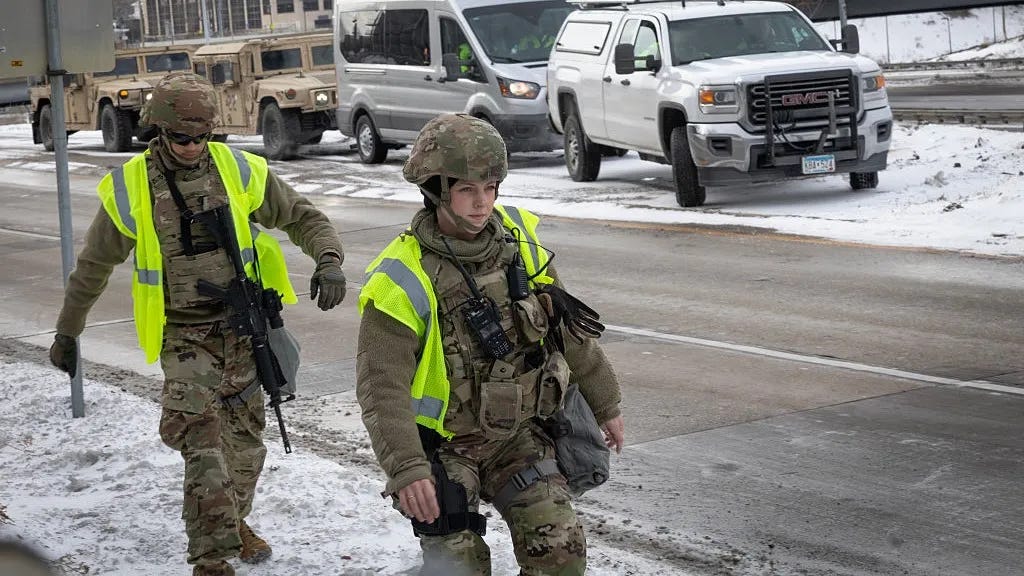
This did not happen in a vacuum.
Pretti’s killing is the third fatal shooting involving federal immigration agents in Minneapolis in less than three weeks, all linked to an expanded enforcement campaign known as Operation Metro Surge.
Federal agencies describe each incident as isolated. Residents are seeing a pattern.
When lethal force appears repeatedly under the same operation, it stops being exceptional. It becomes operational.
A City Overruled
Minnesota political leaders responded with unusual force.
Governor Tim Walz called the shooting unacceptable and announced a state-led investigation, citing a lack of trust in the federal account. He accused federal authorities of rushing out a narrative before facts were established and demanded an end to the operation.
Minneapolis Mayor Jacob Frey publicly asked federal agents to withdraw from the city, questioning how many more civilians would be harmed under the current enforcement strategy.
Attorney General Keith Ellison moved to challenge the legality of the operation in court, arguing that it violates state sovereignty and civil protections.
Despite this opposition, federal enforcement continues.
That is the core tension. City and state officials are rejecting an operation they cannot stop. Federal agents are acting in civilian neighborhoods without local consent. This is not cooperation. It is override.
What the Case Exposes
Three facts now sit uncomfortably together.
First, there is a widening gap between official federal statements and available video evidence. When lethal force is involved, speed without transparency does not build trust. It destroys it.
Second, the enforcement model on display treats civilian proximity as threat. Filming, observing, and even assisting others in a chaotic scene appear to carry risk when federal agents operate with broad discretion and minimal local oversight.
Third, the cost is not evenly distributed. Alex Pretti was not a politician or a criminal suspect. He was a working healthcare professional exercising legal rights in his own city. The consequences of aggressive enforcement are being absorbed by ordinary people, not by those who design or authorize these operations.
This is why residents are calling it violent law enforcement. Not because force was used, but because force appears to be replacing restraint as a default tool.
Why This Cannot Be Dismissed as a Tragedy
This case is no longer just about one man or one moment. It raises unresolved questions that will not go away on their own.
This won’t just stop in Minnesota. It will happen in other states. It will happen in your neighborhood. You guys need to figure out what to do - this is not going to stop.
If the state of Minnesota doesn't prosecute these ICE shooters, they will escalate killing even more citizens because they will know they can get away with it.
Minneapolis needs an umbrella and colour revolution! Learn from the Arabs and Thais! Get funding from the National Endowment for Democracy. I heard they like to fund colour revolutions.