

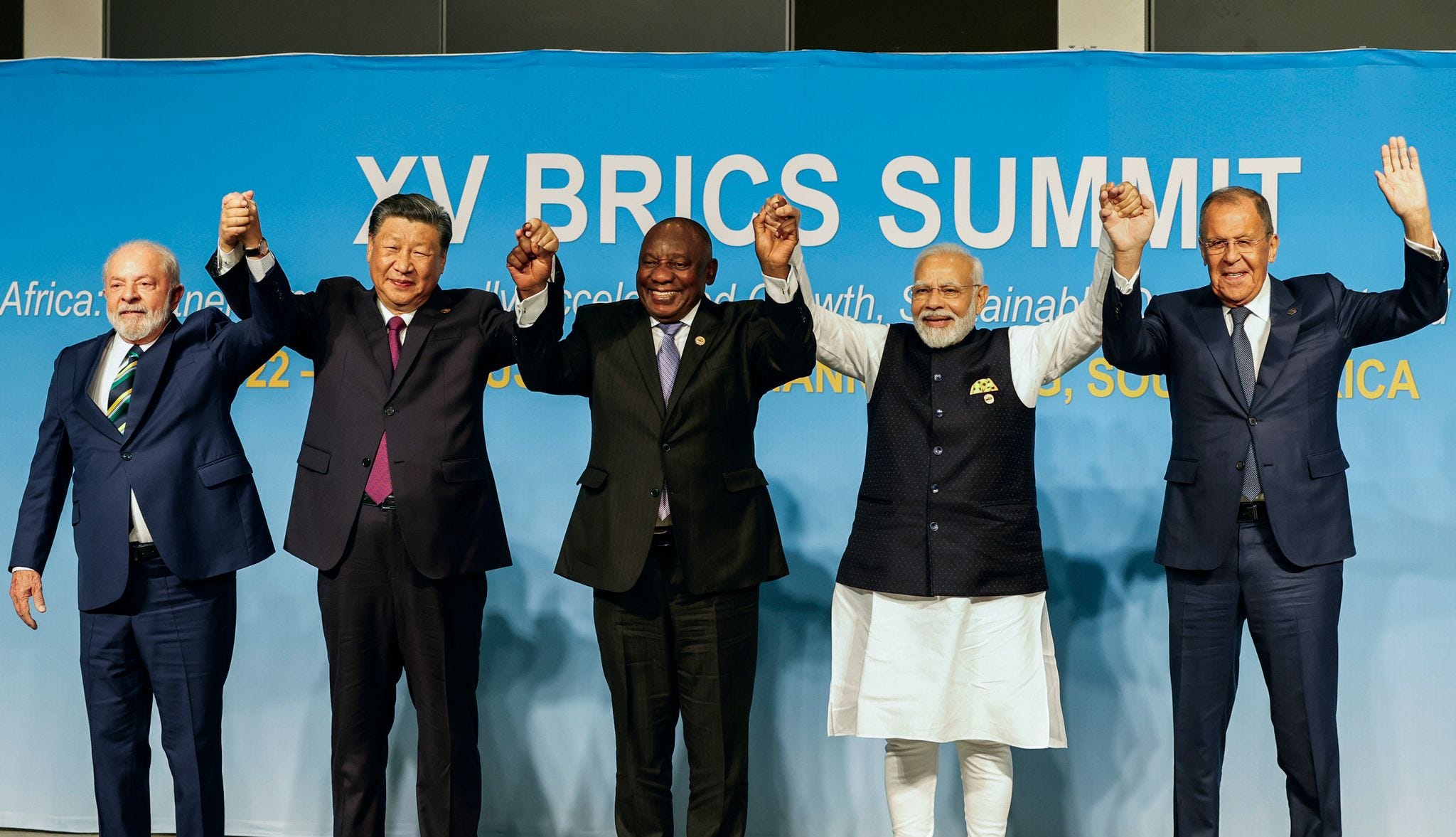
Eleven countries met in New Delhi on September 12 and 13 and adopted a 140-paragraph declaration. Paragraph 22 argued that unilateral measures contrary to international law, including sanctions not authorized by the UN Security Council, can restrict access to food, healthcare and development, with poor and vulnerable people hit hardest.
The summit also covered conflicts in the Middle East, tariffs, reform of international institutions, trade in local currencies, development and artificial intelligence. During the meeting, Xi Jinping called for deeper “Greater BRICS cooperation.”
That phrase is worth examining.
What “Greater BRICS” Actually Means
“Greater BRICS” is the usual English rendering of 大金砖合作. It is not the name of a new organization, treaty or military alliance. It describes a BRICS mechanism that has expanded beyond its five original members and is pursuing broader cooperation.
BRICS currently has 11 full members: Brazil, Russia, India, China, South Africa, Egypt, Ethiopia, Iran, Saudi Arabia, the United Arab Emirates and Indonesia.
It also has 10 partner countries: Belarus, Bolivia, Cuba, Kazakhstan, Malaysia, Nigeria, Thailand, Uganda, Uzbekistan and Vietnam.
No additional group of full members has been officially confirmed. Partner status allows deeper participation, but it does not guarantee eventual full membership.
In this context, “greater” refers to more participating countries, stronger economic connections and increased representation for developing countries in international institutions.
Xi proposed cooperation involving trade, digital industries, smart manufacturing, engineering training and open-source AI. His proposals included a BRICS AI Open Source Zone, a digital industry platform and cooperation on smart factories.
The AI proposal raises practical questions. Who will own the infrastructure? Who will establish the technical standards? Which governments, companies and communities will have access?
Open technology can widen participation. It can also support the commercial or strategic objectives of the governments and companies financing it. Its effects will therefore depend on implementation, ownership and access.
Cooperation Without Alignment
BRICS is sometimes criticized as an incoherent group because its members are not closely aligned. The Council on Foreign Relations describes it as a loose bloc rather than a formal organization.
India and China have strategic and territorial disagreements. Iran and the UAE maintain different security relationships and have serious bilateral disputes. At the same time, both governments backed the New Delhi Declaration and held high-level talks during the summit.
Brazil trades extensively with China, while India maintains close relationships with both Russia and the United States. These differences limit the degree of political unity BRICS can achieve.
BRICS is not NATO. Its members have not made mutual-defense commitments, and they do not follow a common foreign policy. The mechanism allows governments to cooperate in selected areas without requiring agreement on every international issue.
This flexibility helps BRICS attract countries with different interests. It also creates limitations. Agreements may be narrow, and implementation can be slow when members disagree about priorities or methods.
The Real Issue Is Economic Power
One reason BRICS governments seek greater cooperation is that the global economy is not politically neutral.
The dollar’s international role, payment networks, development lending, sanctions, export controls and trade rules give the United States and its allies significant structural influence. BRICS declarations have repeatedly called for greater representation for developing countries and more trade using national currencies.
Donald Trump’s tariff threats became part of this debate. In July 2025, he threatened an additional 10 percent tariff on countries aligning themselves with what he called the “anti-American policies” of BRICS. He later said the group would “end very quickly” if it formed in a meaningful way.
Trump had previously threatened 100 percent tariffs if BRICS members created a new currency or supported an alternative intended to replace the dollar.
Such threats may increase the incentive for other governments to explore alternative payment and trade arrangements.
BRICS is not currently preparing to replace the dollar with a common currency. The more immediate agenda is incremental: settling more trade in local currencies, studying cross-border payment options and expanding development financing.
These measures could give Global South governments more options and reduce their exposure to unilateral financial pressure. They could also remain fragmented, ineffective or disproportionately influenced by the bloc’s largest economies.
The Class Question
A class-based analysis separates the bargaining power of governments from the economic power of workers.
BRICS may increase the policy options available to member states without changing the distribution of wealth or political influence within those states. A government can seek greater independence internationally while maintaining domestic policies that benefit established business and political elites.
National sovereignty is not the same as working-class power.
Multipolarity is not socialism.
That distinction does not make BRICS economically meaningless. If alternative financing and payment arrangements give smaller countries more policy space, the consequences could be significant. The relevant question is how governments use that additional space.
Does development financing support hospitals, housing, energy systems and industrial development? Does technological cooperation remain accessible? Do alternative payment systems reduce transaction costs and vulnerability to external pressure? Do workers receive any measurable share of the resulting benefits?
These questions provide a more useful test than political slogans alone.
BRICS does not define itself as a military alliance designed to defeat the West. The central issue is whether it can limit the concentration of international economic power, how its institutions operate, and who ultimately benefits from the alternatives it creates.