

Trump promised to make life cheaper. Now just 27% of Latino registered voters approve of his performance, while 69% disapprove, according to a new NBC News/Telemundo poll.
Honestly, I’m surprised 27% still approve. But the more interesting question is what happened to the confidence that helped put him back in the White House.
People are checking their bills. They are watching what happens to their families. A president can repeat that everything is wonderful as often as he wants. The supermarket doesn’t accept his speeches as payment.
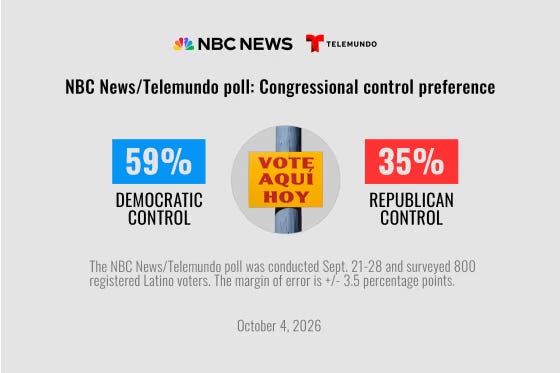
The survey interviewed 800 registered Latino voters from September 21-28, with a margin of error of plus or minus 3.5 percentage points. Its findings tell a clear story: economic disappointment and immigration enforcement are wearing down Trump’s support.
I appreciate everyone who reads and supports my work. This is a one-person operation, so please consider subscribing to my Substack. And if you’re feeling a little generous, becoming a paid subscriber would go a long way in helping me keep this going. Thank you so much.
He campaigned on the bills. Now he owns the promise.
The promise was explicit. Chapter 1 of the Republicans’ 2024 platform pledged to defeat inflation and quickly bring down all prices. It also blamed immigration for driving up housing, education, and healthcare costs.
That connected 2 campaign messages: your life is too expensive, and getting rid of immigrants will help fix it. Trump offered people a culprit and presented himself as the solution.
Now 78% of Latino voters disapprove of his handling of the cost of living. 63% say their family’s income is falling behind living costs. 65% believe his policies have hurt economic conditions.
The income problem was already there in 2024. Trump campaigned on fixing it. People who changed their votes because they were struggling now have every reason to ask where the improvement went.
Luisa Santiago, a 59-year-old Florida retiree, spent her life voting for Democrats before backing Trump in 2024. She even convinced friends to join her.
Now she calls that decision a mistake. She told NBC she feels more embarrassed than her friends because she was the one who persuaded them. She also described the deportation policies as brutal and cold.
Imagine selling your friends on a cheaper life, then having to explain the bills and the raids. Trump gets to move on to another speech. She still has to face her friends.
The red scare meets the grocery receipt
Another Florida voter, Maria, is in her 20s. She told NBC she voted for Trump largely because her family had instilled a fear of socialism and Democrats. Now she is disappointed with the economy and deportations affecting friends and relatives.
That is the contradiction worth examining. Fear of socialism helped influence her vote. The government she voted for then had to deliver something she could live on.
An anti-socialist slogan cannot lower rent. It cannot stretch a pension or make a paycheck cover another week of groceries. Calling the opposition dangerous gives voters no protection from the actual decisions of the people in office.
This is how class interests get buried under political labels. A working person needs affordable housing, healthcare, decent wages, and security. Teach them to fear a word strongly enough, and they can end up judging politicians by that word instead of those needs.
Then the bills arrive. The politician who promised relief has to answer for them.
They wanted safety. They got another reason to worry.
About 2 in 3 Latino voters say Trump’s immigration enforcement has gone too far. Yet 83% support deporting undocumented immigrants who committed serious crimes. Only 37% support deporting every undocumented immigrant.
Those answers are perfectly understandable. Supporting the removal of dangerous criminals does not mean consenting to fear spreading through your family and neighborhood.
31% say they or someone close to them started carrying identification because of concerns about ICE. 27% know someone detained or deported by ICE in the past 2 years.
Citizenship does not make those concerns imaginary. ProPublica documented more than 170 Americans held against their will by immigration agents in 2025.
There is a material cost to fear, too. Leaving home means worrying about a relative, carrying documents, or wondering what happens if an agent stops you. Security should include being able to get through an ordinary day without that burden.
Trump sold immigration enforcement as protection. Many of these voters now experience it as another threat hanging over their lives, alongside the bills he promised to fix.
Their votes belong to them
Latino voters now prefer Democratic control of Congress by 59% to 35%. But the Democrats’ image has not improved since 2024. The opening comes from disappointment with Trump, rather than a sudden flood of confidence in his opponents.
For Democrats, that is an opportunity they still have to earn. For Trump, it is a reckoning with the promise that helped elect him.
People can be persuaded by fear, identity, and slogans. They can also withdraw their support when their lives fail to improve. No party owns their votes.