

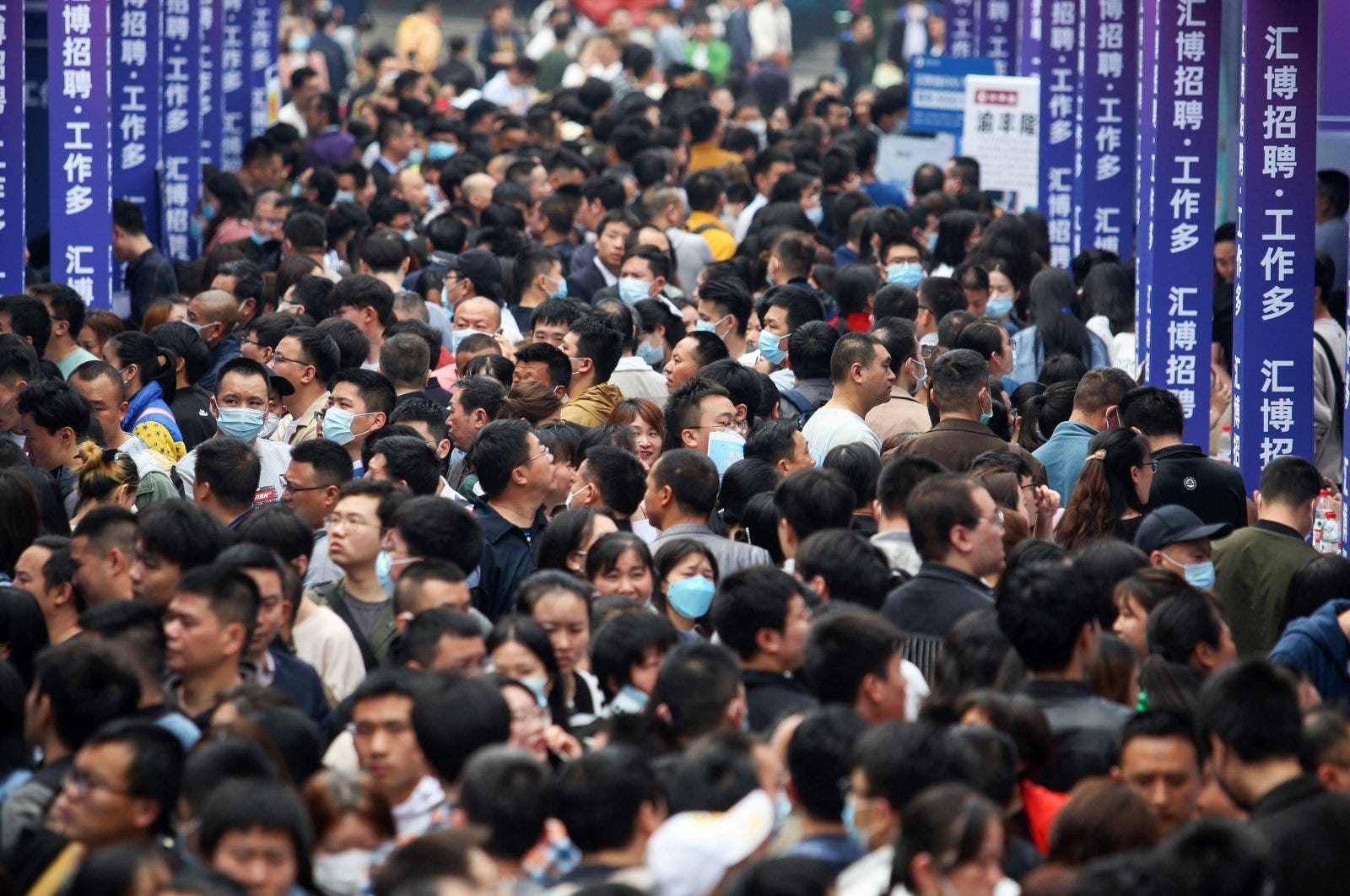
China just sent 12.7 million university graduates into the job market.
That is the largest graduating class in the country’s history.
In July, the month they hit the market, unemployment for young people jumped to 17.9 percent. For everyone else, workers in their thirties, forties and fifties, it sat around 4 percent.
A degree used to protect you from unemployment. For a young person in China, it no longer does.
And the ones who did find work are not getting much for it. After sixteen years of school, a fresh degree in China buys a starting salary barely above what the average city worker makes with no degree at all.
That is the payout on two decades of tuition, tutoring, and one child’s entire childhood.
Where did the 12.7 million go
Not back to school. Fewer of them are sitting the graduate exam every year now. They stopped believing a second degree would fix what the first one could not.
They went for government jobs instead.
For the first time in a decade, more young people are trying to land a state desk than trying to add another degree. The odds of getting one are about one in a hundred.
That is a verdict. A whole generation looked at private companies, decided there was nothing there for them, and bet on a government lottery ticket instead.
The rest went into gig work. Delivery. Ride-hailing. Livestreaming. Sales.
Even that is full now. This spring, Shenzhen’s transport office told people to stop signing up to drive, because there are already too many drivers and not enough rides.
Driving and delivery were supposed to be the fallback when nothing else worked. Now even the fallback is full.
Why the jobs are not there
Start with what this is not. It is not mainly about AI. Youth unemployment in China was already climbing years before AI could take anyone’s job. The real reason the jobs are not there is that the whole economy is shifting at once, and several things are hitting together.
The world is in the middle of a big economic shift. The tariff war and the fights over trade and geopolitics have hit China’s factories and export orders. On top of that, China is deliberately moving away from cheap, basic manufacturing toward high-tech industry, electric vehicles, chips, robotics. That shift kills a lot of the old low-end factory and office jobs that used to soak up young workers. And the long property downturn wiped out huge numbers of white-collar jobs in real estate, finance and tech.
So a young person who wants a normal office job or a steady factory job often cannot find one right now, because the industries that used to offer those jobs are changing under their feet.
AI is the newest layer on top of all of it. And it lands in the worst possible place: the entry-level jobs.
Customer service. Junior coding. Copywriting. Translation. Basic design. Data entry. First drafts. These are the jobs a young graduate takes to get into an industry and learn it. Software does a lot of that work now, so companies hire fewer beginners.
The company gets the same work done and pays fewer people. That saved money goes to the owners. The graduate gets nothing.
What Beijing is doing about it
Here is how the Chinese government is dealing with this. It moved in three ways.
First, it went after the number of jobs. It is paying companies to hire graduates. Subsidies, internships, pressure on state firms to take more young people on.
Second, it started counting them one by one. Since July, every local government has to build a real-name list of the young and unemployed. Everyone on the list is owed the same minimum: career help, a few job referrals, a training slot or an internship. Not a statistic. A name, with a file.
Third, it put AI on the record. In June, the central government wrote AI straight into its five-year jobs plan. It ordered a system to track which jobs AI creates and which it destroys, a warning system for the jobs most at risk, and a new rule: before a big project gets approved, the government now checks how many jobs it will cost.
Why this matters
Keep in mind who these young people are. This is not some random unemployed crowd. These are the educated ones. They did everything they were told to do. They studied for twenty years, they got the degree, they held up their end.
Promise a generation a future, take their money and their time, and then hand them nothing, and they will feel betrayed. That is the real danger here. A large group of educated people who feel lied to is one of the most dangerous things a country can create. It might ignite something down the road.
The part that should scare you
None of this stops at China’s border.
In the United States, fresh college graduates are now out of work at a higher rate than the workforce as a whole.
A degree used to protect you from unemployment. For a young American, it no longer does.
It is the same technology deleting the same first jobs, and the same companies pocketing the savings.
The only real difference is what the people in charge do next.
Beijing at least admits it has a problem: it has produced far more college graduates than the economy can use, and a bachelor’s degree does not carry the value it once did. It is building something to deal with that out loud.
This is the biggest economic shift in a generation. Whole categories of work are being pulled out from under young people, and this is exactly the moment a government is supposed to step in and help them move to what comes next.
Washington offers nothing at all. It offers a 22 year old, newly graduated and buried in student debt, and lectures them that the problem is that they are lazy.
The 50 wealthiest people, Americans, can take care of the country now...with their money. How else will the US survive?
The Republicans continue with an A plus plus job in bankrupting the country. The Democrats keep fighting. Socialist candidates are winning elections across the country.
Language is power. Find the positive statements. I like the ideas of socialism. It feels good. I like the idea of having food for everyone. I like the idea of less war. I like the idea of having a home.
And if anyone comes back with negative examples: Say, how's that working for ya? Get 30 million people saying this 5x a day: and it will be true. Language is power.
Washington offers nothing at all. It offers a 22 year old, newly graduated and buried in student debt, and lectures them that the problem is that they are lazy.
From the 1440 Newsletter: Can graduates join gangs like this one?
The alleged ringleader of one of the largest cryptocurrency heists in the US is due in court today for his plea agreement hearing. Malone Lam, a 22-year-old Singaporean citizen in California, stands accused of siphoning more than $240M worth of bitcoin with the help of 17 others.