

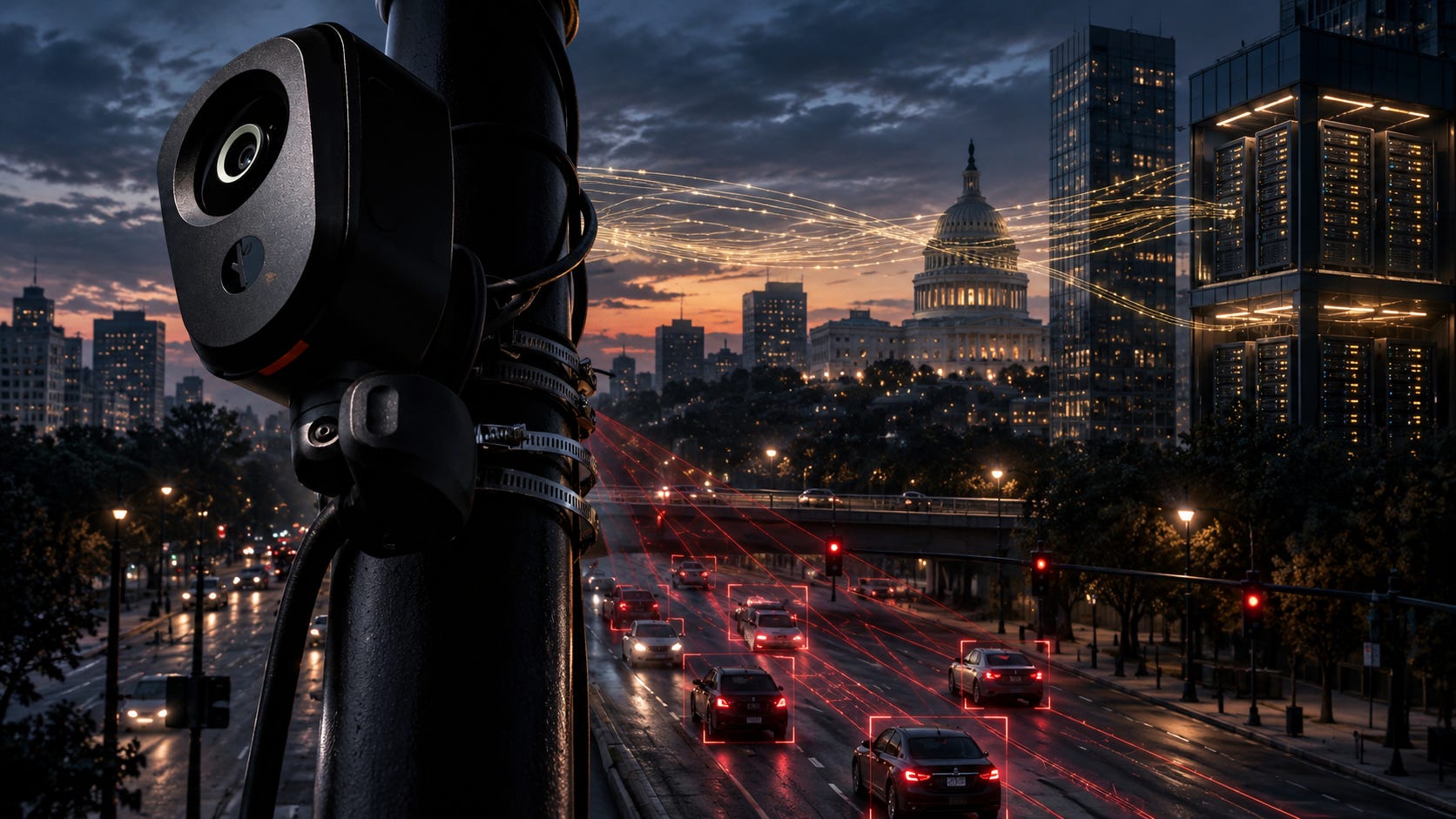
A Flock camera records the plate, location, time and description of vehicles passing beneath it. That information enters a searchable system before anyone in the car has been accused of anything.
The public pays for the camera. Police feed the network. Flock operates the platform and collects the subscription revenue. Lobbyists then work Washington and state legislatures for the budgets, grants and rules that bring in the next customer.
Since 2024, Flock Safety, Axon and Motorola Solutions have spent more than $11 million lobbying lawmakers across the wider law enforcement market, not only on license plate readers.
The camera is only the hardware
Flock leases cameras for roughly $2,500 to $3,000 each per year and says it works with more than 5,000 law enforcement agencies. The cameras have helped locate missing people and suspects.
Those benefits are real. So is the machinery growing around them.
Traditional investigation begins with a crime or suspect and then searches for evidence. This system reverses the order. It records ordinary people first and waits for police to decide later whose movements matter.
One camera is a tool. Thousands of connected cameras become memory. As more departments join, the network becomes more valuable and harder to leave.
The camera is not the product. The network is.
Lobbyists build the road to the contract
Flock has spent more than $2 million lobbying since 2025 and employed lobbyists in 34 states. In Wisconsin, it spent $102,000 supporting bills to fund police purchases of license plate readers.
The bills failed. The business model was still exposed.
The company sells cameras to police. Its lobbyists pursue grants, budgets and favorable rules that make them easier to buy. Public contracts generate recurring revenue that supports further expansion.
Flock is not simply selling to the government. It is helping shape the government into the customer it needs.
When security becomes a growth industry
Privatization is convenient. Police avoid building servers and software while contractors deploy faster and connect agencies more easily.
But convenience becomes dependency. Once data and police procedures sit inside a corporate platform, replacing the vendor becomes expensive. Government keeps the legal authority while a contractor controls much of the technical capacity.
A public security agency is supposed to reduce a threat. A surveillance company needs its market to grow. It does not have to invent crime for that conflict to exist. Its incentives already point toward more cameras, longer retention, broader sharing and more customers.
If the same contractor can help define the threat, sell the solution, operate the platform and lobby the officials buying it, this is no longer only a privacy problem.
It is policy capture.
It is also a national security risk. A country is not secure when its ability to see, remember and investigate depends on vendors whose first institutional obligation is growth.
Working people pay twice
The cameras scan everyone, but enforcement is never equal. Wealth buys lawyers and access. Workers, immigrants and overpoliced communities have less power to challenge an incorrect alert or abusive search.
For the comfortable, an error may be inconvenient. For a worker, it can mean a missed shift, legal bills or contact with immigration enforcement.
Working people pay for the cameras through taxes. Then they carry more of the risk.
Two systems, two chains of command
Washington points to China as the surveillance state. What it prefers not to mention is that American corporations supplied critical technology to Chinese police for more than two decades.
A 2025 Associated Press investigation documented American companies supplying databases, networking and other technology used in China’s surveillance apparatus. China built the Golden Shield and remains responsible for its use. But the machinery did not emerge from an isolated laboratory.
American companies helped sell it the tools.
China’s system is directed toward state-defined political and security objectives. Companies may profit, but the state sets the mission. The American model combines state enforcement power with private infrastructure, recurring revenue, investor expectations and corporate lobbying.
One system concentrates surveillance in the state. The other gives the state the badge while private companies build the eyes, memory and analytical machinery behind it.

From Flock to Palantir
Flock collects and searches location data. Palantir operates higher in the stack, integrating government datasets for military, intelligence and immigration agencies.
But they belong to the same architecture. Cameras observe. Databases remember. Analytical platforms connect. Government agencies act. Private contractors collect revenue at every stage.
The surveillance state is no longer just an agency. It is a market.
Replacing Flock with Axon solves nothing. The real questions concern warrants, access, data retention and responsibility for abuse.
America did not reject the surveillance state. It divided it into local contracts, placed it behind subscription fees and sent the bill to the public.
China’s Golden Shield never had to pretend it was a startup. The American version arrives with investors, sales teams, lobbyists and a monthly invoice.
Great analysis Neil thank you. If I'm going to be surveilled 24-7 by a government I would rather be under the golden shield, at least regular Chinese people have healthcare, good public transport, no homeless, affordable food, no shootings…..