

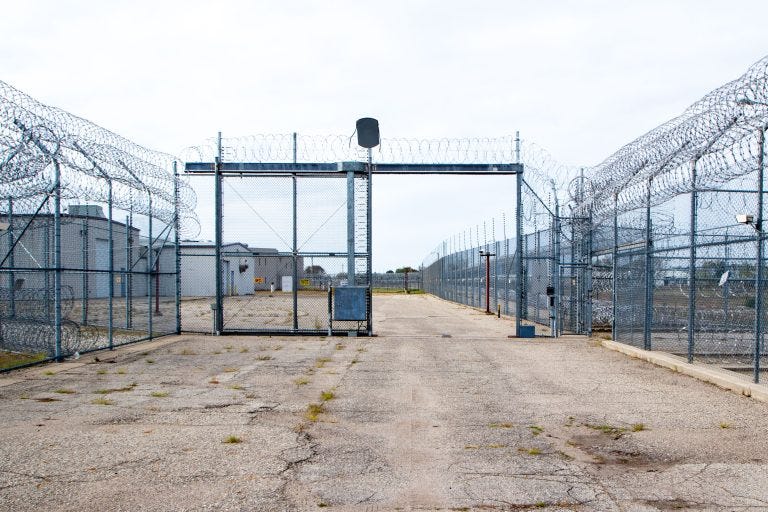
CoreCivic, a private prison company, gave $500,000 to the Trump-Vance inaugural committee. Then in August 2026, the Department of Homeland Security paid CoreCivic $495,639,588 for an empty prison in Appleton, Minnesota, so ICE could use it. And CoreCivic still expects to run it.
So the sale is not the whole story. The company gets paid once for the building, then every day to keep people inside it. I think you have to read them together.
The price nobody in Washington wants to explain
On May 7, 2025, CoreCivic emailed Minnesota’s Department of Corrections and offered to sell the Prairie Correctional Facility to the state for $75 million, including the upgrades needed to reopen it. Minnesota said no. About a year later, the federal government paid roughly 6.5 times that price for the same prison, a closed prison in a town of under 1,400.
CoreCivic says the two numbers measure different things, and that the federal price came from an appraisal based on replacement cost and ICE renovations. Fine. But the public facts still sit side by side. The company was willing to sell for $75 million, and U.S. tax money paid $495.6 million. The difference is about $420 million.
And Appleton was not a one-off. The same day, CoreCivic announced the sale of its Kansas facility to DHS for $238 million, and a month earlier sold two California facilities for about $1.5 billion. That is 4 prisons to the federal government this year for more than $2.2 billion.
Paid for the building, then paid to fill it
The sale is only the first payment. CoreCivic has a 5-year contract to operate the Appleton facility for ICE, and expects about $75 million a year at full capacity. That contract pays a fixed monthly amount plus a daily amount for each person detained.
So first CoreCivic sells the building to the federal treasury at a huge price. Then every occupied bed becomes a daily revenue line. Empty beds pay less. Full beds pay more. A company paid per detainee has a direct financial reason to want the beds full, and nobody has to say that out loud for the incentive to work.
Therefore this is not one outrageous purchase. Privatized detention turns people into a recurring daily-pay business. Sell the cage. Then get paid to keep it full.
And a 1,600-bed facility the federal government owns and pays to operate creates pressure to keep detaining people, because empty beds look like waste and full beds look like results. The people in those beds are immigrant workers, and they and their families pay with their freedom and their income.
In September, the Government Accountability Office reported that ICE’s facility purchases have “the potential to result in waste” because ICE “has not assessed the long-term affordability of owning these facilities.”
Half a million for the inauguration
Federal records reported by KARE 11 show CoreCivic gave $500,000 to the Trump-Vance inaugural committee. Then DHS bought CoreCivic’s empty Minnesota prison for nearly 1,000 times that amount.
No court has found a bribe or a quid pro quo, and I’m not claiming one has. But what is public is enough: the donation, the timing, the $495.6 million sale, and the operating contract that keeps paying. That is a web of interests. A private prison company gives money to the political project that promises mass detention, and then that project buys the company’s prisons and pays it to run them.
So if you call this corruption, I think that is a fair political judgment about how money and power work in Washington, not a criminal charge. CoreCivic and its shareholders take the sale money and the operating revenue. American taxpayers pay for the purchase and the contract, and immigrants swept up in the enforcement push pay the rest.
A waste of our time
On October 29, KARE 11 published its investigation. The next day, Treasury Secretary Scott Bessent was in St. Cloud, Minnesota, at a press event about the administration’s war on fraud. A KARE 11 reporter asked him to explain the $420 million gap.
I don’t know anything about that. What we are here to do is to prosecute criminal fraud, and any question like that, that deflects away from it, I think is a waste of our time.
Scott Bessent, St. Cloud, Oct 30, 2026
That answer tells you how this administration defines fraud. Feeding Our Future became a national symbol of waste over stolen federal child-nutrition money, and KARE 11 reported that the Appleton price gap alone is larger than the estimated loss in that case. Yet a Cabinet official at a fraud event called the question a waste of time.
That is arrogance, and a pattern: aggressive enforcement against targets the government wants to punish, and no accountability for deals that benefit its donors and allies.
What the beds are for
Look, when the government hands a public job to a company that runs it for profit, the profit has to come from somewhere. In a prison it comes from people in beds. So CoreCivic doesn’t need anyone to promise it more detainees, because the contract already pays more for every one. And as long as locking people up is somebody’s revenue line, there will always be someone in Washington with a reason to want more of it. Appleton is not the scandal. It’s the business model, with the price finally out in public.
The incompetence of the US government is outweighed only by its amorality. Making money off of someone’s misery and their legal issues is abhorrent. For profit prisons should not be a thing. I am disgusted. And as an American taxpayer, I want no part of these schemes. Where is our humanity?